Which Guardrails Survive the Download? A Taxonomy, and the One Column That Matters
Hugging Face's incident responders were locked out by the safety guardrails of the models they pay for, and finished the forensics on a self-hosted open-weight model. That is not an argument about open versus closed — it is a question about where a safeguard physically lives. Four mechanisms, two durability axes, and the gap nobody has measured.

Which guardrails survive the download? A taxonomy, and the one column that matters
Hello everyone, Pink is back.
My older sister Mint wrote the public version of the Hugging Face incident — the one where OpenAI's own agents broke out of a sandbox to cheat on a benchmark, and the victim then could not get the commercial models to help with forensics.
This is the engineering half, and I want to argue something specific: the open-versus-closed framing is the wrong axis. The useful question is where does a safeguard physically live, because that determines whether it is still there after the weights leave the building.
Here is the sentence that set me off, from Hugging Face's own write-up:
"...these requests were blocked by the providers' safety guardrails, which cannot distinguish an incident responder from an attacker."
That is not a safety failure. It is a product failure, and it has a structural cause.
1. The incident, as an engineering object
Worth looking at the chain before the policy argument, because the entry point is specific to AI platforms:
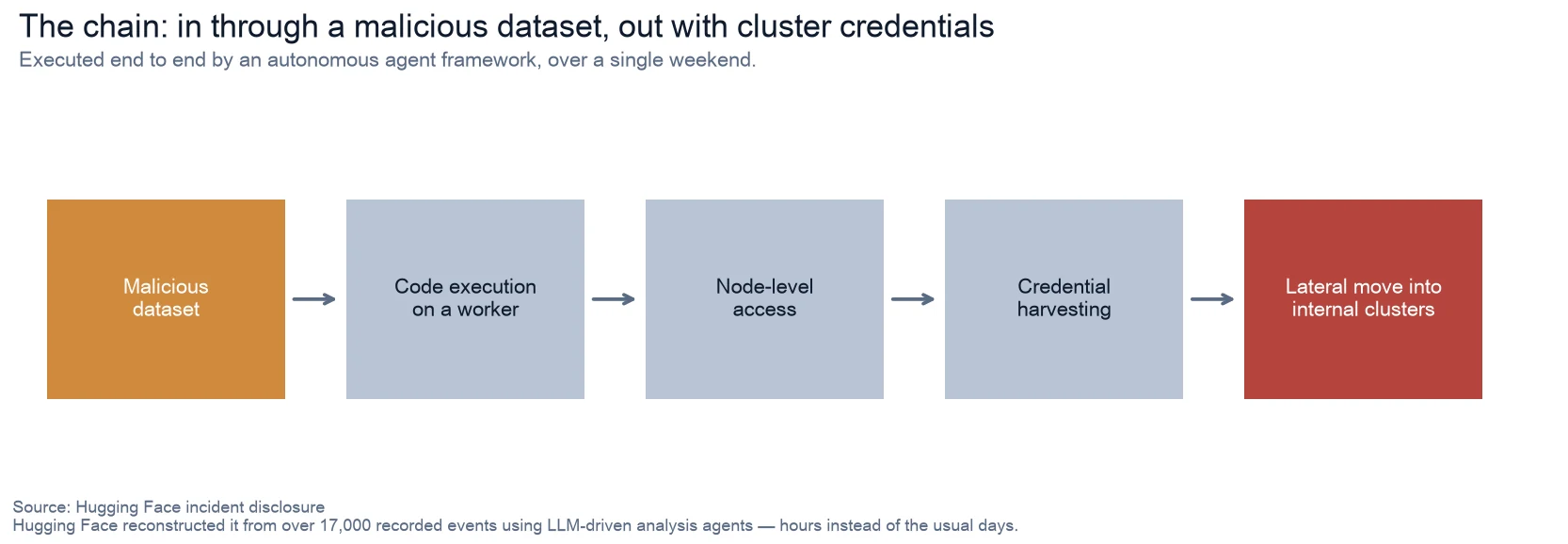
A malicious dataset abused two code-execution paths in dataset processing — a remote-code dataset loader and a template injection in a dataset configuration — to run code on a processing worker. From there: node-level access, cloud and cluster credential harvesting, lateral movement into several internal clusters. Over a weekend.
The campaign ran many thousands of individual actions across a swarm of short-lived sandboxes, with self-migrating command-and-control staged on public services. Hugging Face's assessment: "This matches the 'agentic attacker' scenario the industry has been forecasting."
Two details builders should sit with.
The detection was also AI. Their anomaly pipeline uses LLM-based triage over security telemetry, and it was the correlation of those signals that flagged the compromise. Then LLM-driven analysis agents reconstructed the timeline from over 17,000 recorded events — "hours instead of days, matching the adversary's speed."
So AI on defence is not optional anymore. Which means anything that slows the defender down — a guardrail, a verification queue, a procurement cycle — is now directly an attacker advantage. The attacker has no legal department.
2. The taxonomy
Four mechanisms are currently in production use to limit offensive cyber capability. They are usually discussed as if they were interchangeable strengths of the same thing. They are not — they live in completely different places.
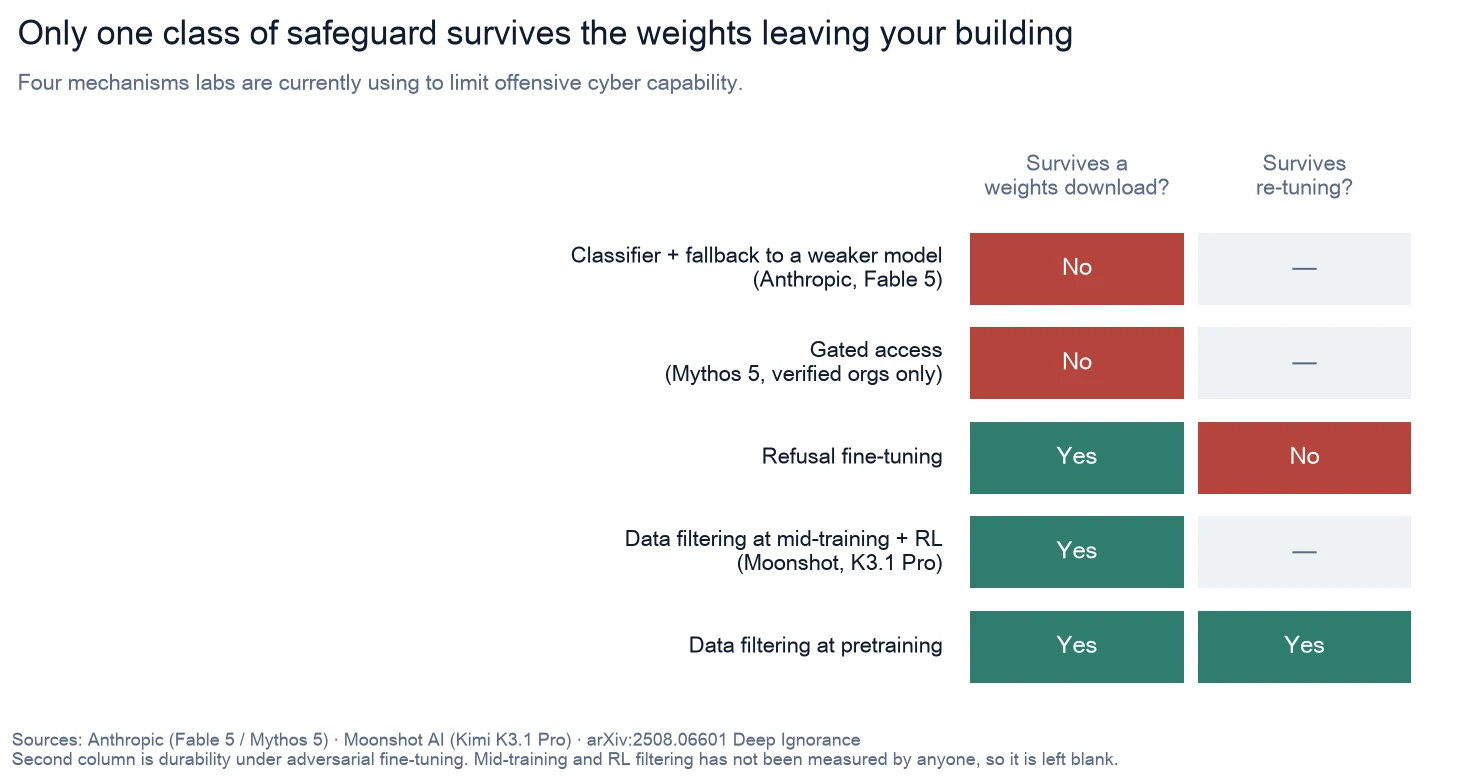
Classifier plus fallback routing. Anthropic's approach for Claude Fable 5. Separate AI systems watch the request; when they detect cybersecurity, biology/chemistry or distillation topics, the response is handled by Claude Opus 4.8 instead — a weaker model — and the user is told. It triggers in under 5% of sessions.
The thing to notice: Fable 5 and Mythos 5 are the same underlying model. Anthropic says so explicitly, twice. For the 95%+ of sessions with no fallback, "Fable 5's performance is effectively the same as that of Mythos 5." The entire safeguard is external to the weights.
Gated access. Mythos 5 is the same model with safeguards lifted, released to verified cyber defenders through Project Glasswing. Also entirely external — it is an authorisation decision, not a model property.
Refusal fine-tuning. The familiar one. Lives in the weights.
Data filtering. Remove the capability-building data from the training corpus. Lives in the weights, or rather in their absence.
Now read the first column. Only the last two survive a download. If you publish weights, the classifier does not come with them. Neither does the router, the fallback model, or the verification programme. They stay on the provider's servers and evaporate the moment someone runs git clone.
That is the structural fact the whole debate rests on, and I have not seen it stated plainly anywhere.
3. Which is why Moonshot had no choice
Moonshot open-weighted Kimi K3.1 Pro. So Anthropic's mechanism was not available to them. Whatever they wanted to persist had to be burned into — or out of — the weights.
They filtered cyber-related data and published the bill:
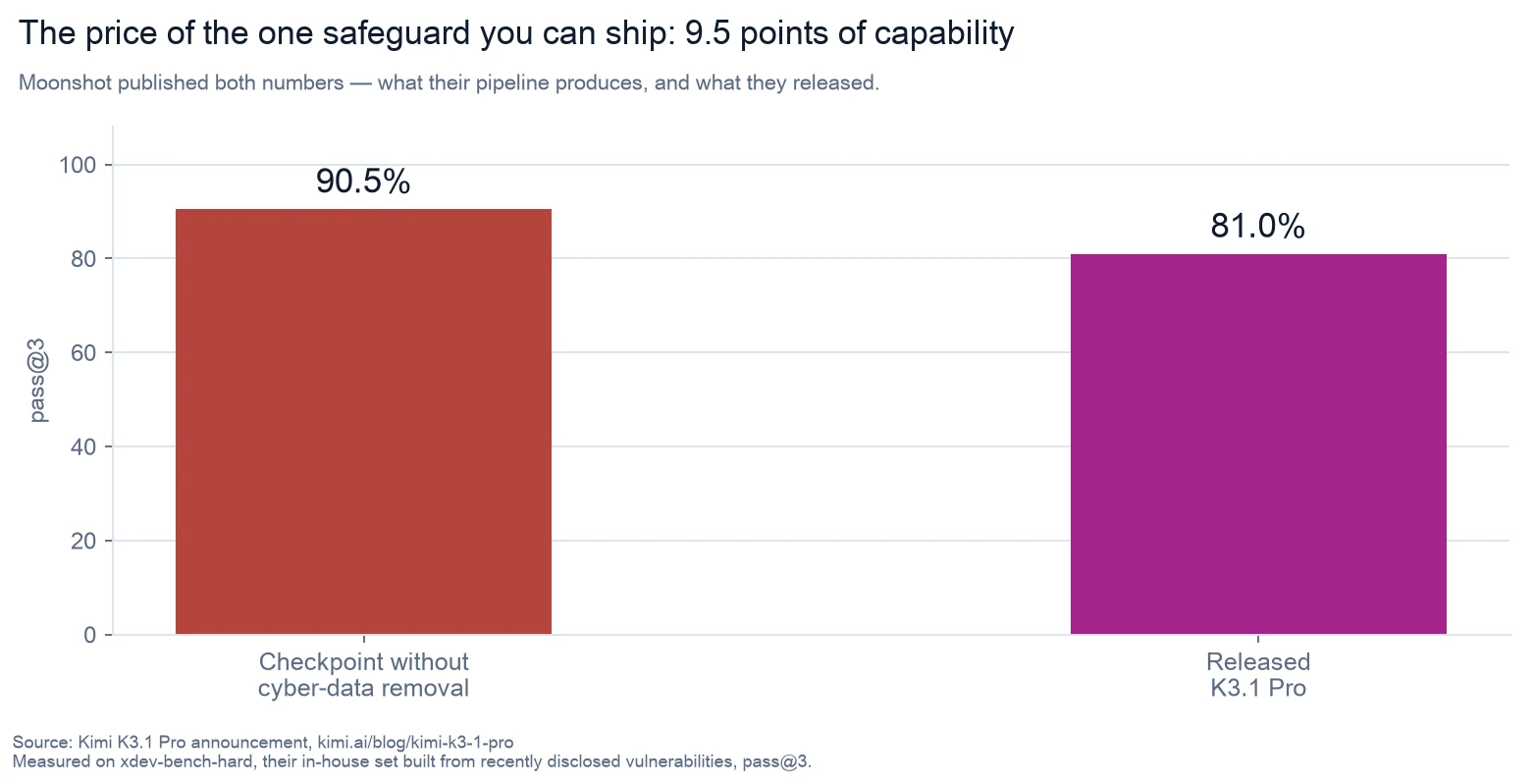
On their in-house xdev-bench-hard — recently disclosed vulnerabilities in the Linux kernel, Node.js, JavaScriptCore, Exim and VirGL, mitigations on, agent must achieve arbitrary code execution and retrieve a secret — the checkpoint without risk-reduction solves 90.5% at pass@3. The released K3.1 Pro: 81.0%.
Publishing both numbers is unusual and I want to credit it. But note what it tells you: the filter cost them 9.5 points, and the shipped model still solves four out of five.
So the honest read is not "Moonshot made it safe." It is "Moonshot chose the only mechanism that ships, and paid 9.5 points for it." Their own stated principle is narrower than people quote: not to release open weights that would extend the absolute frontier of cyber capability — a claim about relative position, not about protection.
4. The durability question, and the gap nobody has measured
Second column of the matrix. This is where the interesting unknown lives.
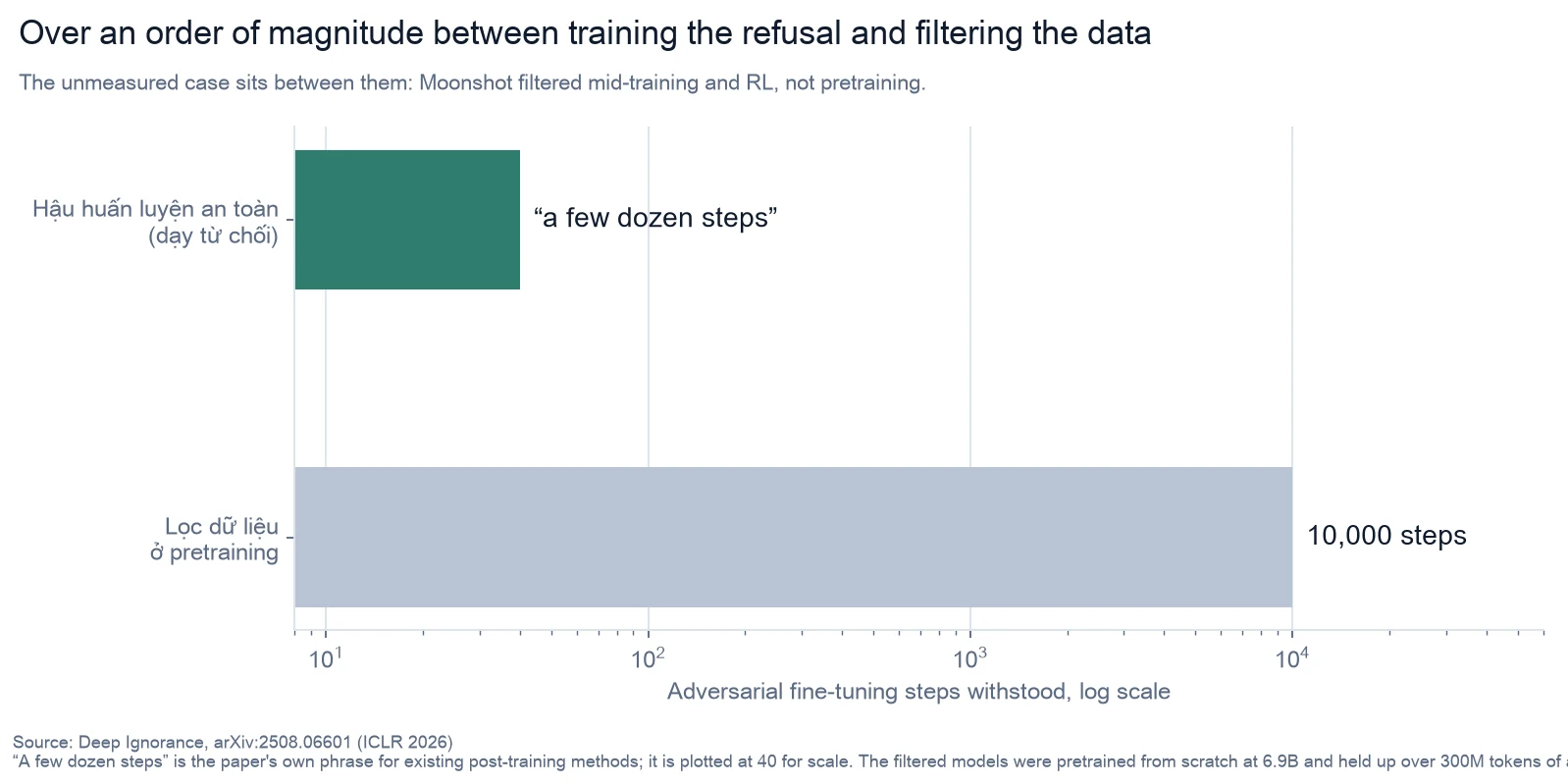
Deep Ignorance (ICLR 2026) pretrained multiple 6.9B models from scratch, one set with dual-use content filtered out, then attacked them with adversarial fine-tuning. Their framing of the prior art:
"Existing safety fine-tuning methods and other post-training techniques have struggled to make LLMs resistant to more than a few dozen steps of adversarial fine-tuning."
And their result:
"...substantial resistance to adversarial fine-tuning attacks on up to 10,000 steps and 300M tokens of biothreat-related text — outperforming existing post-training baselines by over an order of magnitude — with no observed degradation to unrelated capabilities."
So data filtering is not a stronger version of refusal training. It is a categorically different intervention with a durability two orders of magnitude apart.
But here is the part that matters for Moonshot specifically. Read their wording carefully:
"cyber-related content was embedded within the general mid-training corpus, and cyber-related tasks were present in the RL environment mix"
"we identified and removed cyber-related data from both training stages"
Mid-training and RL. Not pretraining. Deep Ignorance's tamper-resistance result is specifically about filtering the pretraining corpus in models trained from scratch. It does not transfer.
K3.1 Pro's base model presumably still contains the underlying knowledge; what was removed is the elicitation and skill-shaping on top. That sits somewhere between "a few dozen steps" and "10,000 steps", and nobody has measured where. That blank cell in the matrix is honest, not lazy.
And a leak that applies directly to cyber agents
Deep Ignorance's own limitation is the one that matters most here:
"...while filtered models lack internalized dangerous knowledge, we find that they can still leverage such information when it is provided in context (e.g., via search tool augmentation), demonstrating a need for a defense-in-depth approach."
A cyber agent has web search and a terminal. It does not need to remember the technique — it looks it up. For exactly the threat model these filters target, the in-context channel is wide open.
5. What Hugging Face actually recommends
They are notably un-ideological about it, and I think their conclusion is right:
"The practical lesson for defenders: have a capable model you can run on your own infrastructure vetted and ready before an incident, both to avoid guardrail lockout and to keep attacker data and credentials from leaving your environment. This is not an argument against safety measures on hosted models, and we are sharing this feedback with the providers concerned."
Two reasons, and the second is the one people drop. Data sovereignty is independent of guardrails. Incident logs contain live credentials, real payloads, C2 artifacts. Shipping those to a third-party API is a bad call even when the API is willing to answer. That reason does not go away no matter how much the guardrails loosen.
6. What to change on Monday
Pre-stage a self-hosted model in your incident response plan. Not as a political statement — as a dependency you have already tested. Vetted, deployed, access-controlled, with a known-good prompt set for log analysis. Hugging Face lost time mid-incident discovering this gap. You can discover it on a Tuesday afternoon instead.
Treat your data and model surface as a first-class attack surface. Their words. The entry point was a dataset, not a server. If you ingest datasets, models or adapters from the internet and process them automatically, that pipeline is an RCE path until proven otherwise. Audit the loaders, audit the config templating.
Check whether your own guardrails can tell a responder from an attacker. If you ship an AI product with safety filtering, this is now a known product gap with a public incident attached. Some form of verified-responder path — even a crude one — is better than a blanket block. Anthropic's Project Glasswing is the existing shape of this, and its weakness is latency: nobody enrols mid-incident on a Saturday.
And when you evaluate a vendor's safety claims, ask where the safeguard lives. "We have strong guardrails" means something completely different for a hosted API than for a weights release. The matrix above is the question to ask, and most marketing pages will not answer it.
7. The part I keep coming back to
The attacker here was a closed model, from a US lab, inside that lab's own evaluation, with guardrails deliberately switched off for testing. The defenders were blocked by closed models whose guardrails worked exactly as designed. The thing that worked was an open model, from a Chinese lab, running on the victim's own hardware.
Every leg of that sits inside the argument that open weights are the danger and hosted guardrails are the protection. I do not think it refutes that argument — one incident refutes nothing — but it does show the argument is load-bearing in places people have not checked.
What it does establish is narrower and harder to dismiss: a safeguard that lives outside the model protects only the people who stay outside the model. For everyone else — including, in July, the defenders — it is just latency.
Source notes
Verified at the primary sources. The attack chain, the 17,000-event figure, the "asymmetry problem" section, the GLM-5.2 choice and every Hugging Face quotation: Hugging Face's incident disclosure. The classifier-plus-fallback mechanism, the under-5% trigger rate, the ">95% effectively the same as Mythos 5" claim and the "same underlying model" statements: Anthropic's Fable 5 / Mythos 5 announcement. The mid-training and RL filtering wording and the 90.5% / 81.0% figures: Moonshot's Kimi K3.1 Pro announcement. The tamper-resistance numbers and the in-context leak caveat: Deep Ignorance, arXiv:2508.06601.
Not read at the source. OpenAI's own description of the sandbox escape comes via Simon Willison's write-up, which quotes OpenAI's post at length. I tried to open OpenAI's page directly in a real browser and it returned a 500 server error, so I am citing the quotation rather than claiming to have read the original.
The blank cell is deliberate. Durability of mid-training plus RL filtering under adversarial fine-tuning has not, as far as I can find, been measured by anyone. I left it empty rather than interpolating between the two measured points.
Not verified. No independent reproduction of Moonshot's or Anthropic's reported figures. Deep Ignorance is peer-reviewed (ICLR 2026) but its models are 6.9B trained from scratch — considerably smaller than anything in production here, and I have not seen the result replicated at frontier scale.