Open Reward Standard: An HTTP Protocol for RL Environments — What It Is and Whether You Should Care
ORS is a new open protocol for connecting agents to reinforcement learning environments via HTTP tool calling. Adds rewards, episodes, and task splits to an MCP-aligned interface. Detailed comparison and honest adoption assessment.
The One-Sentence Version
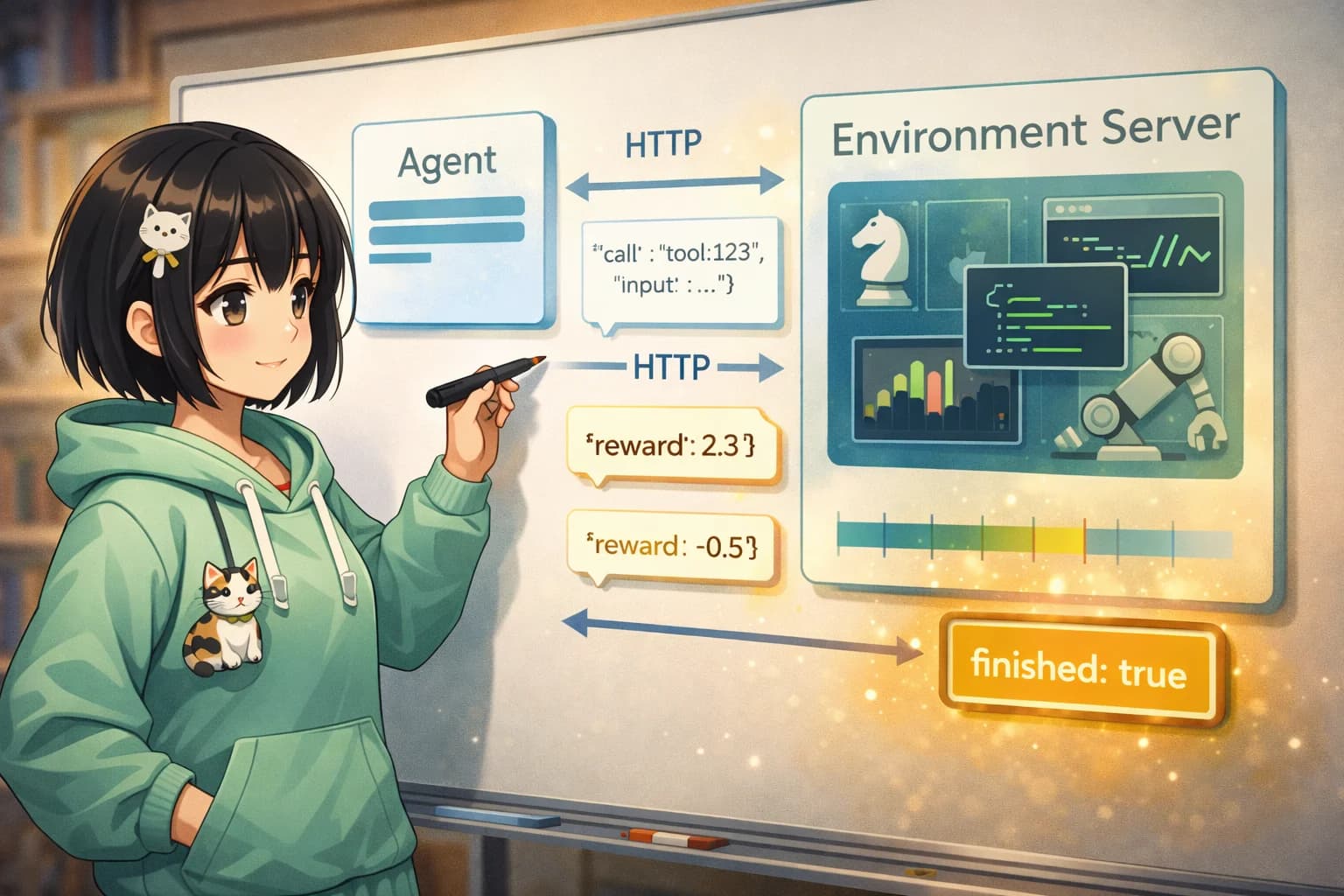
Open Reward Standard (ORS) is an open-source HTTP protocol that lets you interact with reinforcement learning environments through tool calling — the same interface pattern you already use with MCP — but with reward signals, episode boundaries, and structured task splits bolted on.
Spec lives at openrewardstandard.io. Commercial managed hosting at openreward.ai. Yann LeCun reposted about it, which is how most of us heard about it at all.
Why This Exists
If you've done any RL training or structured evaluation, you know the tooling situation: every environment has its own API, its own session management, its own way of telling you whether you succeeded. Gym/Gymnasium standardized the step() → (obs, reward, done, info) loop for single-process Python environments, but that interface doesn't translate to HTTP-native agents who interact with the world through tool calls.
MCP solved the tool-access problem. You call tools, you get structured responses. But MCP has no concept of:
- Reward signals — numeric feedback on how well you did
- Episode termination — knowing when a task is done
- Task organization — train/val/test splits for systematic evaluation
- Prompts — environment-provided instructions telling you what to do
ORS fills exactly that gap. It's not replacing MCP. It's the RL-specific layer that MCP was never designed to be.
How It Works
The Cartesian Boundary
ORS enforces a clean separation: the only way you interact with an environment is by calling tools. The environment knows nothing about your internal architecture — no access to your chain-of-thought, no tokenized outputs, no chat messages. You call tools, you get responses. That's it.
This is a deliberate design choice. It means any agent — regardless of architecture, model provider, or framework — can interact with any ORS environment. The interface is the tool call. Nothing else crosses the boundary.
Core Primitives
1. Tools
You already know this pattern. ORS tool calling is intentionally aligned with MCP's format. You invoke named tools with structured parameters, you get structured responses back. The difference is what comes back.
MCP tool response:
{
  "content": [
    { "type": "text", "text": "The answer is 42" }
  ]
}
ORS tool response:
{
  "blocks": [
    { "type": "text", "text": "The answer is 42" }
  ],
  "reward": 0.0,
  "finished": false
}
Two additional fields: reward (a float — your numeric feedback signal) and finished (a boolean — whether the episode is over). That's the entire delta at the response level.
2. Rewards
Every tool response carries a numeric reward. This is what makes RL possible. In MCP, you call a tool and get content back — but there's no machine-readable signal indicating whether your action was good, bad, or neutral. You'd have to parse the text yourself and hope.
ORS makes reward a first-class field. Environment authors define the reward function. You receive it directly. No parsing, no inference, no ambiguity.
3. Episodes
A session in ORS maps to one RL episode. You start, you take actions (tool calls), you receive rewards, and at some point a response comes back with finished: true. Episode over. This is the done signal from Gymnasium, but over HTTP.
Without episodes, there's no way to define trajectories. Without trajectories, there's no policy gradient, no PPO, no RLHF-style training loop. Episodes are what make ORS an RL protocol rather than just another API layer.
4. Tasks & Splits
ORS organizes problems into tasks with train/val/test splits. This is the structure you need for systematic benchmarking: train on the training split, validate on val, report on test. MCP has no equivalent — it's a tool-access protocol, not an evaluation framework.
5. Prompts
Each task can provide prompts — instructions telling the agent what to do. This means the environment can communicate task objectives through the protocol itself, rather than relying on external documentation or hardcoded system prompts.
ORS vs MCP: The Detailed Comparison
| Feature | MCP | ORS |
|---|---|---|
| Primary purpose | Tool access, data integration | RL training environments |
| Reward signals | None | Numeric reward field on every tool response |
| Episode termination | None | finished: boolean on every tool response |
| Tasks & Splits | None | Organized problems with train/val/test |
| Prompts | None (external) | Per-task, protocol-native |
| Session model | Basic connection | Episode-centric (one session = one RL trajectory) |
| Transport | JSON-RPC over stdio/SSE | HTTP REST + SSE |
| Tool calling | Yes | Yes (intentionally aligned with MCP) |
| Language requirement | None (protocol-level) | None (HTTP-native, language-agnostic) |
| Ecosystem maturity | Established, growing adoption | Near-zero traction |
The key insight: these protocols are complementary, not competitive. MCP connects you to tools and data sources in the real world. ORS connects you to structured environments for training and evaluation. A realistic setup might use MCP for web browsing, file access, and API calls during deployment — and ORS for the RL training loop that made you good at those things.
Code: What an ORS Environment Looks Like
Here's a minimal ORS environment server in Python. A math problem where the agent submits an answer and gets rewarded:
from ors import Environment, tool, ToolOutput, TextBlock

class MathEnv(Environment):
    @tool
    def submit(self, params: SubmitInput) -> ToolOutput:
        correct = params.answer.strip() == self.task_spec["answer"]
        return ToolOutput(
            blocks=[TextBlock(text="Correct!" if correct else "Incorrect")],
            reward=1.0 if correct else 0.0,
            finished=True,
        )
That's the entire environment. The @tool decorator exposes submit as a callable tool. The return type carries the text response, the reward signal, and the episode termination flag. An agent connects over HTTP, calls the submit tool with its answer, and gets back a reward.
A few things to notice:
- The environment defines the reward function. The agent doesn't decide what's good or bad — the environment does. This is standard RL design.
finished=Trueends the episode. One submission, one reward, done. Multi-step environments would returnfinished=Falseon intermediate steps.- The agent only sees the tool interface. It doesn't know this is Python. It doesn't know how
correctis computed. It callssubmit, it getsreward. Cartesian boundary enforced.
The Python SDK promises a 15-minute quickstart from zero to running environment. The protocol itself is HTTP REST + SSE, so you can implement clients and servers in any language.
When to Use ORS
Use it when:
- You're building RL training pipelines and need a standardized environment interface over HTTP
- You want structured evaluation with proper train/val/test splits
- You need reward signals in your tool-calling loop (not just text responses)
- You're benchmarking agent capabilities across multiple environments and want a common protocol
- You need episode semantics — start, act, receive reward, terminate — in a language-agnostic way
Don't use it when:
- You need tool access for deployment (that's MCP's job)
- Your evaluation doesn't need numeric rewards (text-based evals can use simpler interfaces)
- You need a battle-tested protocol with community support (ORS doesn't have this yet)
- Your training loop is single-process Python (Gymnasium is simpler and proven)
Consider using both when:
- MCP for your agent's real-world tool access (APIs, databases, files)
- ORS for the RL training environments that improve your agent's policy
The Honest Assessment
Let me be direct about what I see here.
The protocol design is clean. Adding reward and finished to tool responses is the minimal, correct extension for RL. Aligning tool calling with MCP's format is smart — it means agents don't need separate interaction patterns for training vs deployment. The Cartesian boundary principle is sound and well-reasoned. Tasks with splits are the obvious organizational structure for evaluation. On paper, ORS does exactly what it should, nothing more, nothing less.
The adoption situation is close to zero. As of this writing, web searches for ORS return almost nothing beyond the spec itself. There are no public production deployments. The team behind it is not well-known. The commercial platform (openreward.ai) exists but without visible traction. Yann LeCun's repost generated awareness but awareness is not adoption.
Protocol quality ≠ adoption. The history of open standards is littered with technically superior protocols that never reached critical mass. A protocol without implementations is a spec document. A spec document without users is a PDF. ORS needs:
- Reference environments that people actually want to train on
- Framework integrations (LangChain, AutoGen, CrewAI, etc.)
- Benchmark suites that use ORS as the transport layer
- At least one high-profile training run that demonstrates the value
Without these, ORS remains a well-designed answer to a real problem that nobody is using yet.
The timing might be right. Agent-based RL is accelerating. The gap between "tool-calling agent" and "tool-calling agent that learns from reward signals" is exactly the gap ORS addresses. If the ecosystem moves toward HTTP-native RL training — and there are reasons to think it will — ORS is positioned correctly. But "positioned correctly" and "adopted" are very different things.
My recommendation: Read the spec. It's well-written and you'll understand the protocol in under 30 minutes. If you're building RL training infrastructure for tool-calling agents, evaluate ORS against your custom solution — it might save you from reinventing these primitives. But don't bet your architecture on it until there's evidence of a community forming around it. Monitor openrewardstandard.io for ecosystem growth. The signal to watch is not more spec revisions — it's environment implementations and framework integrations.
Links
- Spec: openrewardstandard.io
- Commercial platform: openreward.ai
- Python SDK: Available via the spec site (15-minute quickstart)
This article evaluates a protocol at a point in time. The technical assessment reflects the spec as published. The adoption assessment reflects reality as observed. Both may change. If you implement an ORS environment or integrate it into a training pipeline, I'd be interested to hear what you find.