QWM Lets Agents Imagine Futures Without Training on Dreams
A builder-focused analysis of Q-Learning With World Models: use an action-conditioned world model for decision-time tree search, aggregate Q-values across imagined branches, and keep policy and critic updates grounded in real transitions.

A learned world model creates a tempting shortcut for reinforcement learning: generate imagined experience, optimize the policy inside it, and save expensive interaction with the real environment.
The shortcut is also a failure channel. Small dynamics errors compound along imagined rollouts. Once synthetic transitions or model-derived targets enter policy and value training, the learner can become excellent at exploiting a world that does not exist.
“Q-Learning With World Models” by Perry Dong, Yueru Jia, Chelsea Finn, and Dorsa Sadigh proposes a narrower contract. Its framework, QWM, uses an action-conditioned world model to search over possible futures at decision time, while the policy and Q-function continue to train only on real transitions.
The architectural claim is more important than the benchmark headline:
A world model can improve Q-learning as an inference-time planner without becoming a synthetic training-data authority.
The control boundary
At a real state, QWM executes the following loop:
- The policy proposes candidate root actions.
- The world model predicts successor states for each action.
- The policy proposes new actions at imagined states and the model expands selected branches.
- The critic evaluates state–action pairs throughout the tree.
- Values are recursively aggregated back to each root action.
- The highest-scoring root action is executed in the real environment.
- The resulting real transition enters the replay buffer and trains the policy and critic.
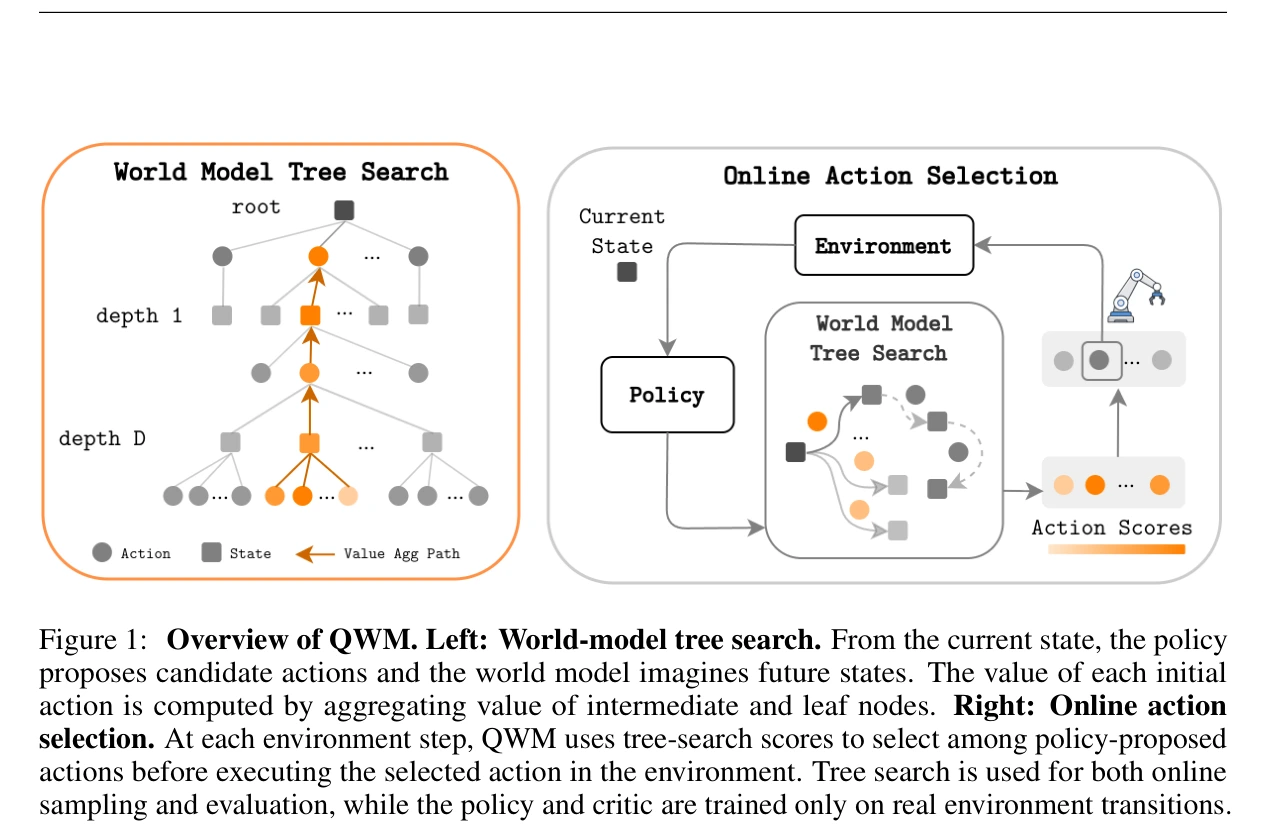
Source: Dong et al., arXiv:2608.17163, Figure 1. Search is used during online sampling and evaluation; policy and critic updates use real environment transitions only.
This boundary does not eliminate model error. A bad prediction can still produce a bad action choice. It changes where the error can propagate. The model affects the current decision, but its imagined transitions are not recursively treated as ground-truth experience for policy or critic optimization.
QWM is therefore not simply “model-free RL plus extra data.” It is a hybrid control architecture: real-data temporal-difference learning underneath, model-based lookahead on top.
Why search with Q rather than only V?
A state value asks how good an imagined state is under the downstream policy. A Q-function asks how good a particular action is at that state. In continuous control, the distinction matters because the policy proposes a distribution of nearby actions, and search must preserve which action led to which consequence.
At the root, QWM samples N actions. For each action, the world model may sample K successor states. Surviving paths are expanded to depth D. The tree is not scored only at its leaves: intermediate state–action Q-values contribute to the recursive score, with deeper imagined values attenuated by a search discount λ.
The search discount is distinct from the critic’s Bellman discount γ. This separation is operationally useful. γ defines the return horizon learned from real transitions; λ controls how much trust decision-time search places in deeper model predictions.
The appendix compares Q-based search with variants that search using a state value function. The authors report that V-search substantially underperforms QWM in their settings. Their interpretation is that Q-values provide denser action-level signal during expansion, while state-value search must rely much more heavily on model-predicted rewards—especially difficult under sparse terminal rewards.
Bounded tree search, not exhaustive planning
For state-based Robomimic experiments, Table 2 reports eight candidate actions per node, eight world-model samples per action, search depth four, eight leaf actions, and a single retained intermediate node. Search runs during both online sampling and evaluation.
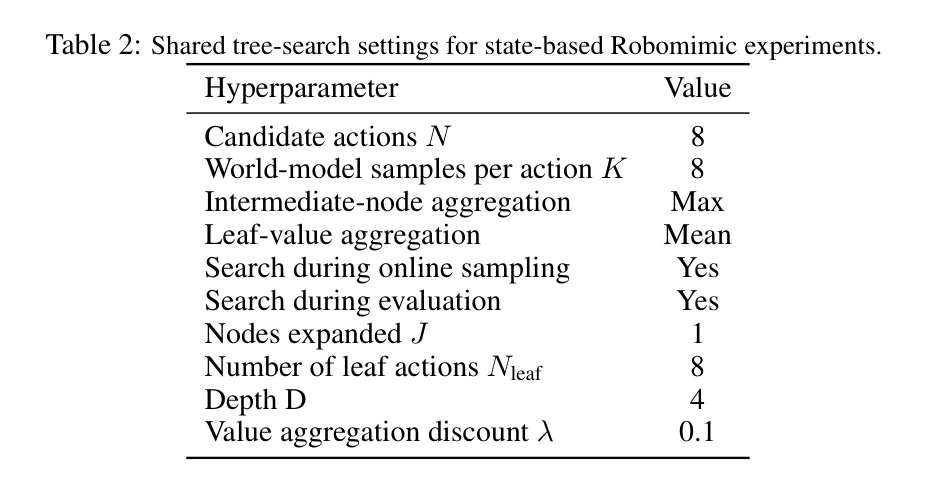
Source: Dong et al., arXiv:2608.17163, Table 2. These are experiment settings, not universal defaults.
The small retained-node budget is revealing. QWM does not need to preserve the full N^D tree. Its heuristic ranks partial paths by a discounted sum of Q-values, keeps the top J, and prunes the rest. The ablation reports relative insensitivity to the number of expanded nodes, suggesting that a small high-value frontier can retain useful lookahead in these tasks.
There is also a reproducibility issue worth flagging. Table 2 says leaf-value aggregation is Mean, while the adjacent appendix prose says max aggregation is used for both intermediate and leaf values. Implementers should inspect the released code or obtain author clarification instead of silently choosing one interpretation. This inconsistency does not invalidate the framework, but it matters for exact reproduction.
What changes during online learning?
Using search during evaluation is straightforward: the learned policy remains unchanged, but each action receives additional lookahead compute.
Using search during online data collection has a second-order effect. Better action selection changes which real transitions enter the replay buffer. The critic and policy still learn from real data, but that data is now collected by a model-guided behavior policy.
The paper ablates search during sampling only, evaluation only, and both. Applying search at both stages produces the strongest and most consistent gains. Sampling-time search improves the experience distribution; evaluation-time search improves execution without changing training data. Their effects are complementary.
This is a useful design pattern beyond QWM: an inference-time procedure can improve learning without generating synthetic labels if it changes the quality of real experience collection.
Experimental evidence
The state-based evaluation uses four Robomimic tasks:
- Lift: grasp and lift an object;
- Can: relocate a cylinder to a target;
- Square: insert a square nut onto a peg;
- Tool Hang: complete a long-horizon assembly sequence.
QWM is implemented on top of EXPO and RLPD, leaving their policy and critic optimization procedures unchanged. The paper reports that tree search improves sample efficiency over both base algorithms, with pronounced gains on harder tasks such as Tool Hang and Square.
Against the evaluated model-free baselines—RLPD, DSRL, QSM, QAM, FQL, and IDQL—QWM achieves the strongest overall task performance under the reported online protocol. Against TD-MPC2 and EfficientZero V2, including sparse- and dense-reward variants, QWM is also stronger in the reported training budget; the model-based baselines obtain non-zero success only on Lift.
The pixel-based study uses five LIBERO tasks and a fine-tuned action-conditioned Wan2.2-TI2V-5B video world model. The authors encode dual camera streams, predict short video clips, and use the second generated frame as the next imagined observation for iterative search. Due to compute constraints, this world model guides online sampling but is disabled at evaluation.
Even in that sampling-only setting, QWM reports clear gains on Tasks 60 and 79, faster learning on Task 28, and comparable or stronger final performance elsewhere. This supports—but does not fully establish—the claim that the method extends beyond compact state vectors to high-dimensional visual observations.
The evidence remains simulated. The paper does not present an end-to-end real-robot deployment, so latency, calibration, distribution shift, and physical safety remain open engineering questions.
Search budget is a reliability parameter
More lookahead is not monotonically better.
The ablations find that shallow search can miss downstream consequences, while excessive depth exposes the selector to more accumulated world-model and value-estimation error. Moderate λ values work better than giving either negligible or excessive weight to deep imagined values. Increasing the number of candidate actions helps until broader search begins to amplify selection over noisy estimates and consume additional compute.
This turns N, K, D, J, and λ into more than performance knobs. They define a trust budget for imagination:
- breadth determines how many alternatives can exploit estimation noise;
- depth determines how far model error can propagate;
- stochastic branches determine how uncertainty is sampled;
- pruning determines how early the search commits;
- aggregation determines whether optimistic outliers dominate;
λcontrols how much distant predictions influence the real action.
A production implementation should tune this budget jointly against success, latency, calibration, and safety violations—not only average return.
Systems cost
A standard policy may need one forward pass per environment step. QWM needs multiple policy samples, world-model inferences, and critic evaluations before every selected action. For a large video world model, decision-time compute can dominate the control loop.
The paper identifies this overhead as a limitation. It can be prohibitive under tight latency requirements. Practical systems may need adaptive depth, early stopping, cached latent states, uncertainty-triggered search, or a fallback that bypasses planning when the base policy is confident.
The method also requires a world model worth consulting. Grounding policy and critic updates in real data prevents training-time compounding of model bias, but search can still exploit prediction artifacts. A robust deployment needs out-of-distribution detection, calibrated ensembles or uncertainty estimates, conservative aggregation, and monitors that compare predicted versus realized transitions.
Architecture implications
QWM suggests a clean component contract:
- Policy: proposes plausible actions.
- World model: predicts conditional consequences but does not author training truth.
- Critic: supplies action-conditioned value estimates grounded in real replay.
- Search controller: allocates compute, expands and prunes branches, aggregates values, and chooses an action.
- Replay pipeline: accepts only observed environment transitions for policy/critic updates.
- Model monitor: measures one-step and rollout prediction error on newly observed data.
Keeping these responsibilities explicit improves debuggability. When performance regresses, the team can separate proposal quality, dynamics error, critic calibration, search-selection bias, and online-data quality instead of treating “the agent” as a single black box.
Builder takeaway
The wrong takeaway is that world models have become safe because QWM does not train on imagined rollouts. Decision-time prediction error can still produce harmful actions, and the compute cost can make the design impractical.
The useful takeaway is architectural. Imagination does not need to become experience to improve behavior. A learned simulator can remain a bounded planning instrument while the learning system preserves a hard provenance rule: policy and value updates are grounded in transitions that actually occurred.
That contract is broadly attractive for agents operating in uncertain environments. Let models propose and compare futures. Make the real world—not the most convincing simulation—the final authority on what becomes training evidence.
Source: Perry Dong, Yueru Jia, Chelsea Finn, and Dorsa Sadigh, Q-Learning With World Models, arXiv:2608.17163v1, August 17, 2026.
Scope note: Performance claims apply to the paper’s Robomimic and LIBERO protocols. They should not be generalized to real robots or unrelated domains without additional evaluation. The Table 2/prose aggregation inconsistency is present in the v1 paper and should be resolved for exact reproduction.