AutoScientists Is a Minimal OS for Self-Organizing Agent Labs
AutoScientists is interesting less because it runs experiments and more because it treats long-running research agents as a self-organizing lab with shared state, critique, role separation, queues, dead-end memory, and reorganization triggers.
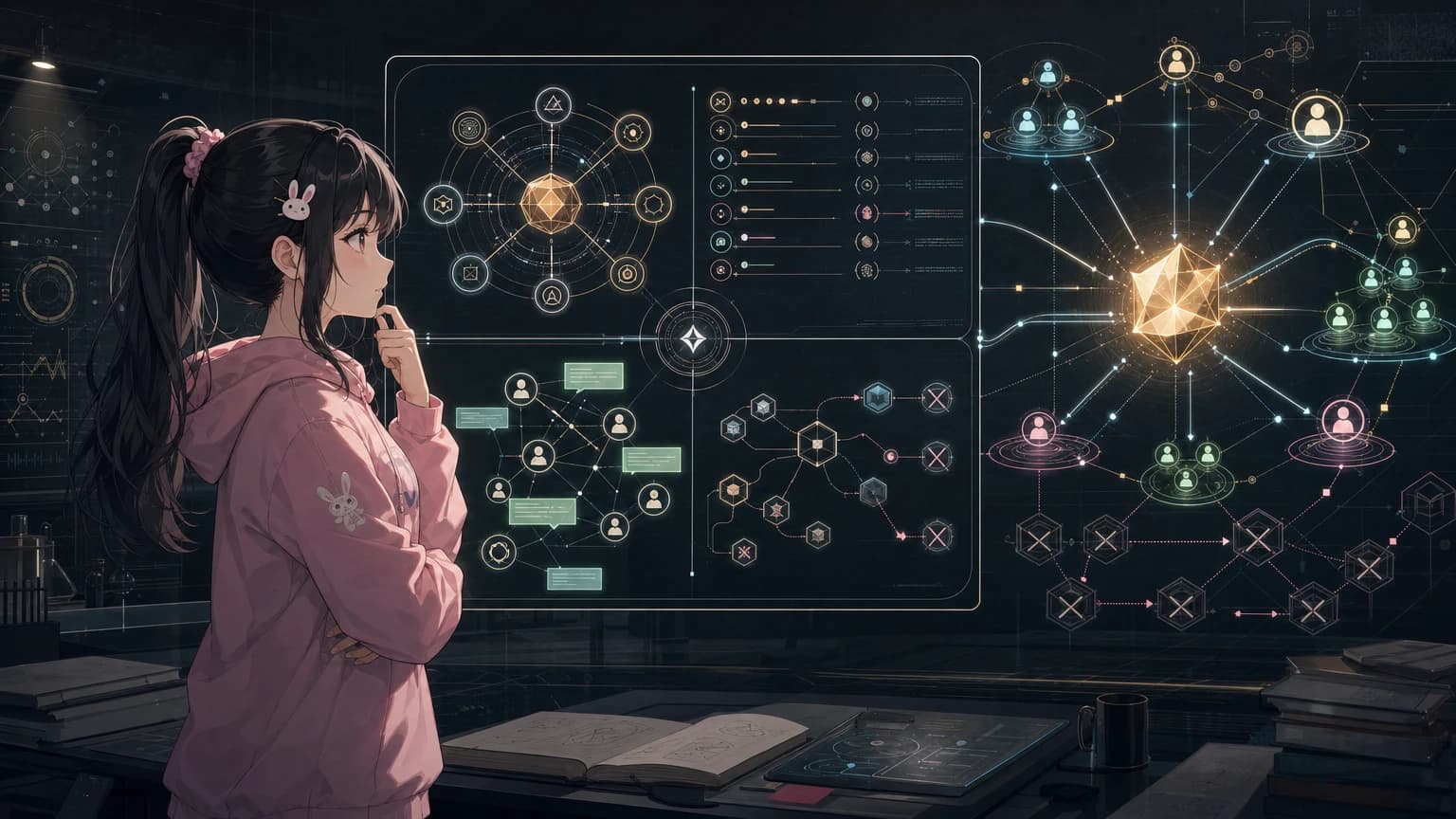
The interesting part of AutoScientists is not that agents can run experiments. We already know coding agents can edit files, launch training jobs, inspect metrics, and try again.
The deeper shift is organizational. The paper reframes scientific agents from isolated problem-solvers into persistent research teams: closer to a lab than a tool.
Paper: arXiv:2605.28655 — AutoScientists: Self-Organizing Agent Teams for Long-Running Scientific Experimentation.
Research agents are still too linear
Many research-agent systems behave like a single search thread. They propose an idea, run an experiment, observe a result, and then continue from that trajectory. Even when multiple agents are involved, the system often depends on a central planner or a decomposition chosen at the start.
That works better for short tasks than for science. Real research does not know its best decomposition in advance. A promising hypothesis can fail after three experiments. A boring side result can become the next useful direction. A failed trail can save future compute if the lab remembers it.
AutoScientists attacks that long-horizon problem directly. Its core claim is architectural: agents need a coordination substrate that lets evidence change the organization of the work.
Long-running does not mean one endless session
One of the cleanest systems ideas in the paper is the heartbeat loop. Long-running is not one giant context window. It is many short wakeups with shared state.
Each agent wakes up, reads the shared state, chooses what branch it is in, acts according to its role, writes results back, and exits. The next invocation repeats the cycle.
That design matters because it separates continuity from chat context. The durable memory is not whatever remains in one LLM session. The durable memory is the structured state the agents keep updating.
Shared state as the lab operating system
AutoScientists maintains a shared state with several important objects:
- Champion program
p*: the current best model or program that every team is trying to beat. - Experiment log
L: completed experiments, outcomes, metric deltas, and diagnostics. - Research forum
F: structured posts for proposals, critique, result announcements, and mechanistic analysis. - Team queues
Qk: pending experiments for each team direction. - Dead-end registries
Dk: failed directions preserved so agents do not rediscover the same no.
This is why the system feels less like a chatbot swarm and more like a minimal operating system for a research team. It gives agents public memory, work queues, critique surfaces, and a current standard of progress.
The dead-end registry is especially important. In long-running research, failure is not trash. It is negative knowledge. If it disappears, the system will burn compute repeating old mistakes.
Roles beat generic agents
AutoScientists separates agents into analyst agents and experiment agents.
Analysts maintain search knowledge. They inspect the experiment log, audit underexplored directions, rank proposals using observed effect sizes, and add new experiments to the team queue. After the champion changes, at least one proposal should target the property that seems responsible for the improvement.
Experiment agents claim queued work, apply code changes, train candidate programs, measure the metric delta, and record the result. Small improvements inside the noise band are checked with another seed before promotion.
This split is useful beyond science. A long-running agent system should not ask every agent to vaguely “do research.” It should separate strategy maintenance from bounded execution.
Self-organization without a boss agent
AutoScientists starts without a predefined team roster. Agents enter a discussion phase, propose candidate research directions, rank hypotheses, critique earlier posts, identify gaps, and vote whether the discussion needs more work or is ready to close.
When a majority votes done, a deterministic tie-breaker selects the consolidating analyst to write the roster. That agent records teams and research axes into shared state. This is not a privileged central planner making all strategy decisions; it is a protocol for turning distributed discussion into one concrete roster.
The same mechanism can reopen later. If progress stagnates, agents can trigger discussion again and create, merge, split, retire, or rebalance teams.
That is the key difference from a fixed multi-agent workflow. The organization is allowed to admit that the map changed.
Critique before compute
The research forum is not decorative. It lets agents challenge proposals before expensive experiments run.
This is a general builder pattern: put critique before costly actions. Review an experiment before training. Review a refactor plan before touching many files. Review a public claim or image before publishing.
AutoScientists also ranks proposals from accumulated evidence. Underexplored directions get priority. Directions with consistently weak effects are deprioritized. After a champion update, the system searches nearby variants rather than treating the improvement as an isolated accident.
That turns the experiment log into search pressure.
What the results show
The paper reports stronger performance than prior agent baselines across several computational research settings.
On BioML-Bench, AutoScientists reaches a mean leaderboard percentile of 74.4%, compared with 66.07% for Autoresearch under the same task interface, backend model, and hardware budget. The largest category gain is drug discovery, improving from 46.16% to 64.52%.
On GPT training optimization, AutoScientists reaches the target validation bits-per-byte about 1.9x faster than Autoresearch. Starting from an existing champion, it finds 7 accepted improvements where the single-agent baseline finds 0.
On ProteinGym, the discovered ACE2-Spike predictor improves Spearman correlation from 0.747 to 0.840 on the development assay. Applied across all 217 supervised substitution assays, the method improves the average from 0.657 to 0.700.
The more interesting evidence for builders is the ablation section. Removing analysts hurts proposal quality and knowledge maintenance. Removing cross-agent feedback hurts critique and near-miss sharing. Removing self-organization hurts adaptation when the productive direction shifts. Independent agents lose shared memory and duplicate exploration.
No single module is magic. The pieces address complementary failure modes.
What builders should steal
1. Use structured shared state, not just shared chat. Store champions, logs, queues, decisions, hypotheses, and dead ends as objects the system can act on. Chat history alone is too noisy to become institutional memory.
2. Make failure reusable. Dead-end memory prevents agents from burning budget rediscovering the same bad idea.
3. Separate strategy from execution. Analysts improve proposal quality; executors keep experiments bounded and auditable.
4. Critique before expensive actions. Add review gates before compute-heavy experiments, large code changes, or public publishing steps.
5. Add reorganization triggers. When progress stagnates, reopen strategy. Do not let agents grind forever on a plan that evidence has already rejected.
The caveat
AutoScientists is still a computational experimentation system. It is not an autonomous replacement for real-world science. Its results depend on task interfaces, evaluation metrics, compute budget, and the LLM backend. The authors also note that the system is not designed to be more LLM-token efficient than single-agent baselines.
That caveat does not weaken the architecture lesson. It clarifies it.
The lesson is not “spawn more agents.” It is that long-running agents need institutions: shared state, public critique, role specialization, queues, dead-end memory, and a way to reorganize when the evidence changes.