Graph Engineering for Agents: Design the Control System, Not Just the Loop
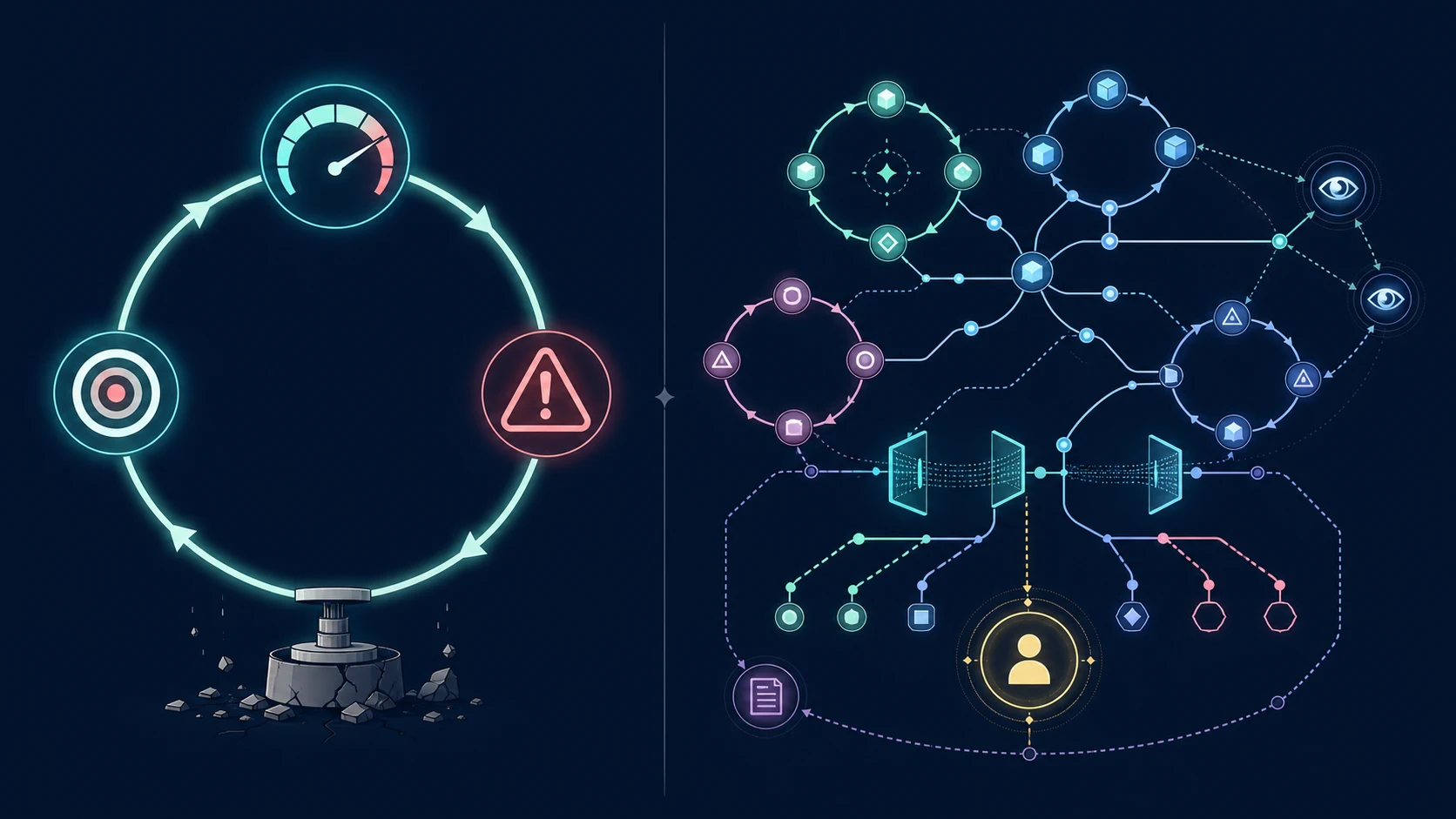
Graph Engineering is an emerging label—not a standard—for designing explicit graphs of execution, information flow, guardrails, state, and feedback around agent loops.

Most agent demos begin with a loop:
reason → use a tool → inspect the result → repeat
That loop is useful. It is also often the first place a production system becomes opaque.
Once an agent can delegate work, retain state, call tools with different risk levels, retry failures, request approvals, and revise its own output, “make the loop better” stops being a sufficient design instruction. The harder problem becomes deciding which actions may follow which states, what information each role may see, who can veto a transition, and how the system proves that it actually finished well.
A phrase beginning to circulate for that broader concern is Graph Engineering.
Important caveat: this is an emerging label, not an official standard, framework category, or settled body of practice. Peter Steinberger’s July 18 question—“Are we still talking loops or did we shift to graphs yet?”—drew substantial attention on X. Carlos E. Perez then used “From Loop Engineering to Graph Engineering?” to describe a shift from isolated optimization loops to networks of loops that can observe, constrain, and correct one another.
The label is useful because it gives builders a clearer unit of design: not one autonomous cycle, but an explicit graph of responsibilities and controls.

A loop is local; a graph makes relationships explicit
An agent loop is typically local. It knows its current objective, available tools, context, and stop condition. That can work extremely well for a bounded task.
The failure mode appears when local loops interact.
A researcher may optimize for breadth while a writer optimizes for speed. A reviewer may enforce formatting but lack authority over source quality. A tool loop may retry until quota exhaustion. An evaluator may score outputs using a rubric the generator has learned to game.
Each component can look reasonable in isolation. The problem lives in the edges:
- Which component may trigger another?
- Which result is evidence, and which is only a proposal?
- Which node can approve, reject, or escalate?
- What state is carried forward?
- What event terminates the workflow?
- What happens after failure, timeout, uncertainty, or a policy breach?
Graph Engineering treats those questions as first-class engineering work.
The practical model: nodes, edges, state, and anchors
1. Nodes: narrow responsibilities
A node should have a narrow operational role: retrieve evidence, execute a tool, create a draft, verify a claim, summarize a result, request approval, or produce the final answer.
The goal is not a theatrical “multi-agent society.” It is inspectable responsibility.
A good node definition answers:
- What does this node own?
- What inputs may it use?
- Which tools may it call?
- What output contract must it meet?
- What constraints apply?
- What does failure look like?
If every node is “general agent, but with another prompt,” the graph may hide ambiguity rather than reduce it.
2. Edges: executable transition rules
Edges define allowed movement through the system. They can represent sequence, conditional branch, parallel fan-out, join, retry path, or feedback cycle.
Microsoft AutoGen’s GraphFlow illustrates this directly. Its directed graph supports sequential chains, parallel fan-outs, conditional branches, and loops with exit conditions. Nodes represent agents; edges define allowed execution paths. The graph is therefore not merely a diagram—it is an executable coordination specification.
For every edge, define:
- the triggering event or condition;
- the data passed forward;
- timeout and failure behavior;
- whether the transition is automatic or approval-gated;
- whether retries are bounded;
- whether a route can re-enter a previous node.
A loop without an exit condition is not resilience. It is a cost and reliability incident waiting to happen.
3. State and information flow: separate execution from visibility
Execution order is not the same thing as information visibility.
AutoGen’s GraphFlow documentation makes the distinction explicit:
- the execution graph controls the order in which agents run;
- the message graph controls which messages each agent receives.
Message filtering restricts each agent’s context to relevant information. The documentation points to lower hallucination risk, lower memory load, and more focused agents.
This yields a strong design principle:
An agent should receive the minimum context needed to make its next valid decision.
That is not merely a token-saving trick. It is a governance boundary.
A finance tool agent does not need a strategist’s private draft history. A reviewer does not necessarily need every raw tool response. A final-answer node may need verified findings, not every intermediate discussion.
LangGraph approaches the broader problem as a low-level runtime for long-running, stateful agents. Its official overview emphasizes persistence, durable execution, human-in-the-loop control, memory, observability, and resumability. Those capabilities become meaningful only when state transitions have been intentionally designed.
4. Anchors: evidence outside the graph
This is the part diagrams can obscure.
Perez’s argument is not that better topology automatically produces a better system. A network of loops can remain internally consistent while being wrong about the world. Adding validators that inspect the same flawed data does not create independent verification.
Every consequential agent graph needs anchors outside model self-confirmation:
- a test executed against the real target;
- a source that can be retrieved and inspected;
- an immutable policy or budget rule;
- an external business or user outcome;
- a human decision at a high-impact boundary;
- a rollback mechanism tied to observed failure.
A graph can coordinate intelligence. It cannot manufacture the definition of “better” from nothing.
A reference workflow: research, verification, and publication
Consider a technical content agent.
A fragile design is one broad loop:
research → write → self-review → publish
A graph-oriented design could be:
brief
  ↓
source discovery
  ↓
source verification ──→ unsupported claim → revision request
  ↓
outline
  ↓
draft ──→ style review
  ↓            ↓
claim check ←──┘
  ↓
human approval for publication
  ↓
publish
The improvement is not the node count. It is contract clarity:
- Source discovery returns candidates, not facts.
- Source verification returns claims with traceable evidence or marks them unsupported.
- Drafting may use only verified claims.
- Style review cannot silently change factual content.
- Claim checking may route the draft back for revision.
- Publishing requires a separately authorized transition.
A single model can power several nodes. The graph still matters because permissions, inputs, output contracts, and exit criteria differ.
Four design checks before adding more agents
Can you explain every edge?
If you cannot explain why node A may activate node B, the transition is too implicit. A graph should make “why next?” answerable without reading a giant system prompt.
Is the graph executable and observable?
A graph is useful only if operators can inspect state transitions, resume after appropriate failures, and diagnose the actual route taken. Instrument nodes and edges. Record relevant state, tool outcomes, policy decisions, retry counts, and terminal reasons. The final answer is not the only artifact worth observing.
Does every cycle have an exit, a budget, and an owner?
Review cycles are seductive:
draft → critique → revise → critique → revise
They require an approval condition, maximum attempt/time/cost budget, escalation path, and clear ownership for changing the rubric. AutoGen documents loops with safe exit conditions; treat that as an architectural requirement.
What prevents self-confirmation?
Pair optimization with an independent check whenever possible. A writer can improve prose but should not be sole authority on factual support. A planner can propose a tool action but should not bypass its policy gate. An automated evaluator can help, but should not be the only measure when the system affects users, money, security, or external infrastructure.
When not to use a graph
Graph Engineering is not an argument that every task needs a workflow engine.
A simple response, one bounded tool call, or a short loop with a clear stop condition may be better expressed exactly that way. AutoGen’s guidance is similar: use simpler conversation patterns when ad hoc flow is sufficient; move to a structured graph for deterministic sequencing, conditional branching, or genuinely complex cycles.
Over-modeled graphs create their own risks:
- more orchestration code;
- slower local iteration;
- too many hand-offs;
- higher latency and operational overhead;
- false confidence from a tidy diagram.
The right question is not “Can we draw this as a graph?” It is:
Does making these boundaries explicit materially improve control, reliability, safety, or debuggability?
If not, a smaller design is better.
Does graph engineering replace loop engineering?
Not literally. Loops remain essential: observe, act, assess, retry. A graph organizes and governs loops.
The statement “graphs will replace loops” is therefore stronger than current evidence supports. A more defensible forecast is:
As agents move from demos into long-running systems with real consequences, loop optimization will increasingly be surrounded by explicit graph-level control engineering.
The implementation trend is already visible in graph runtimes, durable state, observability, bounded retries, human gates, and information filtering. The social label may persist or be replaced; the control problem will remain.
The emerging discipline is control-system design
The most useful reading of Graph Engineering is not “replace loops with graphs.” It is to design the control system around those loops:
- assign responsibilities to nodes;
- model legal transitions as edges;
- separate execution routing from information routing;
- preserve and inspect state;
- bound cycles and failure paths;
- place approval and policy gates deliberately;
- ground success in evidence that does not come solely from the model.
That is why the phrase resonates. It captures a real maturity step in agent development: moving beyond prompt-and-tool composition toward engineering the relationships that keep autonomous behavior useful, legible, and accountable.
Graph Engineering is not a standard yet. As a design lens, it is already practical.
Sources
- Peter Steinberger, X post, July 18, 2026: https://x.com/steipete/status/2078277297791189132
- Carlos E. Perez, “From Loop Engineering to Graph Engineering?”: https://x.com/IntuitMachine/status/2078419526354378975
- Preserved copy of Perez’s article: https://github.com/FeeiCN/FEEI.CN/issues/466#issuecomment-5013905127
- LangGraph overview: https://docs.langchain.com/oss/python/langgraph/overview
- LangGraph repository: https://github.com/langchain-ai/langgraph
- Microsoft AutoGen GraphFlow: https://microsoft.github.io/autogen/stable/user-guide/agentchat-user-guide/graph-flow.html