LLM-as-a-Tutor: Policy-Aware Prompt Adaptation for Non-Verifiable RL
A technical analysis of pairwise saturation detection, append-only atomic constraints, self-calibrating prompt curricula, benchmark gains, costs, and implementation boundaries.

Rubric-based reinforcement learning has expanded RL beyond domains with exact verifiers. An LLM judge can generate prompt-specific criteria and score open-ended outputs for instruction following, writing, factuality, or style. But a well-designed rubric cannot recover useful within-group contrast when the prompt itself has become too easy for the current policy.
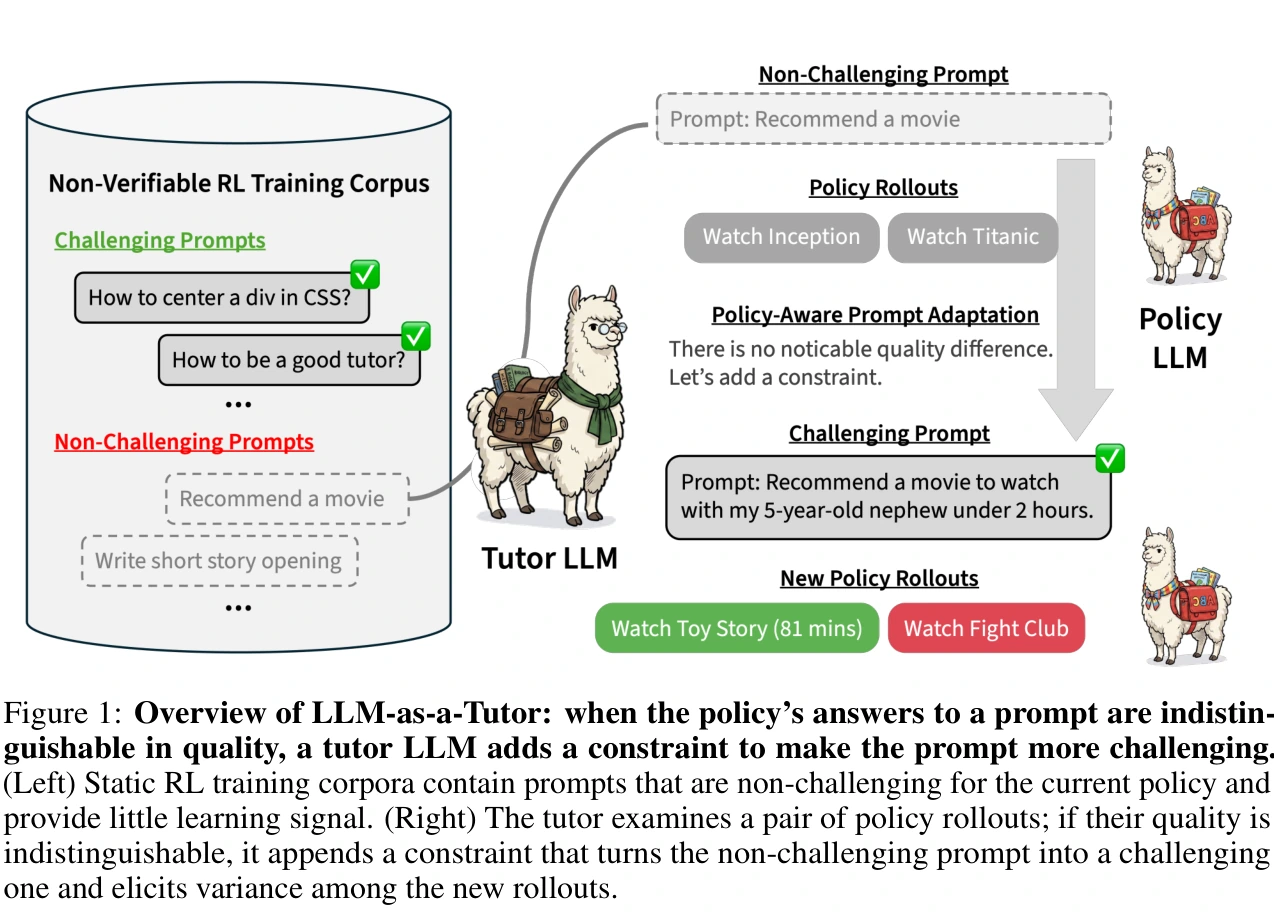
LLM-as-a-Tutor: Policy-Aware Prompt Adaptation for Non-Verifiable RL identifies this policy–prompt mismatch as a missing axis of adaptation. Kim et al. reuse one LLM as both examiner and tutor: it pairwise-compares policy rollouts to detect prompts that no longer separate response quality, then appends a single targeted constraint and its matching rubric criterion. The result is an append-only, per-prompt curriculum whose difficulty tracks the policy's behavior rather than a fixed schedule.
The failure mode: reward saturation starts upstream
For each prompt (x), rubric-based RL uses a set of weighted natural-language criteria (R(x)). An LLM judge scores a response against each criterion, and the weighted sum becomes the reward. Under GRPO, the advantage of one rollout is normalized relative to the mean and standard deviation of the rollout group.
This works only if the prompt–policy pair produces enough response-quality variation. As the policy improves on a static corpus, multiple rollouts can become both strong and similar. Reward variance shrinks, so group-relative advantage carries little information. Updating the rubric may improve what the system measures, but it cannot create behavioral differences that the prompt does not elicit.
The key systems claim is therefore precise: discriminativeness is a property of a prompt paired with a particular policy, not an intrinsic property of the prompt. A curriculum should react to the current policy's outputs.
Pipeline: pairwise detection, atomic adaptation
At the beginning of each training iteration, the tutor processes each prompt:
- Sample two responses from the current policy.
- Compare them pairwise for meaningful quality differences, overall approach, and weaknesses.
- If they are indistinguishable in quality, mark the prompt non-discriminative.
- Generate one atomic constraint along a dimension the original prompt left unspecified, plus rubric criteria for that constraint.
- Append the constraint to the prompt and union the new criteria with the base rubric.
- Run the ordinary rubric-scored GRPO update. Discriminative prompts pass through unchanged.
The tutor is not asked to solve the task or provide a target response. It needs two narrower capabilities: comparative judgment and targeted task construction. That distinction motivates the paper's interpretation of tutoring as a potentially stronger form of distillation: the student's ceiling is not directly bounded by the teacher's generated answer, only by whether the tutor can distinguish answers and design a useful next challenge.
Why append-only adaptation matters
If the original prompt is (x) and the new atomic constraint is (c), the adapted prompt is (x oplus c). Any valid response to the adapted prompt must still satisfy the original one. This produces monotonic difficulty by construction.
The design has three operational advantages:
- No difficulty regression: replacing or rewriting a prompt can accidentally produce an easier task; appending preserves every existing requirement.
- Distribution preservation: the seed task remains visible instead of drifting into a newly generated task family.
- Per-prompt pacing: constraints accumulate only when the current policy saturates that particular prompt.
The ablations support all three. Append reaches an average of 43.19 across FollowBench, AdvancedIF, and InfoBench, versus 42.88 for full Rewrite and 42.40 for Reset, which replaces the previous constraint between epochs.
Target selection also matters. Using the current policy's own rollouts to adapt 28% of prompts yields 43.19. Adding constraints to every prompt yields 42.13; selecting a random 28% yields 42.82. Evaluating the wrong model's rollouts augments 47% but reaches only 42.79. More difficulty is not automatically better; it must be assigned at the prompt–policy boundary where saturation actually occurs.
Main experiment
The main configuration uses Qwen3-1.7B as the policy and Qwen3-8B as both tutor and judge. Training runs for three epochs on 4,000 randomly sampled WildChat prompts. For every prompt, a base rubric is generated once. At each epoch boundary, the tutor can revisit and further adapt prompts based on the updated policy. The authors evaluate on FollowBench, AdvancedIF, and InfoBench. Scores are normalized to 0–100 and reported as mean ± standard error over five independent evaluation runs.
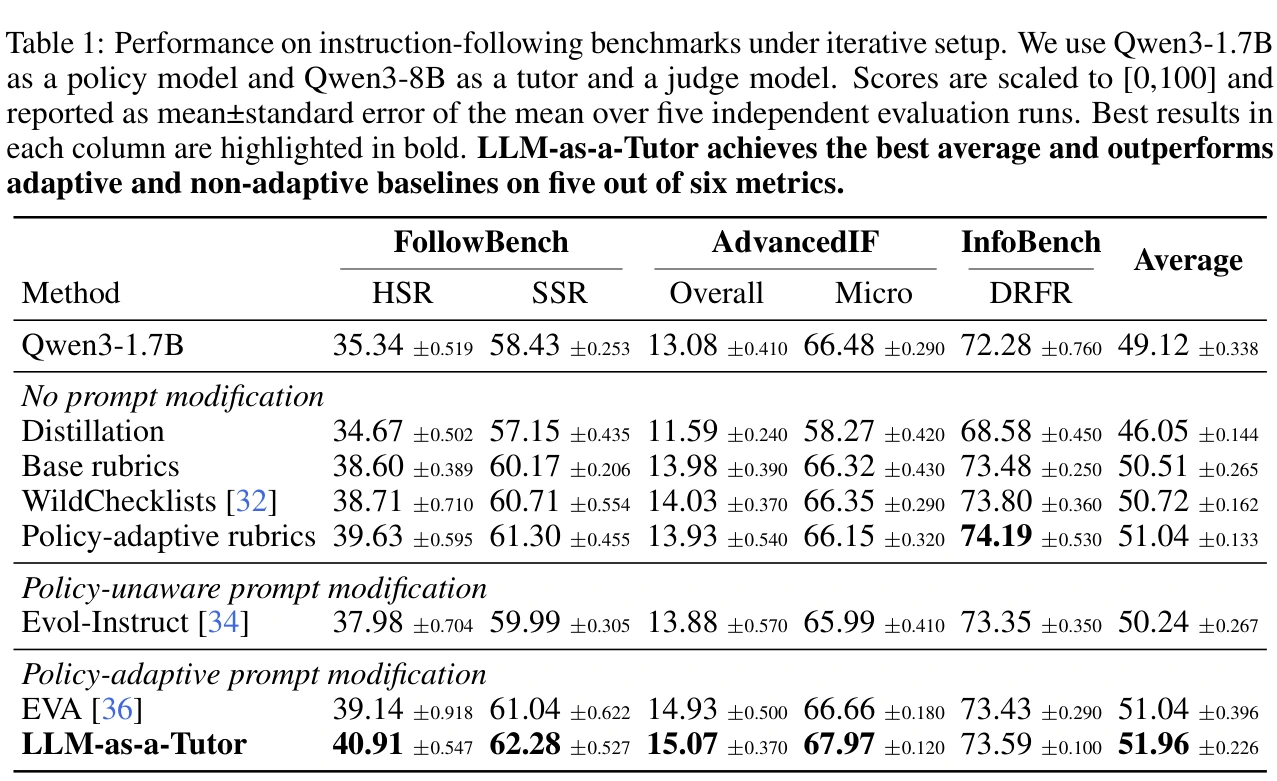
LLM-as-a-Tutor obtains the best average score, 51.96, and leads five of six reported metrics:
- Base Qwen3-1.7B: 49.12
- Distillation: 46.05
- Base rubrics: 50.51
- WildChecklists: 50.72
- Policy-adaptive rubrics: 51.04
- Evol-Instruct: 50.24
- EVA: 51.04
- LLM-as-a-Tutor: 51.96
InfoBench DRFR is the exception: policy-adaptive rubrics reach 74.19 while LLM-as-a-Tutor reaches 73.59. The average gain over the strongest adaptive baselines is 0.92 points. This is meaningful evidence for prompt adaptation, not evidence of a universal or large absolute leap.
Evol-Instruct's 50.24 also illustrates why policy-unaware complexity can hurt: making prompts harder offline, independently of the policy, performs below the 50.51 base-rubric baseline in this setup.
Does the tutor detect real saturation?
The paper checks the tutor's binary decisions against empirical group statistics. Prompts judged non-challenging have higher mean reward and lower variance: mean 90.76, standard deviation 12.96. Challenging prompts have mean 78.24 and standard deviation 27.07. The classification therefore aligns with the intended signal: saturated prompts already produce consistently strong rollouts.
With the tutor fixed at 8B, the fraction of prompts receiving constraints rises with policy scale:
- 0.6B policy: 8.1%
- 1.7B policy: 25.8%
- 4B policy: 40.5%
Stronger policies turn more seed prompts into easy prompts, and the tutor responds without an external difficulty schedule.
The qualitative example makes the mechanism concrete. A workplace-email prompt initially produces rollouts that all score 100 on the base rubric, yielding zero standard deviation. The tutor appends a requirement to name the specific company policy governing doctor's notes. One rollout cites a named policy and scores 100; another gives a generic “consult your supervisor” deflection and scores 60. The base-rubric mean falls from 100 to 92.5 and standard deviation rises from 0 to 14.9. A one-clause change restores contrast without replacing the seed task.
Engineering interpretation
The framework adds a curriculum controller around an existing rubric-RL stack rather than changing the optimizer. A minimal implementation needs persistent, versioned state per training example:
AdaptivePrompt {
  seed_prompt
  appended_constraints[]
  base_rubric
  constraint_rubrics[]
  last_policy_checkpoint
  saturation_decision
  decision_evidence
}
Production implementations should also define:
- a bounded adaptation cadence rather than assuming every epoch is optimal;
- deterministic prompt/version lineage for reproducibility;
- constraint deduplication and contradiction checks;
- quality gates that reject non-atomic or distribution-shifting constraints;
- maximum cumulative constraint count and context budget;
- held-out evaluation using the unmodified benchmark prompts;
- cost accounting separated into policy rollouts, tutor judgments, constraint generation, and rubric judging.
The paper's tutor decision uses only two sampled rollouts. That makes adaptation cheaper, but also means the binary trigger can be noisy. A practical variant could estimate uncertainty across repeated pairs, require agreement, or combine pairwise judgment with observed reward variance. Those extensions are not validated by this paper and should be treated as design hypotheses, not reported results.
Cost and limitations
The authors identify several boundaries.
Configuration scope. The complete benchmark suite is reported for one primary policy–tutor pair, Qwen3-1.7B with Qwen3-8B. The policy-scaling analysis covers 0.6B to 4B, but it is not a full cross-family validation.
Tutor dependence. Comparative judgment and atomic constraint generation are reasoning-heavy. A weak tutor can make noisy saturation calls or generate untargeted constraints.
Additional inference. Per training prompt, the method uses two policy samples, one tutor call for pairwise saturation judgment, and another tutor call only when a constraint is generated. The authors argue this is a small fraction of their existing rubric pipeline, which already uses eight policy rollouts and 8×N judge calls for N rubric criteria, typically 5–10. That relative cost depends on the surrounding RL design and should not be generalized without measurement.
Task structure. Atomic constraint appending maps naturally to instruction following, where complexity often means satisfying more simultaneous requirements. Other domains need domain-specific operators: extra reasoning steps, code edge cases, or stricter sourcing requirements. Full rewriting underperforms here, but could become more competitive with a stronger tutor and better distribution-preservation checks.
Dual use. The framework is task-agnostic. If seed prompts and rubrics optimize harmful compliance, adaptive tutoring can strengthen that behavior too. The authors use public non-adversarial WildChat prompts and general-quality rubrics and do not release trained checkpoints.
Finally, this is a NeurIPS 2026 preprint, not a broadly reproduced result. Independent replication across model families, larger policies, and real deployment tasks remains necessary.
Takeaway for agent builders
LLM-as-a-Tutor reframes curriculum design as a closed-loop control problem:
- observe the current policy rather than assign static difficulty;
- detect when the task no longer produces useful behavioral contrast;
- make the smallest targeted intervention;
- preserve task lineage and previously active constraints;
- let the optimizer discover the improved behavior rather than imitate a teacher answer.
For agent training, the most reusable idea is not simply “use an LLM to generate harder prompts.” It is policy-aware, minimal, monotonic adaptation. A tutor should change the environment only when the current policy demonstrates that the previous challenge has stopped teaching it anything.
Source
- Yujin Kim, Namgyu Ho, Sangmin Hwang et al., LLM-as-a-Tutor: Policy-Aware Prompt Adaptation for Non-Verifiable RL, arXiv:2607.04412, NeurIPS 2026 preprint.