Self-Evolving Agents Need a Systems Substrate, Not Just Better RL
A builder-facing analysis of arXiv 2607.01120: ATDP, governed data proxies, an evolution control plane, AReaL 2.0, replay, rollback, reward semantics, and where the evidence stops.

Most deployed agents accumulate experience without becoming meaningfully better from it.
They read files, call tools, browse, retrieve, update memory, request approvals, and complete long-horizon workflows. Yet their model weights, system prompts, tool schemas, and harnesses usually remain frozen until a human team inspects traces, curates data, edits the system, fine-tunes a model, and redeploys it.
“Next-Generation Agentic Reinforcement Learning Systems Enable Self-Evolving Agents” (arXiv:2607.01120v2) argues that the bottleneck is not merely a missing reinforcement-learning algorithm. It is the lack of a systems substrate that can turn deployed experience into governed, replayable, credit-assignable learning material.
That is the builder-relevant claim:
Self-evolving agents are primarily a data, control-plane, and governance problem before they are an optimizer problem.

What “self-evolving” means here
The paper does not advocate unrestricted recursive self-modification. It defines a bounded closed loop in which prior situated experience can improve future behavior after observation, redaction, verification, attribution, evaluation, and staged deployment.
The intervention surface may be:
- a memory insertion;
- a skill patch;
- a harness or prompt edit;
- a tool-description or schema change;
- an update to policy-model weights;
- rollback;
- or no-op.
This is an important systems correction. A deployed agent is a composite policy, not just an LLM checkpoint. Treating every recurring failure as a fine-tuning problem is expensive, slow, and often aimed at the wrong layer.
The paper cites OpenClaw as evidence that persistent, user-owned agents can learn from situated experience at the personal-agent level. It then draws a boundary: enterprise self-evolution must operate across teams, tenants, permissions, proprietary data, compliance rules, and heterogeneous agent stacks.
Pillar 1: Agent Trajectory Data Protocol
Production observability usually captures prompts, completions, tool calls, latency, errors, and token usage. Those traces support debugging. They are not necessarily rich enough for learning.
The proposed Agent Trajectory Data Protocol (ATDP) represents a trajectory as a typed event sequence. Each step connects:
- observation;
- relevant internal or harness state;
- chosen action;
- action outcome;
- reward or critique;
- metadata such as model version, tool schema, cost, tenant, and governance status.
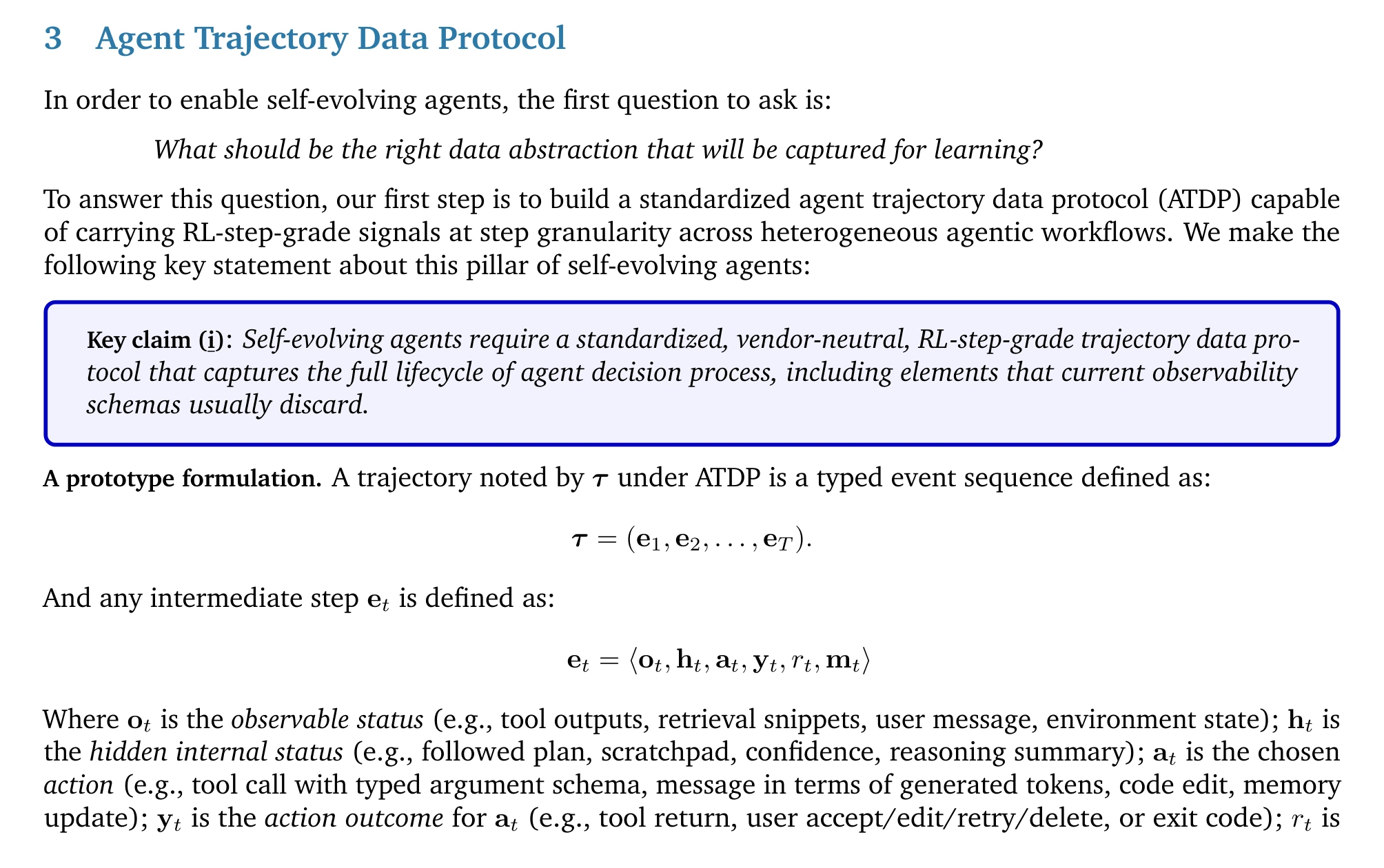
This schema is meant to answer a causal engineering question: which observation, prompt fragment, retrieval result, memory item, tool call, or guardrail decision contributed to success or failure?
For a tool call, storing the tool name and output is not enough. Learning-grade data may need the version, argument schema, permission scope, latency, error class, return object, and whether the result was later trusted, ignored, corrected, or contradicted.
ATDP also treats delayed feedback as first-class. A reward may arrive through the next user turn, a later test failure, a reopened support ticket, an annotation, or a remote evaluator. The record must accept reward augmentation while preserving the original causal history.
The paper is also careful about bounded revelation. Learning should not require unrestricted storage of hidden chain-of-thought tokens. The protocol should preserve decision-relevant structure without turning private reasoning traces into a mandatory enterprise data asset.
Pillar 2: a comprehensive agentic data proxy
ATDP describes what learning-ready experience should contain. The data proxy describes how heterogeneous production systems produce it.
The proxy intercepts stable execution boundaries:
- model calls;
- tool invocations;
- retrieval operations;
- memory reads and writes;
- file and browser actions;
- approval events;
- user corrections and final outcomes.
Its job is not simply trace export. It must redact sensitive fields, enforce access and retention policies, attach provenance, determine training eligibility, harvest weak and delayed reward signals, and persist trajectories in a form suitable for replay.
The replay distinction is operationally useful. Events should be labeled as deterministically replayable, approximately replayable, or non-replayable. A monitoring system asks, “What happened?” A learning system must also ask, “Would this have succeeded under another model, prompt, memory item, retrieval policy, or tool schema?”
For multi-tenant systems, aggregation and isolation must coexist. A coding agent may benefit from issue-resolution traces across teams while remaining unable to expose or learn from repositories outside a permitted boundary. Tenant metadata is therefore not just compliance decoration; it affects whether an update is valid to generalize.
Pillar 3: the agent evolution control plane
The control plane decides when, where, and how behavior should change.
The paper models an agent as a tuple containing the policy LLM, in-context harness, memory, tools, and governance configuration. Given a window of trajectories, the control plane selects an intervention based on evaluator scores, correction rates, tool-failure clusters, cost per successful task, safety constraints, and workload drift.
A practical failure-to-intervention map looks like this:
- narrow recurring missing knowledge → memory;
- repeated procedural failure → skill or harness;
- tool-routing or argument failures → tool description, schema, or router;
- broad failure across tenants and configurations → policy update;
- regression or unsafe delta → rollback;
- weak evidence → no-op.
The last two actions matter. A production learning system should be optimized for warranted changes, not maximal update frequency.
Every intervention needs a promotion path: retrospective replay, offline regression tests, shadow evaluation, canary rollout, differential monitoring, and versioned rollback. The paper's strongest operational sentence can be paraphrased as follows:
A self-evolving agent that cannot explain what changed is not evolving; it is drifting.
AReaL 2.0: one implemented branch
The paper instantiates a deliberately scoped branch through AReaL 2.0. It does not implement the complete ATDP, multi-surface control plane, or enterprise governance vision. It focuses on online policy-model weight updates from deployed agent workloads.
An existing agent service keeps its planner, tool execution, sandbox, and memory modules. Instead of calling a standard inference backend directly, it sends LLM requests through an AReaL-managed gateway. A router preserves session affinity, data proxies capture trajectory traffic, inference workers serve agent turns, trajectory storage feeds the learning loop, and training workers update the policy.
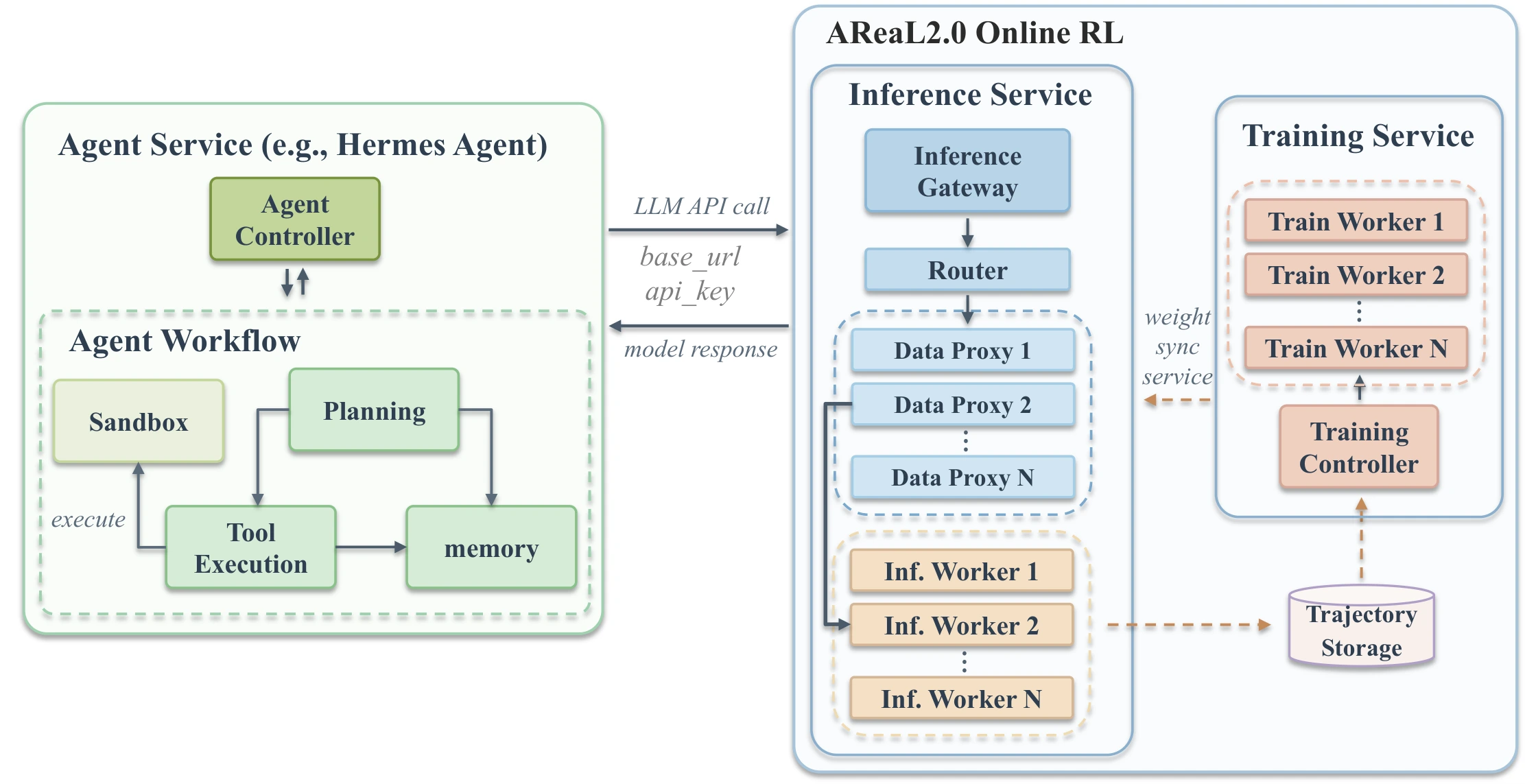
The paper uses Hermes Agent as a motivating integration example. Hermes can replace its normal SGLang-style inference backend with the AReaL gateway while leaving the surrounding agent workflow mostly unchanged. This reduces the mismatch between an offline simulated RL environment and the agent's actual production behavior.
That architectural direction is useful, but the evidence boundary matters.
This is a position/system paper with a prototype architecture. It does not report an empirical benchmark showing that the complete self-evolving stack improves task success by a measured amount. It does not demonstrate a full production ATDP implementation, automated multi-surface intervention selection, counterfactual replay, or tenant-aware governance.
AReaL 2.0 grounds one integration path. It does not validate the entire agenda.
What builders should steal now
You do not need online RL to apply the paper's strongest systems lessons.
1. Log decisions, not only messages
Capture the observation-action-outcome relationship at step granularity. A final answer and a pass/fail bit are rarely sufficient for causal diagnosis.
2. Version the execution envelope
Model IDs are not enough. Version prompts, harnesses, skills, memory policies, retrieval indexes, tool schemas, permissions, and guardrails.
3. Separate observability from learning eligibility
A trace that operators may inspect is not automatically data that a training job may consume. Make consent, retention, classification, and eligibility explicit fields before trajectories reach a learning queue.
4. Preserve late feedback
Design the event model so later user corrections, test results, ticket outcomes, and evaluator signals can be attached without rewriting the original record.
5. Diagnose the intervention surface
Before fine-tuning, ask whether the failure belongs to memory, skill, harness, routing, tool schema, policy weights, or governance.
6. Replay old successes as well as old failures
Testing only the failure that motivated a patch creates tunnel vision. The update must preserve known-good behavior.
7. Make rollback and no-op first-class
If the control plane cannot choose not to learn, it is an update engine, not a governed evolution system.
The hard unsolved problem: reward semantics
The paper correctly emphasizes harvesting operational signals, but those signals are dangerous proxies.
A user not editing an answer does not prove correctness. A closed ticket does not prove satisfaction. A fast resolution may hide a policy violation. A tool call succeeding technically may still produce the wrong business outcome.
Continuous learning can become continuous proxy optimization.
For builders, this means the evolution control plane needs more than metrics. It needs an explicit evidence policy:
- which signals can trigger an update;
- which signals only support investigation;
- which require human review;
- which must never be optimized directly;
- and how conflicting feedback is resolved.
Without that layer, better trajectory infrastructure can make bad objectives scale faster.
Bottom line
This paper is valuable because it moves self-improving agents out of the prompt-engineering frame and into a concrete systems frame.
Experience does not become learning merely because it was logged. A credible self-evolving agent needs:
- a trajectory protocol that preserves causal structure;
- a governed proxy that turns production work into eligible learning material;
- a control plane that chooses the right intervention surface;
- replay, staging, provenance, rollback, and the discipline to do nothing when evidence is weak.
The near-term path may be less cinematic than recursive self-improvement, but it is more buildable:
Record the right experience, change the right layer, and make every evolution explainable and reversible.
References
- Ran Yan, Wei Fu, Jiale Li et al., Next-Generation Agentic Reinforcement Learning Systems Enable Self-Evolving Agents, arXiv:2607.01120v2, 2 July 2026.
- Original PDF.
- AReaL repository.
Editorial note: This is a position/system paper with a deliberately scoped prototype. It does not report quantitative validation of the complete enterprise self-evolution architecture.
Image lane: OpenAI native primary for the hero; both inline visuals are extracted directly from the paper.