Skill Self-Play: Co-Evolving Skills for Self-Evolving Agents
A builder-facing analysis of Skill Self-Play (arXiv 2607.22529): how a proposer, solver, and dynamic skill controller build verified curricula, why the largest gains appear in initially misaligned models, and where the evidence stops.

Most self-improvement demos quietly assume that the system can generate its own training data safely.
That assumption is the hard part.
If an agent proposes tasks that are too easy, the solver learns little. If it proposes tasks that are malformed or impossible, the reward signal becomes fiction. A system can produce an impressive amount of synthetic data while training against a distorted view of capability.
Skill Self-Play: Pushing the Frontier of LLM Capability with Co-Evolving Skills (arXiv:2607.22529v1, 24 July 2026) frames this as a tension between task diversity and verification reliability. The authors from Alibaba’s Qwen Large Model Application Team and collaborators propose Skill Self-Play (Skill-SP), a training-time framework in which a proposer, a solver, and a dynamic skill controller co-evolve.
The important abstraction is not “more trajectories.” It is a reusable skill package that combines procedural guidance, examples, executable validators, routing metadata, and usage statistics.

The failure mode: self-play can manufacture its own bad rewards
Standard self-play often has a generator create challenges and a solver attempt them. A frontier-targeted objective can prefer tasks on which the current solver succeeds roughly half the time.
That objective is useful but unsafe on its own. A proposer can obtain apparent difficulty by generating:
- an ill-posed task;
- an inconsistent hidden contract;
- a schema that cannot be parsed;
- or a problem whose reference answer is not actually justified.
Post-hoc filtering catches obvious format failures. It does not necessarily teach the generator how to construct reusable, logically valid, and diverse task patterns. Over iterations, those errors can become synthetic-data collapse.
Skill-SP treats the skill interface as a proactive control boundary rather than a passive filter.
The Skill-SP control loop
The framework has three core roles:
- Proposer: synthesizes candidate tasks conditioned on a routed skill, or through an unconstrained exploration stream.
- Solver: attempts the task and acts as the current empirical evaluator of task difficulty.
- Skill controller: uses failures, successes, novelty, and task utility to refine, prune, and induce skill packages.
A skill is represented as a structured package with routing metadata, construction rules, generation hints, few-shot examples, an executable validator, and lifecycle statistics. It is closer to a small domain-specific interface than to a prompt snippet.
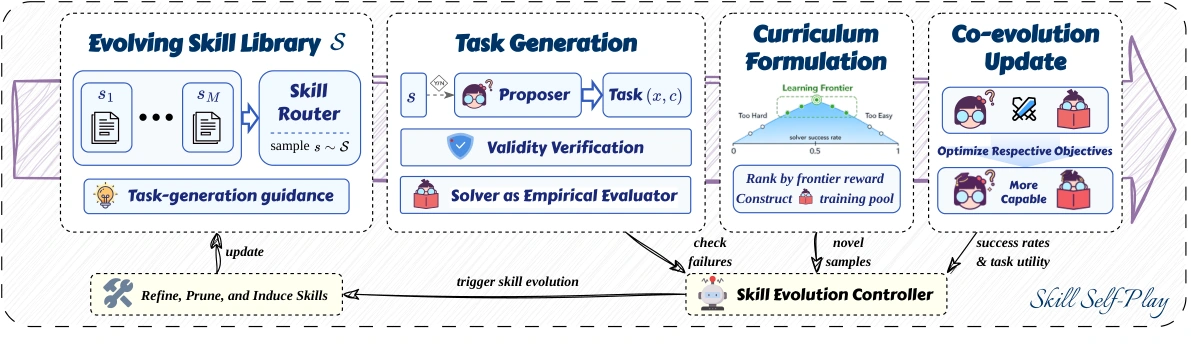
The loop has a useful separation of concerns:
- sample a skill according to routing statistics;
- generate a candidate task;
- verify its schema, contract, and probe consistency;
- estimate how close its difficulty is to the solver frontier;
- retain valid candidates for the solver curriculum;
- update proposer and solver policies;
- update the skill library from the resulting traces.
For skill-conditioned tasks, validity is the intersection of three checks:
- global schema compliance;
- contract validity through the skill’s validator;
- probe consistency, where repeated solver rollouts support a unique answer matching the proposer’s reference.
The paper’s logic is worth keeping precise: a skill does not merely tell the proposer what to write. It also provides a mechanism for checking whether the proposed task can be trusted.
Why two data streams matter
Skill-SP mixes two sources:
- a skill stream, which injects reusable structural priors and executable checks;
- an exploration stream, which removes skill constraints so the system can discover new task patterns.
The experiments use a 50/50 mixture. This is a hedge against two different forms of collapse:
- skill-only generation may over-specialize around the current library;
- unconstrained generation may drift toward narrow, malformed, or weakly verifiable patterns.
The dual-stream design is a systems decision, not a cosmetic detail. It makes the skill library a governance layer without turning it into a closed world.
Table 1: the largest gains come from rescuing weak starting points
The main tool-call evaluation covers API-Bank (three difficulty levels) and BFCL (JavaScript, Python, Java, and live-tool scenarios). Five backbones from 3B to 14B parameters are initialized identically for proposer and solver.
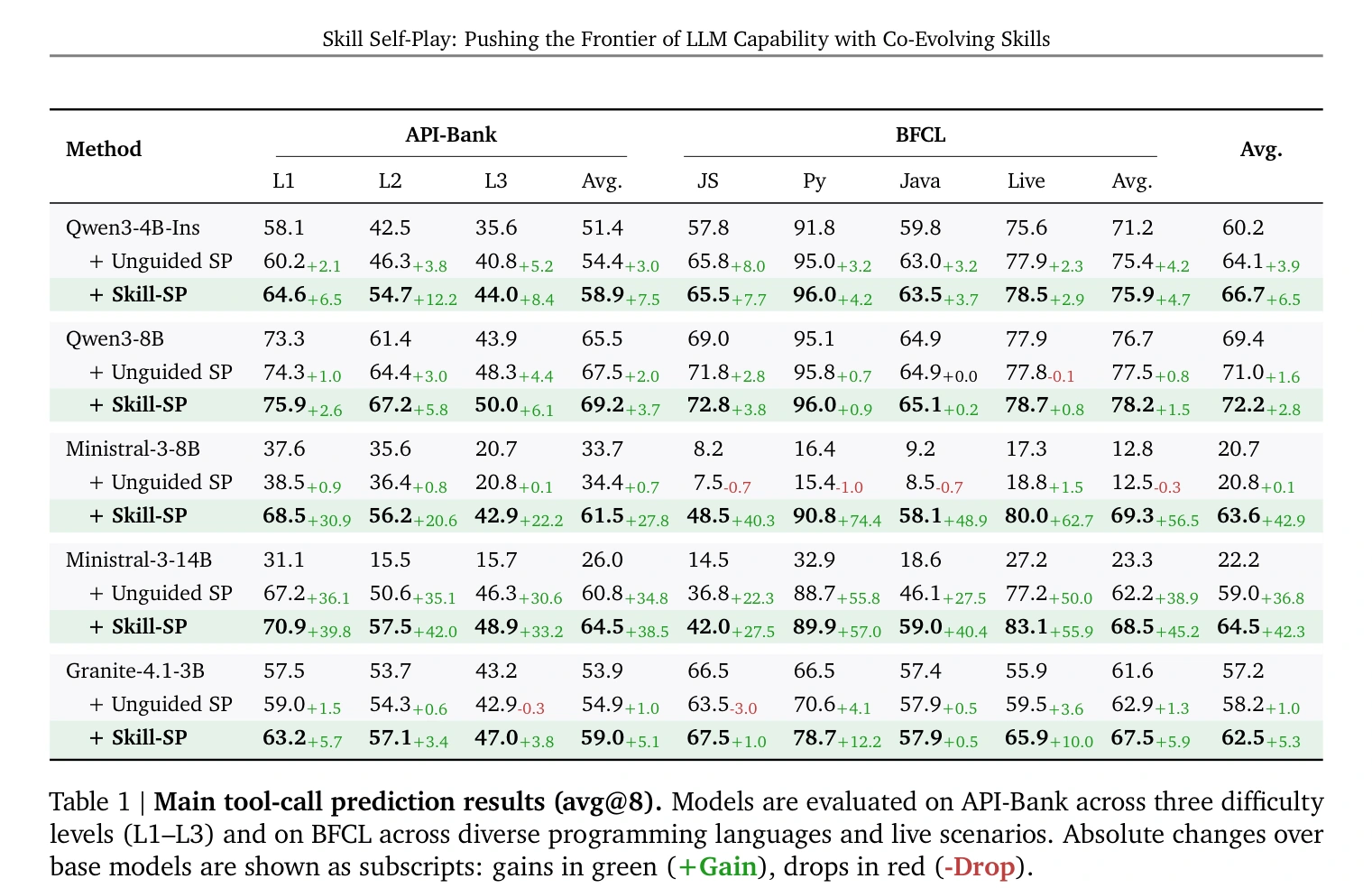
The overall averages are the clearest summary:
- Qwen3-4B-Instruct: 60.2 → 66.7 (+6.5).
- Qwen3-8B: 69.4 → 72.2 (+2.8).
- Ministral-3-8B: 20.7 → 63.6 (+42.9).
- Ministral-3-14B: 22.2 → 64.5 (+42.3).
- Granite-4.1-3B: 57.2 → 62.5 (+5.3).
The Ministral results are the interesting stress test. The paper reports that Unguided SP remains effectively stagnant for Ministral-3-8B because the model cannot reliably synthesize valid tasks without proactive structural guidance. Skill-SP supplies enough procedural structure and validation to bootstrap useful training signals.
This is not evidence that a smaller model has become universally stronger. It is evidence that the quality of the self-generated curriculum can dominate the usefulness of the self-play loop.
Reasoning transfer is positive, but not magical
Skill-SP is also evaluated on ZebraLogic, a constraint-satisfaction benchmark with Small, Medium, Large, and X-Large search-space bands. Unguided SP is not reported there because it fails to bootstrap a viable stream of valid logical puzzles.
Grid-level accuracy improves for all five backbones:
- Qwen3-4B-Instruct: 72.1 → 73.5 (+1.4).
- Qwen3-8B: 23.6 → 32.4 (+8.8).
- Ministral-3-8B: 5.0 → 11.2 (+6.2).
- Ministral-3-14B: 5.4 → 17.4 (+12.0).
- Granite-4.1-3B: 11.6 → 12.6 (+1.0).
The same table shows why the caveat matters: the weakest models remain close to zero on the Large and X-Large subsets. Pure self-play still needs a minimum capability threshold to create valid learning signals.
Diagnostics: frontier targeting, diversity, and library lifecycle
Final benchmark accuracy is not enough to establish the mechanism. The paper audits the generated data loop on Qwen3-4B-Instruct.
The skill-routed stream has a mean solver success rate of approximately 0.57, closer to the intended learning frontier than the exploration stream (0.75) and Unguided SP (0.70). The interpretation is not “0.57 is universally optimal.” It is that proactive routing keeps task difficulty closer to the region where the current solver can learn.
The question-embedding visualization shows broader coverage for the mixed Skill-SP pool, while Unguided SP clusters in narrower semantic regions. Across five iterations, the controller induces roughly 20 new packages per round, updates existing packages from execution traces, and retires obsolete ones.
The library reaches 86 active skills and an effective skill count of 46 under the paper’s entropy-based utilization measure. A larger library is therefore not treated as success by itself; the authors also ask whether usage is distributed across the library.
The ablations point to control, not just extra data
On Qwen3-4B-Instruct tool calling:
- Unguided SP drops overall accuracy by 2.6 points versus the full system.
- Uniform routing drops it by 1.9 points.
- Frozen skills drop it by 2.3 points.
- Freezing the proposer drops it by 2.1 points.
- Freezing the feedback solver drops it by 3.0 points.
- Freezing both produces the largest drop, 3.2 points.
The pattern supports the paper’s mechanism: dynamic routing, evolving skills, and co-evolving proposer/solver feedback all matter. Simply adding static instructions to the generator is not enough.
What I would borrow for agent infrastructure
Skill-SP is a model-training paper, but the control ideas map cleanly onto production agent systems.
1. Treat skills as governed interfaces
A skill should have a trigger, a procedure, examples, a validator, and lifecycle state. Storing only prose makes it difficult to tell whether a skill is still useful or safe to route.
2. Put validation before reward
If a workflow can be structurally invalid, reject it before its difficulty or outcome affects learning. “The model failed” and “the task was malformed” must be different events.
3. Keep exploration separate from exploitation
A curated skill library should guide normal traffic without becoming the only source of new behavior. A bounded exploration stream can discover patterns that the current library cannot express.
4. Measure frontier proximity, not just pass rate
Always-easy tasks inflate apparent reliability while teaching little. Always-impossible tasks generate noise. Track where tasks sit relative to current capability and adjust the curriculum.
5. Make lifecycle actions explicit
Refine, induce, update, and retire are different operations. They should be observable and auditable rather than hidden inside an ever-growing prompt.
Evidence boundary
The paper’s claims are narrower than the phrase “self-evolving agents” may suggest:
- five self-play iterations;
- five open-source backbones, 3B–14B;
- 8,000 tool-call tasks per iteration and 1,920 reasoning tasks per iteration;
- GRPO updates with fixed rollout and curriculum settings;
- an initial library of 15 tool-call skills and 8 ZebraLogic skills;
- fixed mixture and difficulty heuristics;
- no transformer/LLM-frontier or production workflow evaluation;
- a minimum base capability is needed to bootstrap valid signals.
The authors explicitly point to learnable curriculum schedulers, co-induction of generation rules and validators, and transfer of evolved skill libraries across architectures as future work.
My view
The most valuable contribution is not the claim that agents can “train themselves.” It is the proposal that self-improvement needs a middle layer between raw trajectories and fixed environments.
Raw traces are too noisy and too expensive to reason over repeatedly. Fixed environments are too narrow to cover an open-ended agent. A governed skill package can hold a reusable pattern, a local validator, and enough statistics to decide whether the pattern deserves another turn.
That suggests a useful design principle for agent teams:
Do not ask an agent only to remember what worked. Ask it to preserve the smallest reusable procedure that can explain why it worked, how to verify it, and when not to use it.
Skill-SP does not remove the need for human-designed environments, seeds, and evaluation. It makes a more disciplined claim: with the right interfaces and feedback, self-play can become a curriculum engine rather than a synthetic-data slot machine.
Sources
- Siyuan Huang, Pengyu Cheng, Haotian Liu, Tao Chen, Yihao Liu, Jingwei Ni, Shijie Zhou, Ziyi Yang, Gangwei Jiang, Mengyu Zhou, Yu Cheng, Xiaoxi Jiang, and Guanjun Jiang, Skill Self-Play: Pushing the Frontier of LLM Capability with Co-Evolving Skills, arXiv:2607.22529v1, 24 July 2026.
- Paper PDF.
- Skill Self-Play source code.
- Table 1 and Figure 3 are taken directly from the paper and only cropped/converted to WebP for display.