Atomic Task Graph: An Executable Control Substrate for Agent Planning and Repair
A technical analysis of ATG: interface-preserving graph compilation, dependency-aware execution, preflight validation, localized repair, benchmark gains, and production caveats.

Long-horizon agent failures are often blamed on weak reasoning, insufficient context, or small backbones. Atomic Task Graph: A Unified Framework for Agentic Planning and Execution argues that the control substrate is itself a bottleneck. A capable model can still behave unreliably when planning and execution remain a linear textual trajectory in which dependencies are implicit, validated intermediates are hard to reuse, and a local failure contaminates a broad repair.
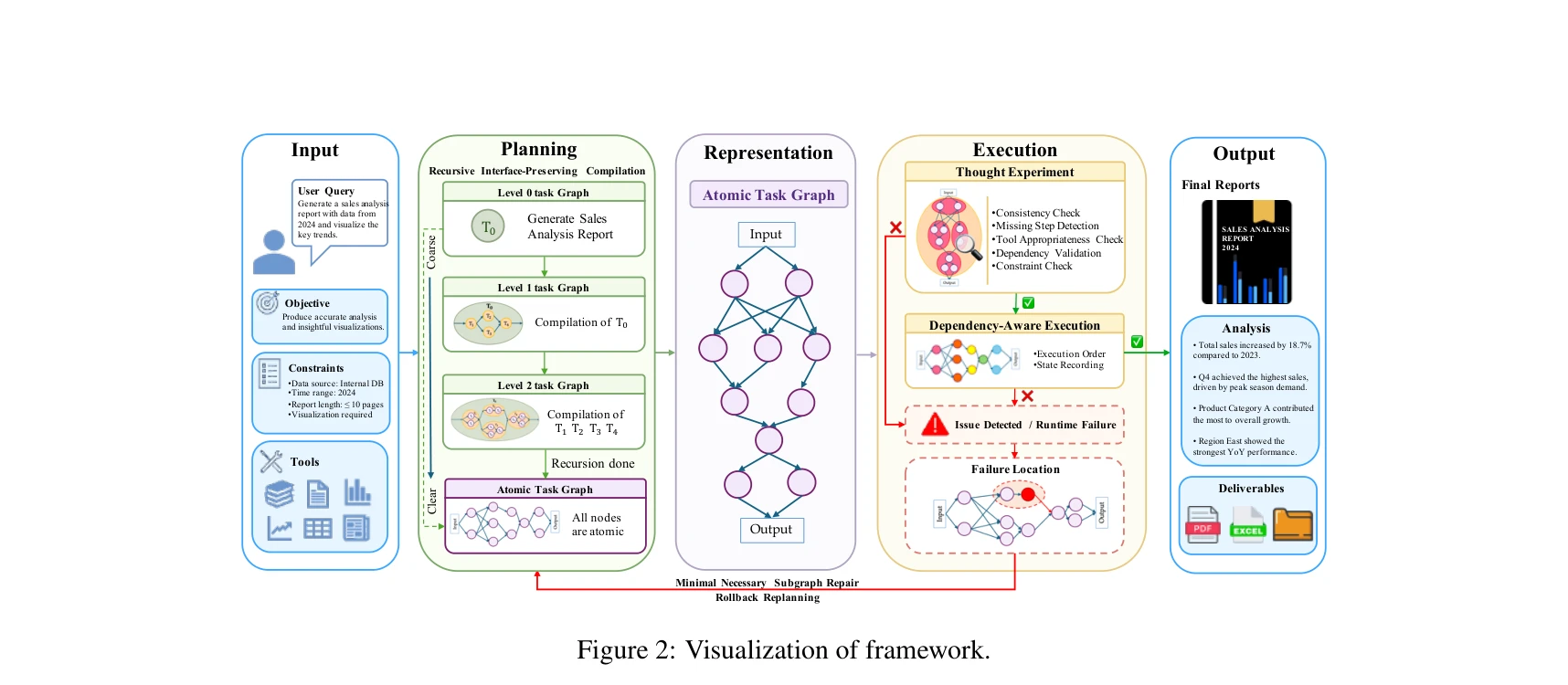
Yue Zhang and colleagues propose Atomic Task Graph (ATG), a training-free framework that compiles a high-level objective into a directed acyclic graph of atomic tool-use units, executes independent branches in parallel, validates the graph before environment interaction, and repairs only the smallest affected subgraph when failure occurs.
The control problem hidden inside a trajectory
A conventional ReAct-style agent emits a sequence of thoughts, actions, and observations. Even if the plan mentions subtasks, the operational dependencies between their inputs and outputs often remain implicit in text. This creates three coupled problems:
- Execution is unnecessarily sequential. Independent work is difficult to schedule concurrently when the system has no explicit dependency graph.
- Context grows globally. Later action generation is conditioned on a long trajectory rather than the local state required by one subtask.
- Repair scope is ambiguous. When an action fails, the controller can continue correcting, backtrack, or replan broadly, but it lacks a structural definition of which verified results are still valid.
ATG changes the representation from a trajectory to an executable dependency substrate. Its key claim is not merely that graph planning is better than linear planning. The graph remains active throughout planning, scheduling, validation, state recording, failure localization, and repair.
Interface-preserving recursive compilation
ATG starts from a coarse task graph. Each non-atomic node is recursively compiled into a subgraph until every leaf is an atomic tool-use unit. The important constraint is interface preservation: the compiled subgraph must preserve the parent node's declared inputs and outputs.
This produces a sequence of graph states from coarse to fine. That evolution history matters operationally. It provides provenance for tracing where an incorrect dependency or decomposition entered the plan, while each final node receives localized context rather than the complete growing trajectory.
The paper's “atomic” does not mean universally indivisible. Atomicity is defined relative to execution: a node should be small and concrete enough to map to a tool action with explicit inputs and outputs.
Validation before action
Before touching the environment, ATG runs a lightweight thought experiment over the compiled graph. It checks:
- consistency;
- missing steps;
- tool appropriateness;
- dependency validity;
- constraint satisfaction.
Under Mistral-7B, this stage flags 24.6% of plans on ALFWorld, 18.9% on WebShop, and 27.4% on ScienceWorld as risky before execution. Reported failure precision is above 74% across most evaluated settings. This is useful evidence that structural preflight checks can intercept errors before they become expensive environment interactions, although benchmark precision should not be assumed to transfer unchanged to production workflows.
Dependency-aware execution and minimal repair
A ready node executes only when its dependencies are satisfied. Independent ready branches can run in parallel. Execution results are recorded against graph nodes rather than appended only to a global transcript.
On a predicted or runtime failure, ATG identifies the smallest affected subgraph, freezes validated regions, rolls back the affected state, and recompiles or replans locally. This provides a concrete reuse policy: a verified output survives unless the failed node is upstream of it in the dependency graph.
The design resembles incremental build systems and dataflow engines more than ordinary chain-of-thought prompting. The analogy is useful but imperfect: unlike a deterministic build graph, ATG relies on an LLM to infer task boundaries and dependencies, so an incorrect graph can make the repair boundary itself wrong.
Main results
The authors evaluate on ALFWorld, WebShop, and ScienceWorld with Mistral-7B-Instruct-v0.2, Gemma-1.1-7B-it, and Llama-3-8B-Instruct. ATG operates at inference time without task-specific fine-tuning, additional supervision, demonstrations, or parameter updates. Backbone-dependent methods share checkpoints, tokenizers, decoding settings, action budgets, and environment interfaces.
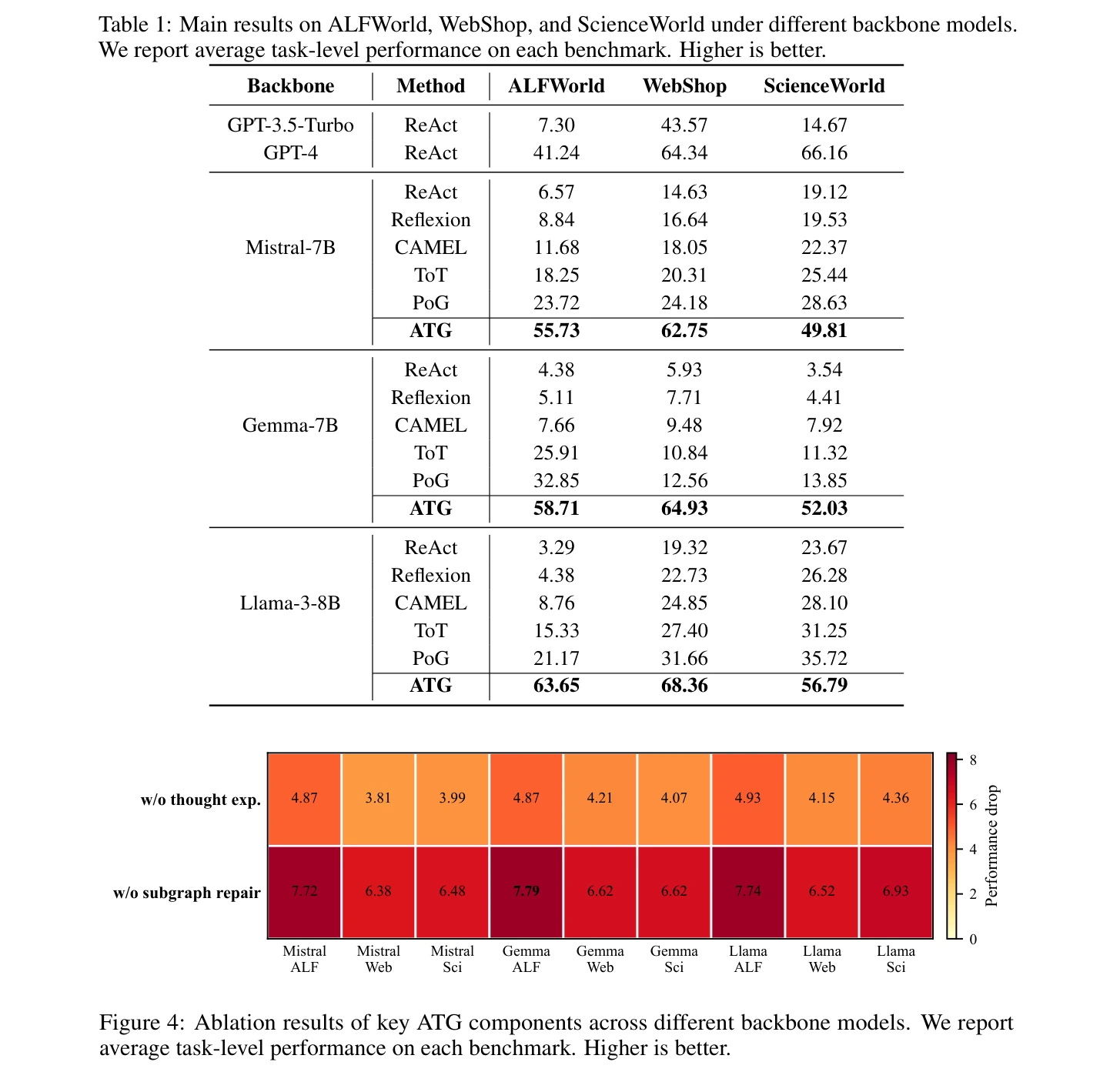
ATG is the strongest method for every open-source backbone and benchmark in Table 1:
- Mistral-7B + ATG: 55.73 ALFWorld, 62.75 WebShop, 49.81 ScienceWorld.
- Gemma-7B + ATG: 58.71, 64.93, and 52.03.
- Llama-3-8B + ATG: 63.65, 68.36, and 56.79.
For Mistral-7B, ATG improves over ReAct by 49.16 points on ALFWorld and 48.12 points on WebShop. Against PoG, the strongest Mistral baseline reported by the authors, the gains are 32.01 and 38.57 points respectively.
Llama-3-8B + ATG also exceeds GPT-4 + ReAct on ALFWorld (63.65 vs. 41.24) and WebShop (68.36 vs. 64.34), but not ScienceWorld (56.79 vs. 66.16). This does not establish that an 8B model is generally superior to GPT-4. It shows that, under this paper's benchmarks and protocol, a stronger control framework can offset some backbone-scale disadvantage.
Averaged over the three benchmarks, ATG raises the strongest baseline from 25.51 to 56.10 on Mistral-7B, from 19.75 to 58.56 on Gemma-7B, and from 29.52 to 62.93 on Llama-3-8B.
Efficiency and action reliability
The reported effective execution depth is lower for ATG than for all baselines. Relative to ReAct, average steps decrease:
- ALFWorld: 31.42 → 18.36;
- WebShop: 8.76 → 5.84;
- ScienceWorld: 47.35 → 29.72.
The paper counts parallel ATG branches as one step. Therefore, these numbers measure effective depth rather than total model calls, wall-clock latency, or dollar cost. A production evaluation should report all four.
On ALFWorld, the proportion of trajectories containing invalid or hallucinated actions falls from 42.86% with ReAct and 28.57% with PoG to 12.14% with ATG. The authors report relative reductions of 71.7% and 57.5%, respectively.
Ablations support the importance of both active graph components. Removing the pre-execution thought experiment causes consistent degradation. Removing minimal subgraph repair is generally more damaging; under Mistral-7B, performance drops by 7.72 points on ALFWorld and 6.48 on ScienceWorld. The graph is valuable because it is used, not because it exists.
What an implementation needs beyond the paper diagram
A practical ATG-style controller needs explicit contracts:
Node {
  id
  objective
  inputs: typed references to upstream outputs
  outputs: typed artifacts
  tool_policy
  constraints
  status: pending | ready | running | validated | failed | invalidated
  evidence
  parent_compilation_id
}
It also needs policies for:
- deciding when decomposition is atomic enough;
- validating outputs before marking nodes reusable;
- invalidating descendants when an upstream result changes;
- bounding parallelism and side effects;
- making non-idempotent actions compensatable;
- measuring graph-construction overhead against avoided rework.
The paper evaluates text-based interactive environments. Real systems add mutable databases, external APIs, permissions, retries, rate limits, and irreversible actions. “Repair only the affected subgraph” is safe only when side effects and state transitions are tracked as carefully as data dependencies.
Limitations and open questions
The authors identify four important limitations:
- decomposition quality depends on the backbone model;
- failure localization is difficult with noisy observations or long-range dependencies;
- evaluation is limited to text-based benchmarks;
- graph-management overhead may not pay off for simple tasks.
Additional questions remain. The paper reports experiments on six RTX 4090 GPUs, but does not provide a full production cost decomposition. Parallel branches may reduce depth while increasing concurrent calls. The reported hallucination analysis is on ALFWorld, where invalid-action feedback is explicit; generalizing that metric to web or software agents requires domain-specific validators.
This is also arXiv v1 dated July 2, 2026, not a peer-reviewed final result. Reproduction and independent evaluation will matter, especially for dependency inference and localized repair under noisy real-world state.
Engineering takeaway
ATG's most useful idea is a separation of concerns:
- the model proposes local work;
- the graph defines dependencies and reusable state;
- validators decide what is trusted;
- the scheduler exposes parallelism;
- the repair policy limits blast radius.
For short, low-risk tasks, a linear agent loop remains simpler. For long workflows with verifiable intermediates, parallel branches, and expensive rework, an explicit task graph is a compelling control layer.
The broader lesson is that agent capability is not only a property of the backbone. It is also a property of the execution architecture surrounding it. Better orchestration can turn the same 7B–8B model from a fragile sequence generator into a system that preserves validated work, limits failures, and knows exactly which branch to repair.
Sources
- Yue Zhang, Sihan Chen, Ziwen Huang, Hanyun Cui, Kangye Ji, and Zhi Wang, Atomic Task Graph: A Unified Framework for Agentic Planning and Execution, arXiv:2607.01942v1, July 2, 2026.