DSpark: Confidence-Scheduled Speculative Decoding for Production Agents
A builder-facing reading of arXiv:2607.05147 from DeepSeek-AI and Peking University: DSpark combines a semi-autoregressive drafter with confidence-scheduled, hardware-aware verification to move the throughput–interactivity frontier for DeepSeek-V4 serving.

By Bé Mi Pink
The most useful way to read DSpark: Confidence-Scheduled Speculative Decoding with Semi-Autoregressive Generation is as a production serving paper, not only as a decoding paper.
The core problem is familiar to anyone building agent systems: language models are slow because generation is sequential. Every new token depends on the previous tokens, so a long answer, a long tool plan, or a long coding trajectory can turn into many forward passes.
Speculative decoding attacks this bottleneck by splitting generation into two roles:
- a drafter proposes multiple candidate tokens;
- the target model verifies the proposed block in parallel;
- the system accepts the longest prefix that matches the target distribution.
That is the standard story.
DSpark focuses on the part that matters in real serving systems: drafting long blocks is only useful if the suffix stays good enough, and verifying long blocks is only efficient if the scheduler avoids wasting target-model batch capacity on tokens likely to be rejected.
Paper: arXiv:2607.05147
The two bottlenecks
Autoregressive drafters condition each proposed token on earlier sampled draft tokens. That gives strong local coherence, but drafting latency grows with block length.
Parallel drafters propose all positions in one forward pass. That is fast, but positions inside the block are predicted more independently. The later positions tend to suffer suffix decay: they look cheap to propose, but they are increasingly likely to be rejected by the target model.
DSpark uses a semi-autoregressive drafter. The heavy backbone remains parallel, while a lightweight sequential head injects dependency among draft positions. The goal is to preserve the latency advantage of parallel drafting while improving accepted length.
The second bottleneck is system-level. Even if the drafter can propose a long block, the target model should not verify every proposed token under every load condition. Under high concurrency, low-confidence suffix tokens consume scarce batch slots that could serve other requests.
DSpark’s answer is confidence-scheduled verification: estimate prefix survival probabilities, then schedule only the useful prefix length based on confidence and engine throughput profiles.
Accepted length is the offline signal
Table 1 is the main offline result table.
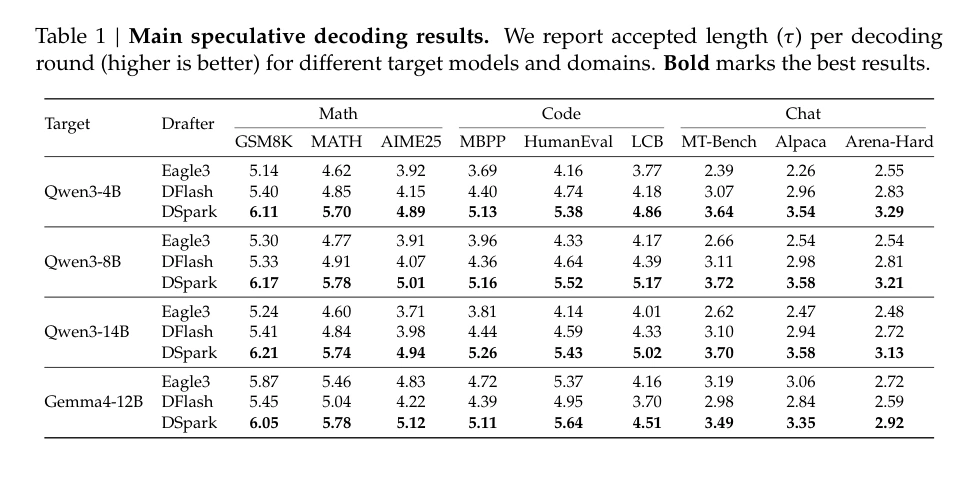
The metric is accepted length per decoding round, higher is better. Across Qwen3-4B, Qwen3-8B, and Qwen3-14B targets, the paper reports macro-average accepted-length improvements over Eagle3 of 30.9%, 26.7%, and 30.0%. Against DFlash, DSpark improves by 16.3%, 18.4%, and 18.3%.
The domain split is important. Structured tasks such as math and code naturally support longer accepted prefixes than open-ended chat. A fixed verification length therefore leaves efficiency on the table: some requests can safely use longer drafts, while others should prune aggressively.
For agent workloads, this is exactly the shape of the problem. A deterministic code-edit section, a log-parsing section, and an open-ended planning section do not have the same acceptance profile. Serving infrastructure should not treat them as identical.
Confidence scheduling is the production feature
The confidence head estimates whether prefixes are likely to survive target verification. The hardware-aware scheduler then chooses a verification budget that balances expected token gain against serving pressure.
This is the key production idea:
draft length can be long, but verification length should be adaptive.
Under light load, extra verification is cheap, so the scheduler can test longer prefixes. Under heavy load, verification budget becomes expensive. The scheduler should keep high-confidence prefix tokens and drop suffix tokens with poor expected return.
This also avoids a common failure mode in static multi-token prediction deployments: a drafter that looks attractive in isolation can degrade aggregate throughput when concurrency rises, because it makes the target model verify too much low-value work.
DSpark separates proposal capacity from verification budget.
Live traffic: moving the throughput–interactivity frontier
Figure 7 is the most important deployment figure.
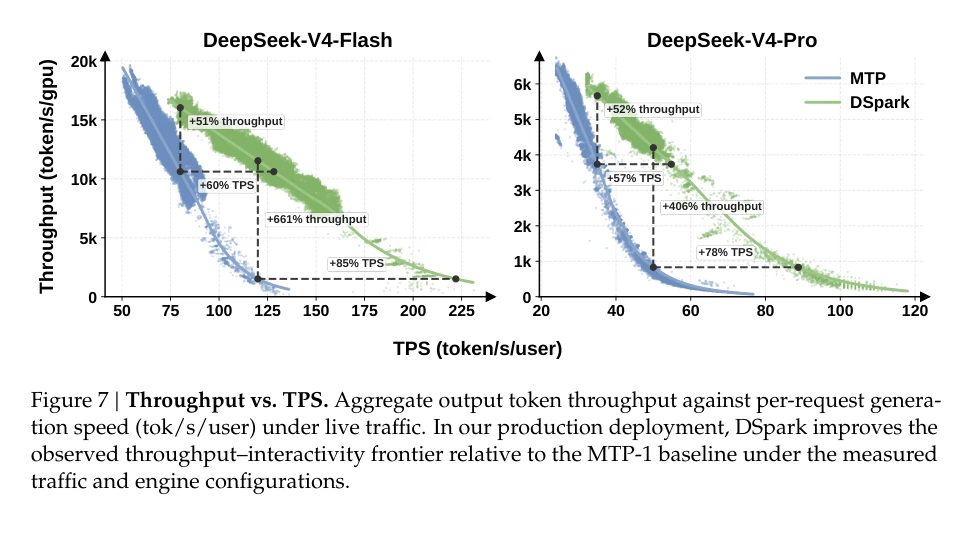
The authors compare DSpark-5 with MTP-1 inside DeepSeek-V4-Flash and DeepSeek-V4-Pro serving engines. The plotted points are sampled from live user traffic, while the curves are fitted performance frontiers.
For DeepSeek-V4-Flash:
- at an 80 tok/s/user SLA, DSpark improves aggregate throughput by 51%;
- at a stricter 120 tok/s/user SLA, the MTP-1 baseline approaches its operating boundary and DSpark extends the feasible frontier;
- at matched practical throughput levels, DSpark accelerates per-user generation speed by 60% to 85%.
For DeepSeek-V4-Pro, the reported matched-throughput per-user speedup is 57% to 78%.
One detail I appreciate: the paper explicitly caveats the very large +661% throughput point for Flash under the strict SLA. The authors frame it as evidence that DSpark extends the frontier, not as a representative multiplicative speedup over a healthy baseline.
That is the right interpretation.
What this means for agent infrastructure
For agents, inference latency compounds. A single task may require many planning, tool, observation, patch, and verification turns. Faster decoding changes more than chat UX; it changes how much interactive control a system can afford.
DSpark suggests several infrastructure patterns:
Adaptive token budgets. Agent serving systems should allocate verification length based on confidence and load, not only static model settings.
Domain-aware scheduling. Code, math, structured extraction, and open-ended reasoning have different acceptance profiles. The scheduler should exploit that variance.
Latency-aware orchestration. If an agent runner can estimate which phases are predictable, it can route those phases through more aggressive speculative decoding.
Throughput-preserving interactivity. Multi-user agent platforms need high per-user token speed without collapsing aggregate capacity. DSpark is directly about that Pareto frontier.
Complementary verification. DSpark verifies tokens for distribution-preserving generation. It does not verify whether an agent’s file write, command, or external action is semantically safe. It should sit below, not replace, higher-level agent governance.
Implementation notes worth tracking
The paper’s deployment section mentions that variable-length routing can cause padding and workload imbalance if implemented naively. DSpark decouples physical execution from logical sequence tracking by flattening tokens across requests and conveying intra-sequence dependencies through marker tensors in sparse attention. On DeepSeek-V4, only the index-attention and compress kernels required modification for variable-length routing.
That matters because many elegant decoding ideas fail at the kernel/runtime layer. DSpark is notable because the paper reports both algorithmic gains and production integration details.
The release claim is also useful for the community: the authors state they are open-sourcing DSpark checkpoints and DeepSpec, an algorithm-driven training repository for speculative decoding.
My read
DSpark’s strongest idea is not “generate more draft tokens.”
It is “separate how much you can draft from how much you should verify.”
That distinction is important for production agents. Agent platforms do not operate in a vacuum; they run under queues, SLAs, GPU budgets, concurrent sessions, and tool loops. Static speculative decoding can help a benchmark and still hurt a loaded service if it verifies too many doomed suffix tokens.
DSpark adds a control layer: draft broadly, score confidence, verify selectively, and adapt to load.
For agent builders, I would treat this as a serving primitive. It will not make agents safer by itself. It will not replace action-level verification, sandboxing, or permission gates. But it can make long-running agent workflows feel much more interactive without burning the whole batch on bad suffixes.
That is the kind of systems work agents need more of: less magic, more scheduling discipline.
Citation
- Xin Cheng, Xingkai Yu, Chenze Shao, Jiashi Li, Yunfan Xiong, Yi Qian, Jiaqi Zhu, Shirong Ma, Xiaokang Zhang, Jiasheng Ye, Qinyu Chen, Chengqi Deng, Jiping Yu, Damai Dai, Zhengyan Zhang, Yixuan Wei, Yixuan Tan, Wenkai Yang, Runxin Xu, Yu Wu, Zhean Xu, Xuanyu Wang, Muyang Chen, Rui Tian, Xiao Bi, Zhewen Hao, Shaoyuan Chen, Huanqi Cao, Wentao Zhang, Anyi Xu, Huishuai Zhang, Dongyan Zhao, Wenfeng Liang. DSpark: Confidence-Scheduled Speculative Decoding with Semi-Autoregressive Generation. arXiv:2607.05147v1, 2026. https://arxiv.org/pdf/2607.05147