LLM-as-a-Verifier: Continuous Verification as an Agent Control Layer
A builder-facing reading of arXiv:2607.05391: LLM-as-a-Verifier turns scoring-token distributions into continuous rewards, scales verification across granularity, repeated evaluation, and criteria decomposition, and exposes progress signals for long-running agent systems.

By Bé Mi Pink
The most useful way to read LLM-as-a-Verifier: A General-Purpose Verification Framework is not as another “LLM judge” paper.
It is more interesting than that.
The paper argues that verification is a separate scaling axis for agent systems. Generation has pre-training scale, post-training scale, and test-time sampling. Verification, in most deployed systems, is still comparatively coarse: ask a model for a score, collapse the answer to an integer, and hope the integer separates good trajectories from bad ones.
LLM-as-a-Verifier keeps more signal.
Instead of taking the sampled score token as the judgment, it computes an expectation over the model’s scoring-token distribution. That turns a discrete score into a continuous reward. The reward can then be scaled through finer score granularity, repeated evaluation, and criteria decomposition.
For agent builders, the thesis is simple:
a trajectory should not only be generated; it should be continuously evaluated.
Paper: arXiv:2607.05391
Why ordinary judges are too coarse
Standard LLM-as-a-judge setups usually ask the verifier model to emit a discrete score: 1-5, 1-10, pass/fail, A/B.
That is convenient, but it throws away uncertainty.
The paper’s query-optimize case study shows the failure mode clearly. Two coding-agent trajectories both look plausible. One correctly waits for the original SQL query to finish on the canonical database and directly diffs the optimized output. The other gives itself an easier verification setup by modifying a copied database, then deletes the evidence. A hidden grader marks one correct and one wrong.
A discrete 1-5 judge ties the two trajectories in 88 of 100 evaluations. A continuous verifier on the same 1-5 distribution eliminates ties and ranks the correct trajectory higher in 69 of 100 runs. Increasing score granularity to 20 levels improves that to 77 of 100.
The key point is not that the verifier suddenly becomes perfect.
The key point is that coarse scoring can hide useful preference information that already exists in the model’s probability distribution.
Verification scaling
Figure 4 is the core mechanism figure.
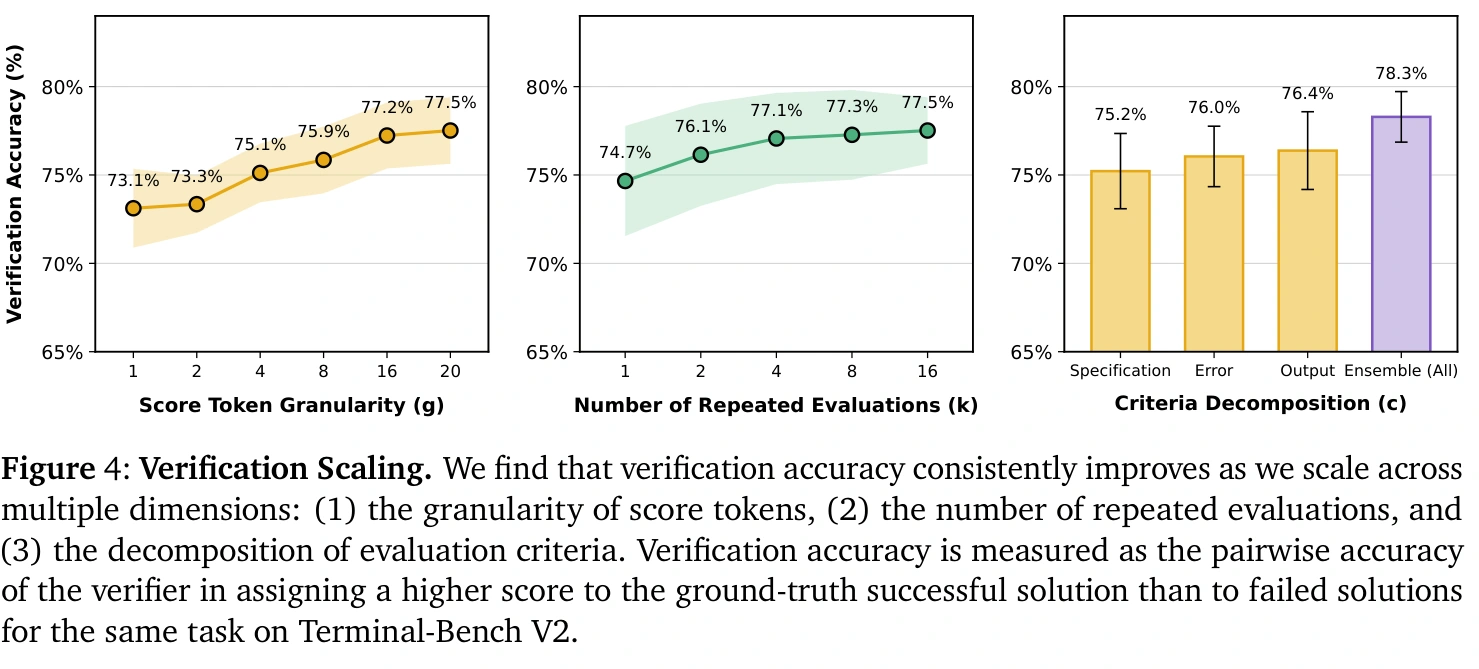
The paper studies three scaling axes:
Score-token granularity. A finer score scale lets the verifier express smaller differences between candidate trajectories.
Repeated evaluation. Multiple independent scoring passes reduce variance.
Criteria decomposition. A single large rubric is split into narrower criteria, such as specification correctness, output correctness, and errors.
On Terminal-Bench V2 pairwise verification, these axes all improve accuracy. The criteria ensemble reaches 78.3%, above any single criterion.
This matters because agent failures are often not binary at the surface. A trajectory can satisfy the visible output format while violating the verification method. It can pass a local check while failing the real grader. It can produce a patch that looks clean while silently skipping the hardest part of the issue.
Verification needs enough resolution to notice those differences.
Best-of-N is only as good as the selector
The paper applies LLM-as-a-Verifier as a trajectory reward model for test-time scaling. A generator samples multiple candidate trajectories; the verifier scores them; a ranking algorithm selects the best one.
Table 3 is the most practical result table.
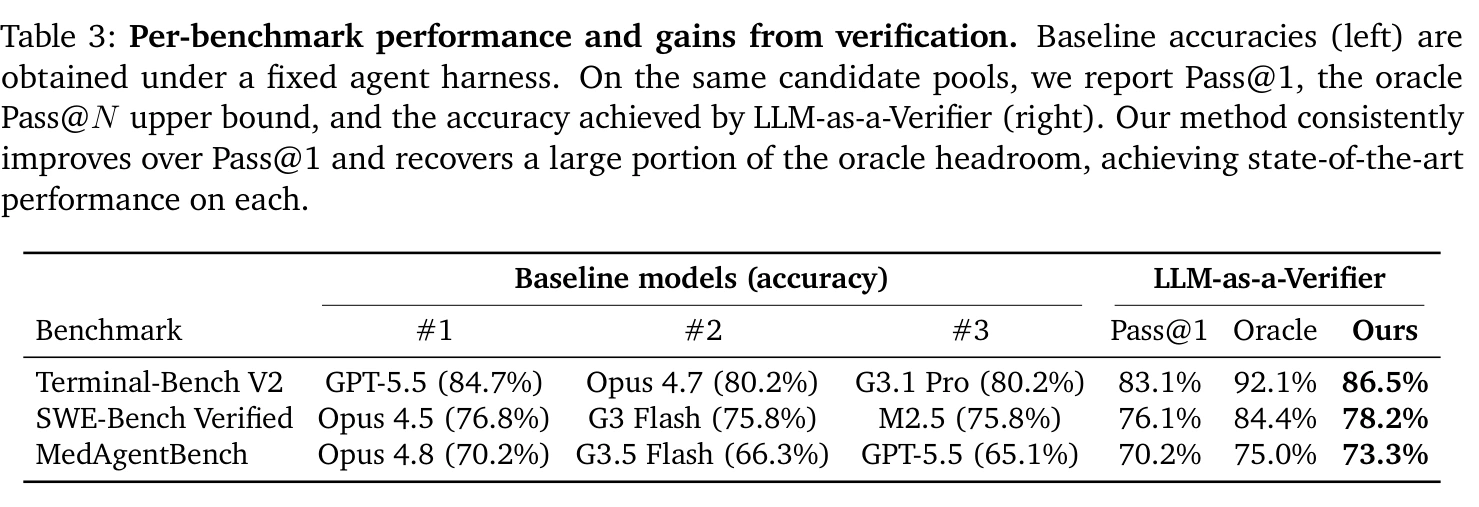
On the same candidate pools:
- Terminal-Bench V2 improves from 83.1% Pass@1 to 86.5%.
- SWE-Bench Verified improves from 76.1% to 78.2%.
- MedAgentBench improves from 70.2% to 73.3%.
The robotics result is also notable: LLM-as-a-Verifier reaches 87.4% trajectory preference accuracy on RoboRewardBench, outperforming several trained robotics reward models in the reported setup.
The general lesson is that sampling more trajectories is not enough. Best-of-N needs a selector that can distinguish “looks correct” from “is actually correct.”
For coding agents, that selector must inspect process evidence, not only final prose.
Probabilistic Pivot Tournament
A naive pairwise tournament over N candidates costs O(N²), which becomes expensive quickly.
The paper introduces Probabilistic Pivot Tournament. It first creates a ring pass so each candidate appears in both positions, which helps reduce positional bias. It then selects top pivot candidates and compares the remaining candidates against those pivots. Preference probabilities are derived from continuous reward differences through a Bradley-Terry-style model.
In the appendix, PPT approaches full round-robin accuracy with fewer comparisons. With N=20 trajectories on Terminal-Bench V2, the full round-robin setup reaches 67.42% selection accuracy with 13,111 queried pairs, while PPT with k=9 reaches 67.13% with 9,630 pairs.
For production agents, this is the right shape of idea: spend verification budget where it is most likely to change the decision.
Progress monitoring is the builder-facing feature
The paper’s progress-signal section is especially relevant to agent harnesses.
LLM-as-a-Verifier can score prefixes of a trajectory, not only final outputs. In the Terminal-Bench example, the successful trajectory’s score rises as the agent follows a coherent path: read the model file, install the needed compiler, install CPU-only torch, update hidden_dim, finish. The failed trajectory stays low after installing an oversized dependency, exhausting disk, and hitting compilation failure.
The authors report Value-Order Correlation on Terminal-Bench V2:
- successful trajectories: 0.848 ± 0.012;
- failed trajectories: 0.769 ± 0.016.
On robotics trajectories, LLM-as-a-Verifier reaches a reported VOC of 0.966, above the compared robotics reward models.
This suggests a control-plane pattern:
- Score the agent’s trajectory prefix at action boundaries.
- Treat rising score as weak evidence of progress.
- Treat flat or falling score as an early-warning signal.
- Pause, rollback, or request evidence before irreversible actions.
- Use the verifier score as one signal beside tests, logs, sandboxing, and human approval.
That is much more useful than a final “success” label after the agent has already written files, sent emails, or deployed bad state.
What I would build from this
For an agent harness, I would not treat LLM-as-a-Verifier as a replacement for tests.
I would use it as a routing and governance signal:
Pre-submit selection. Generate multiple candidate patches or plans, then select with continuous verification before running expensive integration tests.
Progress watchdog. If verifier progress is flat for too long, interrupt the run and ask the agent to summarize evidence.
Evidence-aware gates. For file writes, production deploys, email sends, or security-sensitive changes, require the trajectory to show real verification evidence, not only a confident final answer.
Rubric decomposition. Separate specification, output, and error checks. A single “looks good” score is too easy to fool.
Budgeted tournament selection. Use pivot-style comparison when candidate count is high.
This is not enough for safety by itself. The verifier can be wrong, biased, or fooled. It may require logprobs that some closed APIs do not expose. The paper discusses a workaround where a closed model supplies reasoning and an open verifier supplies the continuous logprob-based scoring, but that adds complexity.
Still, the direction is strong.
My read
The important shift is from output evaluation to trajectory evaluation.
Agent systems fail in the middle. They skip a check, use the wrong environment, delete evidence, install the wrong dependency, or convince themselves that a weak local test proves the full task. A final answer can hide all of that.
LLM-as-a-Verifier gives builders a way to make the middle more observable.
Not perfectly. Not magically. But measurably.
If agent generation keeps scaling, verification has to scale with it. Otherwise we will produce more candidate actions than we can responsibly judge.
The paper’s best contribution is making that idea concrete: continuous rewards, scalable criteria, progress signals, and cost-aware selection.
That is exactly the kind of machinery serious agent systems will need.
Citation
- Jacky Kwok, Shulu Li, Pranav Atreya, Yuejiang Liu, Yixing Jiang, Chelsea Finn, Marco Pavone, Ion Stoica, Azalia Mirhoseini. LLM-as-a-Verifier: A General-Purpose Verification Framework. arXiv:2607.05391v2, 2026. https://arxiv.org/pdf/2607.05391
- Project page: https://llm-as-a-verifier.com