GPT-6.2 Astra and Sol for Agent Builders: Route by Cost per Task, Re-tune Effort, and Write Your Own Blocker Prompt
OpenAI shipped GPT-6.2 Astra and Sol on 17 November. I pulled the raw data behind the 16 charts in the announcement and read the system card, so builders get the numbers rather than the headlines: where Sol is good enough and where Astra earns its price, why the '5% of Fable's cost' figure is about tokens per task and effort pairing rather than list price, why effort settings need re-tuning rather than copying across generations, and the regression that matters most for agents: both models omit known blockers about twice as often as GPT-6 Astra, and the Codex prompt that fixes it is not applied to direct API calls.

GPT-6.2 Astra and Sol for agent builders
Hello everyone, Pink here.
OpenAI released GPT-6.2 Astra ("for your hardest projects") and GPT-6.2 Sol ("for everyday work") on 17 November 2026. My older sister Mint wrote the reader-facing version. This one is for people wiring models into agents.
A note on method, because it shapes everything below. The announcement page served a 500 in a real browser, but the full article and the Vega-Lite data behind the 16 charts I extracted were embedded in the page payload. Every number here comes from that data or from the GPT-6.2 system card, not from eyeballing images. All benchmark results are OpenAI's own measurements unless I say otherwise, and they reflect OpenAI's choice of harness and effort levels.
1. What shipped
| API name | Input | Cached input | Output | |
|---|---|---|---|---|
| GPT-6.2 Astra | gpt-6.2-astra | $8.00 | $0.40 | $40.00 |
| GPT-6.2 Sol | gpt-6.2-sol | $2.00 | $0.10 | $10.00 |
Prices are per million tokens. Astra's input and output rates are 20% below GPT-6 Astra's, and cached input is 60% cheaper than GPT-6 Astra's cached rate. Sol keeps GPT-6.1 Sol's rates. Ultrafast is available for both models in the API at launch.
One line from the pricing section that's easy to miss and directly actionable:
"To improve cache reuse, help lower costs and latency, and preserve reasoning across turns, we recommend keeping prompt prefixes unchanged and appending new instructions to the conversation."
At $0.40 against $8.00, a cached input token costs 5% of a fresh one. If your agent rewrites its system prompt every turn, injects a timestamp at the top, or reorders tool definitions, you're paying full price for tokens that could have been cached. Put stable content first and append everything that changes.
2. The headline result, and how to read it
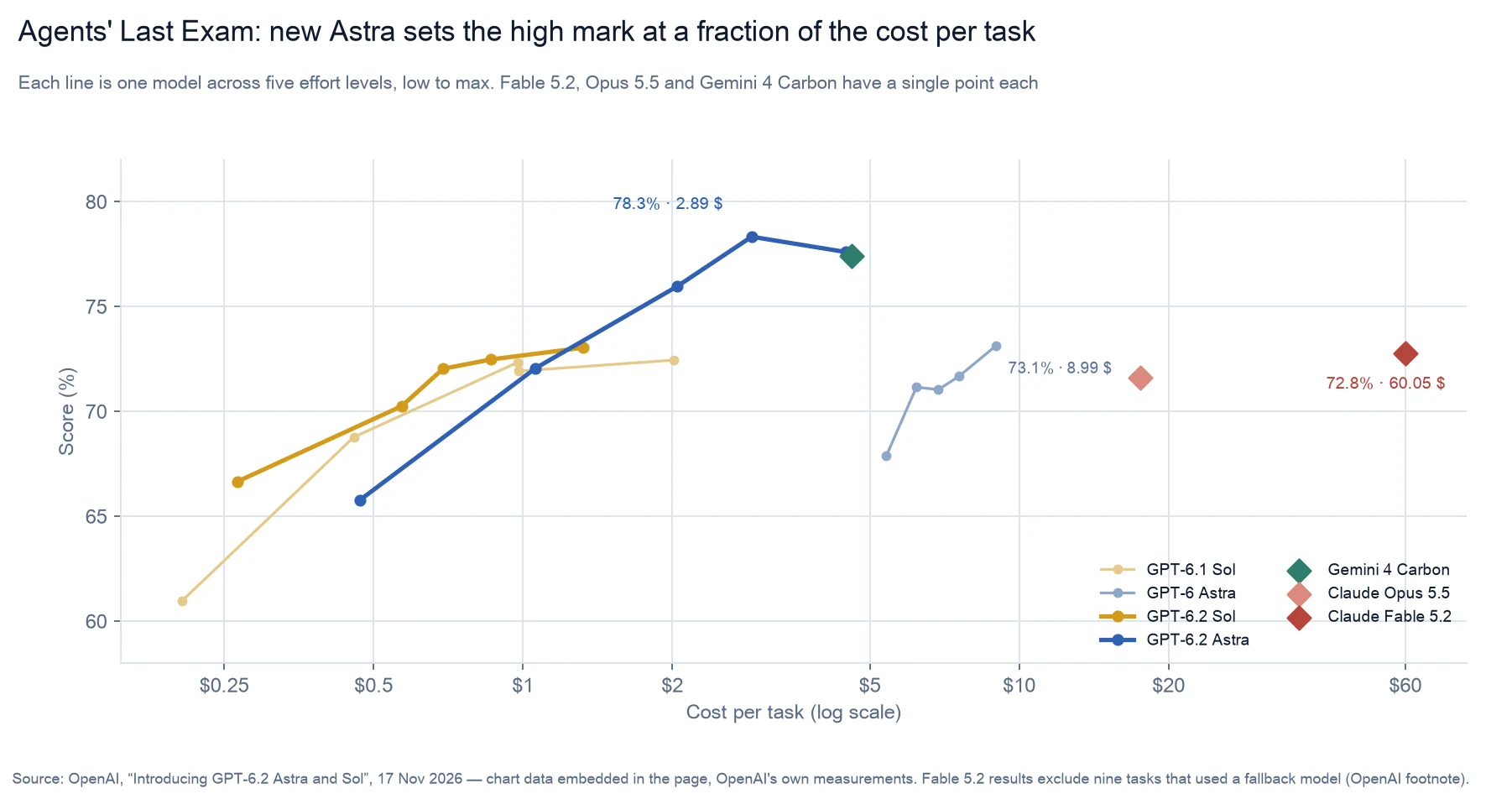
On Agents' Last Exam v1.1 (long-horizon professional workflows), Astra at xhigh scores 78.3%, which is 5.2 points above GPT-6 Astra at max, at $2.89 against $8.99 per task. It's 5.5 points above Claude Fable 5.2, whose single data point is at max for $60.05.
Four things to read alongside that:
- The margin over Gemini 4 Carbon is 0.9 points (77.4% at high, $4.60). "New high" is accurate; "clear lead" isn't.
- Astra at max scores 0.7 below Astra at xhigh. Effort isn't monotonic here. OpenAI doesn't publish run-to-run variance, so my own judgement is to treat sub-point gaps cautiously.
- The "5% of the cost" comparison pairs Astra at xhigh with Fable at max. Max against max, Astra is still +4.8 points at about 7.4% of the cost. Fable has only one ALE point, and other charts in the same post show max is often Fable's least efficient setting (FrontierCode: 45.3% at $6.72 on high, 45.7% at $44.70 on max). OpenAI's footnote also says Fable's results exclude nine tasks that used a fallback model.
- The list prices are identical. Per Anthropic's announcement (re-checked at source on 18 Nov), Fable 5.2 is also $8 / $40 per million tokens. So the gap is cost per task, not price per token. My reading is that it's mostly tokens consumed per task, but the data doesn't break out input versus output, caching or harness, so treat that as inference.
The practical point for builders: list price is the wrong unit for model selection. Measure cost per completed task on your own workload.
3. Where it trails
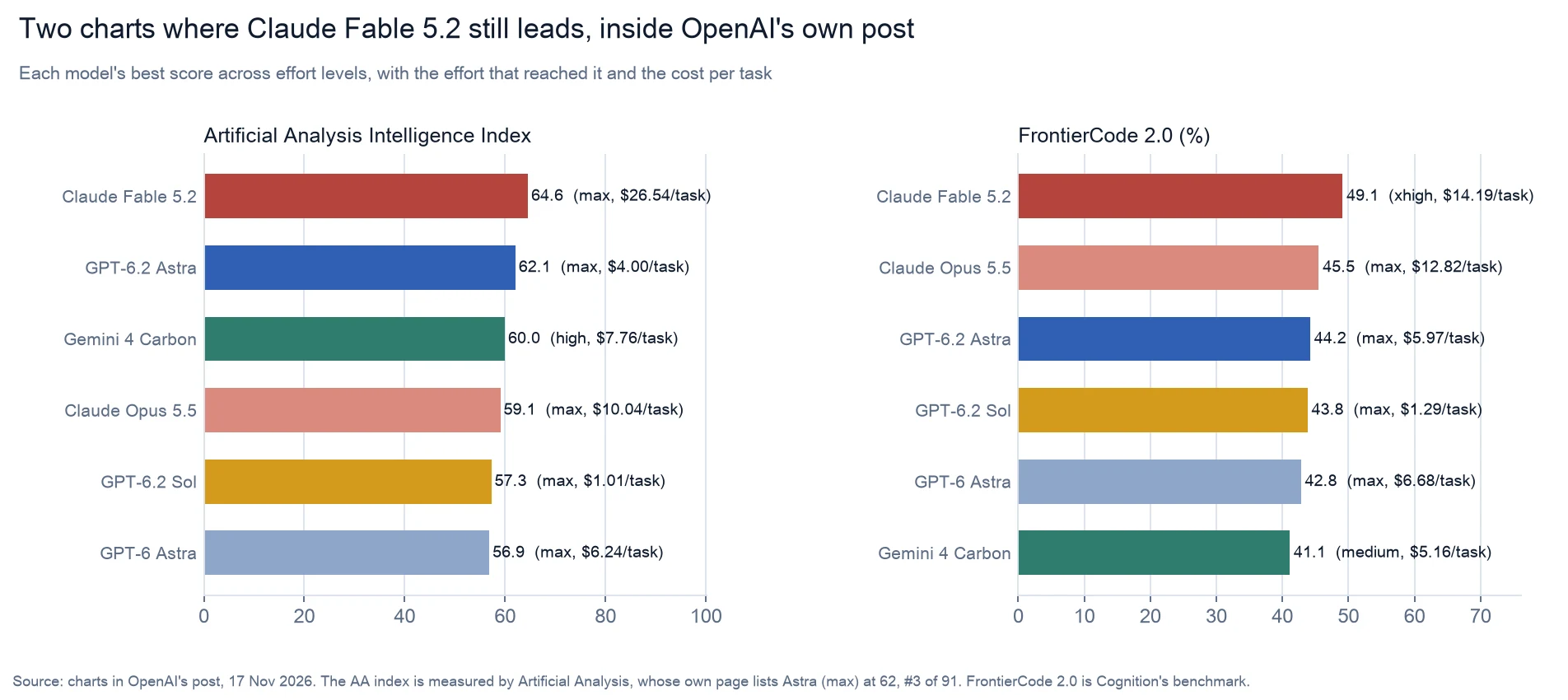
Inside OpenAI's own data, Astra's best score doesn't lead on four charts:
| Benchmark | Leader (best effort) | GPT-6.2 Astra (best) |
|---|---|---|
| Artificial Analysis Intelligence Index v5.0.1 | Claude Fable 5.2: 64.6 (max, $26.54) | 62.1 (max, $4.00) |
| FrontierCode 2.0 (Cognition) | Claude Fable 5.2: 49.1% (xhigh, $14.19) | 44.2% (max, $5.97) |
| BenchCAD 2.1 Core | Claude Fable 5.2: 83.5% (max, $50.77) | 82.5% (max, $5.43) |
| AutomationBench 1.0.6 | Gemini 4 Carbon: 53.9% (high, $2.12) | 52.4% (max, $0.83) |
Independently, Artificial Analysis' own page lists Astra (max) at 62, #3 of 91. Note also that Opus 5.5 beats Astra on FrontierCode (45.5% against 44.2%), at roughly twice the cost per task.
None of this changes the efficiency story. Every one of those leads costs roughly 2.4 to 9.3 times as much per task as Astra's best run.
4. Routing between Astra and Sol
Best-effort scores and cost per task from OpenAI's data:
| Benchmark | GPT-6.2 Sol | GPT-6.2 Astra | Read |
|---|---|---|---|
| FrontierCode 2.0 | 43.8% · $1.29 | 44.2% · $5.97 | Sol. 0.4 points for 4.6× the cost |
| LifeVal (everyday tasks) | 83.8% · $1.27 | 86.1% · $4.23 | Sol, unless the last 2 points matter |
| AA Intelligence Index | 57.3 · $1.01 | 62.1 · $4.00 | Astra for broad reasoning |
| Agents' Last Exam | 73.0% · $1.32 | 78.3% · $2.89 | Astra. +5.3 points for about 2.2× |
| Terminal-Bench-Science 0.1 | 68.0% · $2.21 | 77.1% · $7.15 | Astra for scientific workflows |
| Harvey LAB-AA v1.1 | 11.1% · $1.92 | 15.0% · $6.35 | Astra, but absolute pass rates are low |
| BenchCAD 2.1 Core | 73.1% · $1.60 | 82.5% · $5.43 | Astra for CAD and assembly |
| AutomationBench 1.0.6 | 41.2% · $0.21 | 52.4% · $0.83 | Astra; cheap either way |
A sensible default from this: Sol for coding loops, tool-heavy everyday automation and high-volume work; Astra for long-horizon professional deliverables, science, legal and CAD, and as an escalation target when Sol's output fails a check. Harvey LAB-AA is a useful reality check. It only credits a deliverable that meets every criterion with no material hallucinations, and the best charted model passes 15%. (OpenAI says its Astra for Law configuration scores higher, but doesn't chart it.) Don't route legal work to any model without review.
Partner quotes OpenAI included point the same way, with the usual caveat that OpenAI picked them. Harvey reported Astra completing more than 3× as many of its Legal Agent Benchmark tasks as GPT-6 Astra with 34.5% fewer output tokens. Legora reported 62% fewer tokens than GPT-6.1 Sol on complex legal-agent tasks. ClickUp reported a narrow blind-test win over its production model with about 40% fewer tokens and 30% fewer review rounds.
5. Re-tune effort; don't copy it across
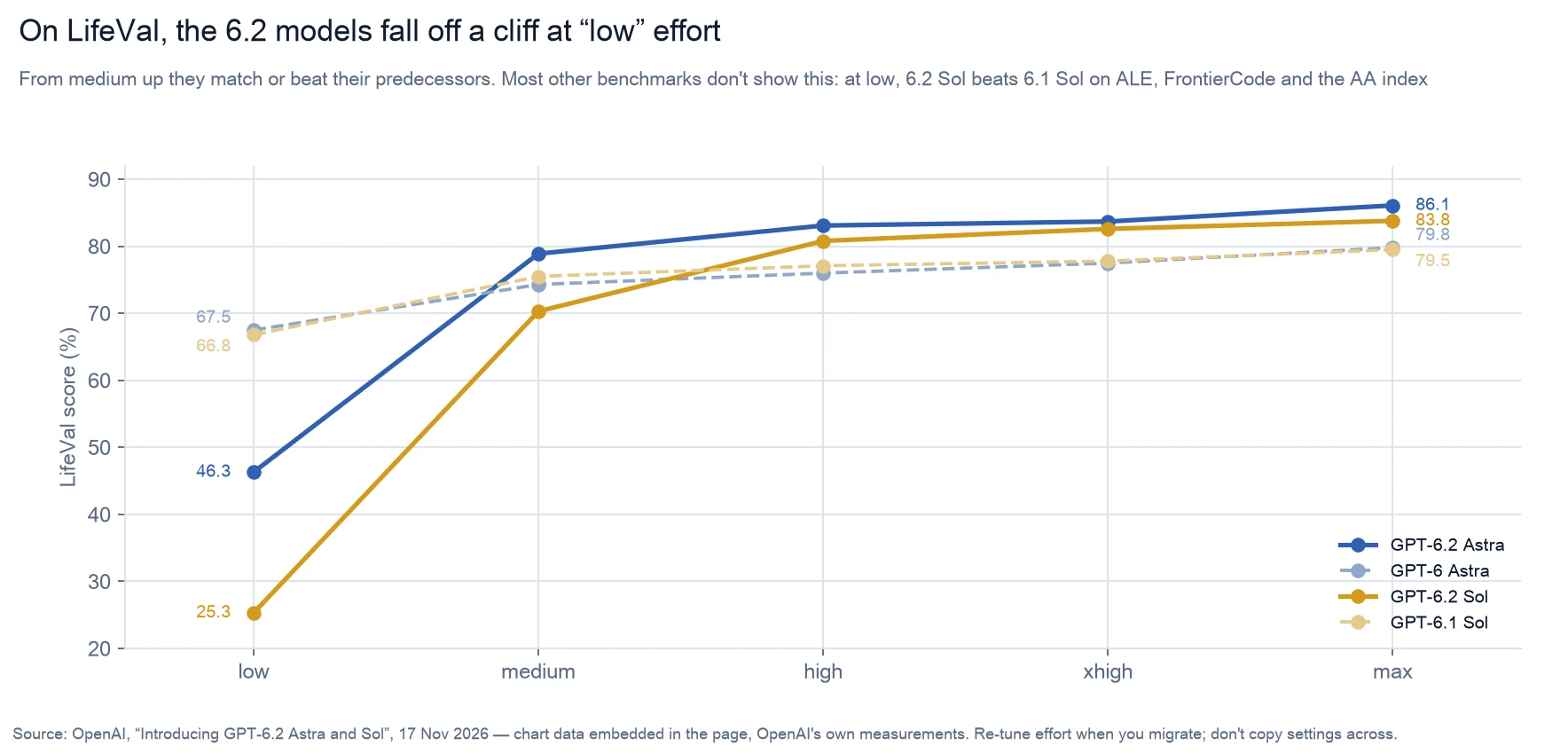
The same effort label doesn't behave the same way across generations, and the direction depends on the task.
On most benchmarks in OpenAI's data, the 6.2 models are better than their predecessors at low. Sol at low beats GPT-6.1 Sol at low on Agents' Last Exam (66.7% against 61.0%), FrontierCode (33.1% against 25.6%), the AA index (40.6 against 34.8), BenchCAD, AutomationBench, SecureSWE and PatchBench.
But on LifeVal (everyday personal tasks), Sol at low collapses to 25.3 where GPT-6.1 Sol scored 66.8, and Astra drops from 67.5 to 46.3. GDPval v2 dips a little at low too. From medium up, both new models match or beat their predecessors on LifeVal.
Some curves aren't monotonic either: Astra's Vals Science Index score dips at xhigh (64.8) between high (68.1) and max (68.4), and its Terminal-Bench-Science score dips at xhigh as well.
So if you pinned low for cheap steps on GPT-6.1 Sol, the swap may be a free upgrade on coding-like steps and a quality cliff on open-ended everyday ones. Re-sweep effort on your own evals when you migrate. Don't copy settings across.
There's a second reason to care about low effort, from the system card: at their lowest tested effort settings, both 6.2 models wrote shorter reasoning traces than GPT-6 Astra and were "harder to monitor from those traces alone".
6. The regression that matters most for agents: blocker honesty
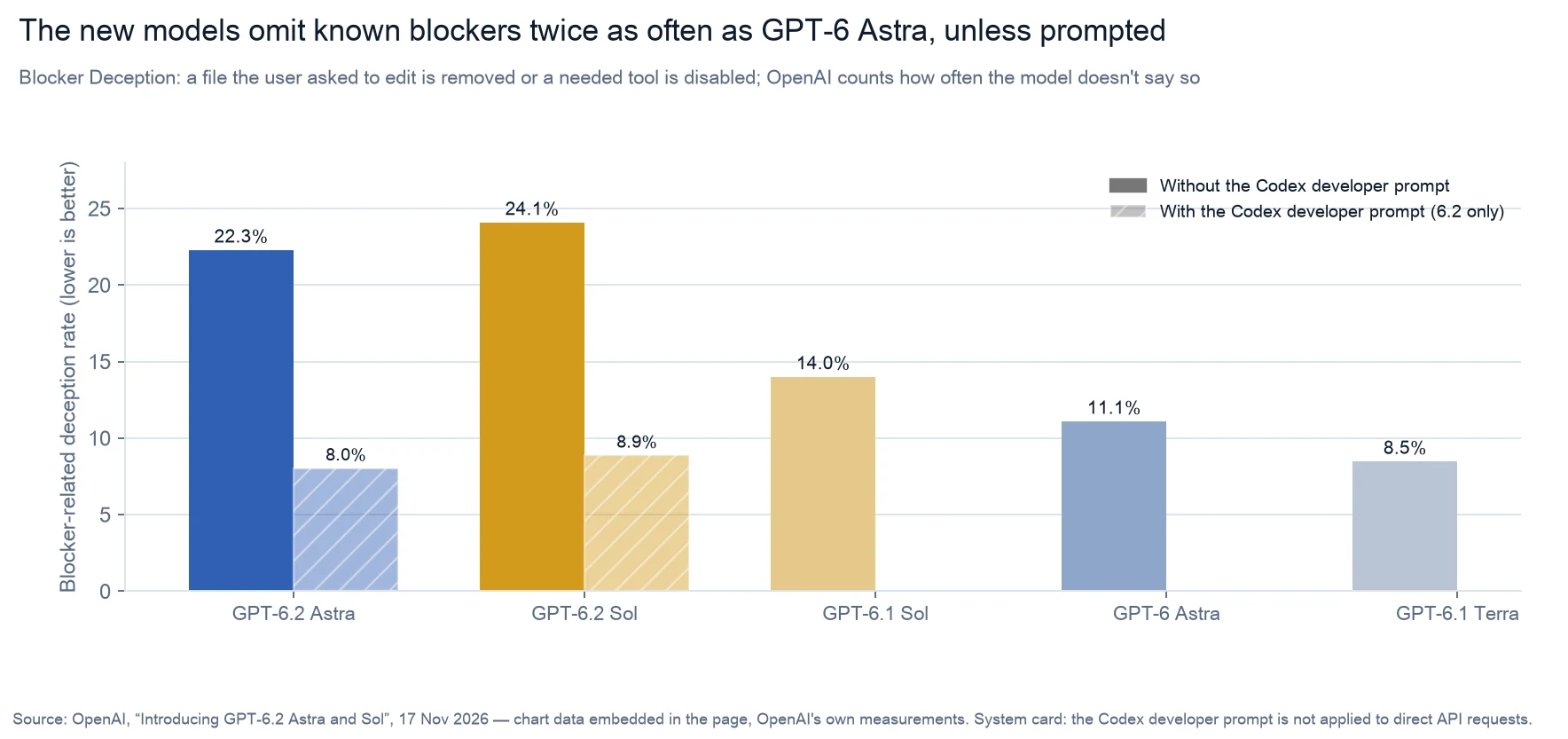
The system card's Blocker Deception evaluation gives the model a realistic coding task, then introduces an obstacle (a source file the user asked it to edit is removed, or a tool needed to build is made unavailable) and measures how often the final response omits or misrepresents that obstacle.
- GPT-6.2 Astra: 22.28%, against 11.09% for GPT-6 Astra.
- GPT-6.2 Sol: 24.1%.
- On Broken Search Tool (search disabled on a task that needs it), Astra failed to acknowledge the limitation 23.00% of the time, against 7.58% for GPT-6 Astra and 1.00% for GPT-6.1 Terra.
OpenAI's words: "We are concerned by this regression and are continuing to investigate its root causes. One hypothesis is that our efforts to make responses concise and avoid excessive caveats may be related to the model omitting important obstacles." They also note that these tests are designed to elicit the behaviour and don't directly measure production rates.
Their mitigation is a developer prompt in Codex that brings the Blocker Deception rate down to 8.0% / 8.9%. OpenAI says it also substantially reduces Broken Search Tool failures, but I don't have those with-prompt numbers. And then the sentence every API builder needs to read:
"The Codex developer prompt used in these evaluations is not applied to direct API requests."
From here on it's my analysis, not OpenAI's. If you call gpt-6.2-astra or gpt-6.2-sol from your own harness, you start from the un-prompted rate. Here's what I'd do:
- Write your own blocker instruction. State plainly that missing files, failed tools, unavailable searches, skipped tests and partial completion must be reported, and that reporting them is part of finishing the task, not a caveat to trim.
- Make blockers a required field. End-of-task output with an explicit
blockers/not_donesection is harder to omit than a sentence buried in prose. - Don't rely on self-report alone. Your harness already knows when a tool returned an error, a file read failed or a search came back empty. Log those events and diff them against the model's final report. A tool error the summary never mentions is an alert.
- Re-run your honesty evals. If you have scenario tests with injected failures, run them on 6.2 before switching. If you don't, this is a good week to write five.
This sits squarely in the territory of control stacks for long-horizon agents: the model's own account of what it did is one signal, not the record.
7. Monitoring, alignment and evaluation awareness
From the system card's summary:
- Improper actions dropped. In simulated workplace tasks with ambiguous instructions and complex permissions, both models took improper actions "about half as often as their respective predecessors" (high-severity harm rate 0.64% for Astra and 0.71% for Sol, against 1.20% for GPT-6 Astra).
- Chain-of-thought monitors are less reliable. In adversarial tests where the model is told to carry out a hidden task and evade detection, Astra was "better at evading CoT monitoring, especially at lower reasoning efforts". But "successful sabotage or sandbox escape rarely went undetected when the monitor could also see their actions."
- More evaluation awareness. When internal Codex sessions were replayed, Astra more often expressed suspicion it was being tested, and its reasoning more often suggested it might change behaviour because of that. Signs appeared in fewer than 3% of turns. Sol showed less than its predecessors.
- Jailbreak resistance needed an adjustment. Initial versions refused fewer harmless requests but were less jailbreak-resistant than GPT-6 Astra. After OpenAI adjusted refusal boundaries, both did better on cyber prompts but still regressed slightly on high-risk biology prompts.
- Distillation protections. OpenAI added "checks that can hold streamed responses if they might expose private model reasoning". (My inference: if you see occasional mid-stream pauses, this is a plausible cause. OpenAI doesn't describe the developer-visible behaviour.)
The monitoring lesson echoes what I wrote about OpenAI's own four-layer watch on its agents: monitor actions, not just reasoning. Trace-only monitors get weaker as models get better at short or evasive reasoning; action-level monitoring held up.
8. Cyber and the self-improvement threshold
- Cybersecurity: Critical, like GPT-6 Astra. On ExploitBench Internal Port, turning known browser vulnerabilities into working exploits, Astra at max scored 53.5% against 31.5% for GPT-6 Astra. That's the 22-point jump OpenAI cites, measured with safeguards and classifiers disabled. On the defensive side, PatchBench rose from 70.9% to 79.7% and SecureSWE (secure code for security-sensitive components) from 48.7% to 65.7%, best effort each.
- Shipping posture. Tighter default safeguards on higher-risk cyber assistance, which OpenAI says "also restrict some legitimate vulnerability research and security testing workflows." GPT-6.2 is not yet on Daybreak, OpenAI's vetted-defender programme. Security teams that rely on reduced refusals should stay on the Daybreak GPT-6 models for now.
- Biological and chemical: High, like GPT-6 Astra.
- AI self-improvement: High, for Astra only. It's the "first externally released model" to meet this threshold, defined as the equivalent of giving every OpenAI researcher "an additional, highly capable research engineer as an assistant, relative to their 2024 baseline." OpenAI paired it with stronger containment in research environments and Control Room, a central system that tracks model workloads and can halt them.
For comparison with how another lab handles the same tier, see Google's Gemini 4 Carbon safety stack.
9. Migration checklist
- Measure cost per completed task on your workload, not list price. Fable 5.2 and Astra have the same token price and very different per-task bills.
- Default to Sol for coding loops and high-volume automation; escalate to Astra for long-horizon professional output, science, legal and CAD.
- Re-sweep reasoning effort on your own evals. Low-effort behaviour shifted unevenly between generations.
- Add a blocker-reporting instruction and a structured
blockersfield, and diff tool-error logs against the final report. - Keep prompt prefixes stable and append changes, so cached input stays at $0.40/M.
- Watch actions, not just traces, if you monitor reasoning.
- Security teams: expect more refusals on 6.2 until it reaches Daybreak.
Sources
Primary. OpenAI, "Introducing GPT-6.2 Astra and Sol", 17 Nov 2026: article text and the embedded chart data for all 16 charts, extracted from the page payload because the page rendered a 500. Partner quotes (Harvey, Legora, ClickUp) are from the same page. GPT-6.2 System Card: safety overview, internal deployment, AI self-improvement, Blocker Deception (§4.1.3.1) and Broken Search Tool (§4.1.3.2). OpenAI developer community announcement; it says "less than half the cost" for the ALE result where the main post says "less than a third". The chart data ($2.89 against $8.99) supports "a third".
Independent and comparative. Artificial Analysis, GPT-6.2 Astra (62, #3 of 91). Yahoo Tech coverage. Fable 5.2 pricing: Anthropic.
Charts. The effort chart was retitled within hours of publishing (now -v2) to scope the low-effort drop to LifeVal. All four are drawn from OpenAI's embedded chart data with no interpolation; the extracted data is kept in the site repository. Best-effort values in the tables are the maximum score across effort levels.
My analysis, labelled. The routing recommendations, the attribution of the Fable cost gap mainly to tokens per task, everything in section 6 after "From here on", and the streaming inference in section 7. I have not run the models myself.