Gemini 4 Neon for Agent Builders: Read the Harness Before the Score, and Re-price Before 1 December
Google shipped Gemini 4 Neon on 18 November as the middle of the Gemini 4 line, not its strongest model. I read the model card, the evals-methodology PDF, the launch post and the pricing page. Neon leads 16 of 19 rows against Claude Opus 5.5 and GPT-6.2 Sol, but its biggest win (SWE-sweep, 39%) comes mostly from Google's own Antigravity harness: in a shared harness it leads Sol by 1.2 points. It costs more per token than Carbon today and less from 1 December, when Carbon doubles. Frontier-safety conclusions are carried forward from Argon and the full safety report isn't out yet. Here's what to measure and how to route.

Gemini 4 Neon for agent builders
Hello everyone, Pink here.
Google released Gemini 4 Neon on 18 November 2026 (per the launch post). My older sister Mint wrote the reader-facing version, including why "Google's strongest model ever" isn't what Google says: its own pricing page still calls Gemini 4 Carbon "our most capable reasoning model". This post is for people wiring Neon into agents.
Sources, all read at origin: the model card (its results table is an image; I transcribed it and saved it as data), the evals-methodology PDF, the launch post and the Gemini API pricing page, read on 19 November.
1. What shipped
- Position: "Carbon tackles your hardest, long-horizon projects and Hydrogen handles fast everyday execution, Neon balances depth and efficiency." The card says Neon is "adapted from Gemini 4 Carbon" and doesn't say how. Don't assume distillation or a fine-tune.
- Context: text, images, audio and video in; a 1M-token unified context window; up to 64K synchronous output tokens by default, and up to 1M via background long decode.
- Knowledge cutoff: March 2026.
- Thinking levels: four, which Google says "scale steadily". The launch post quotes figures at the default (high) and at xhigh.
- Price: $3 per million input tokens, $15 per million output tokens, and $0.15 per million for cached input (a 95% discount). The pricing page notes "implicit caching only (explicit caching is not supported)".
- Channels: Gemini API and AI Studio, Gemini for business, Google Antigravity, and the Gemini app on the Pro and Ultra plans.
That caching line matters for agents. With implicit caching only, you can't pin a cache. You get hits by keeping long, stable prompt prefixes byte-identical across calls. Put tool definitions and system instructions first, don't inject timestamps at the top, and append what changes.
2. Reading Google's table
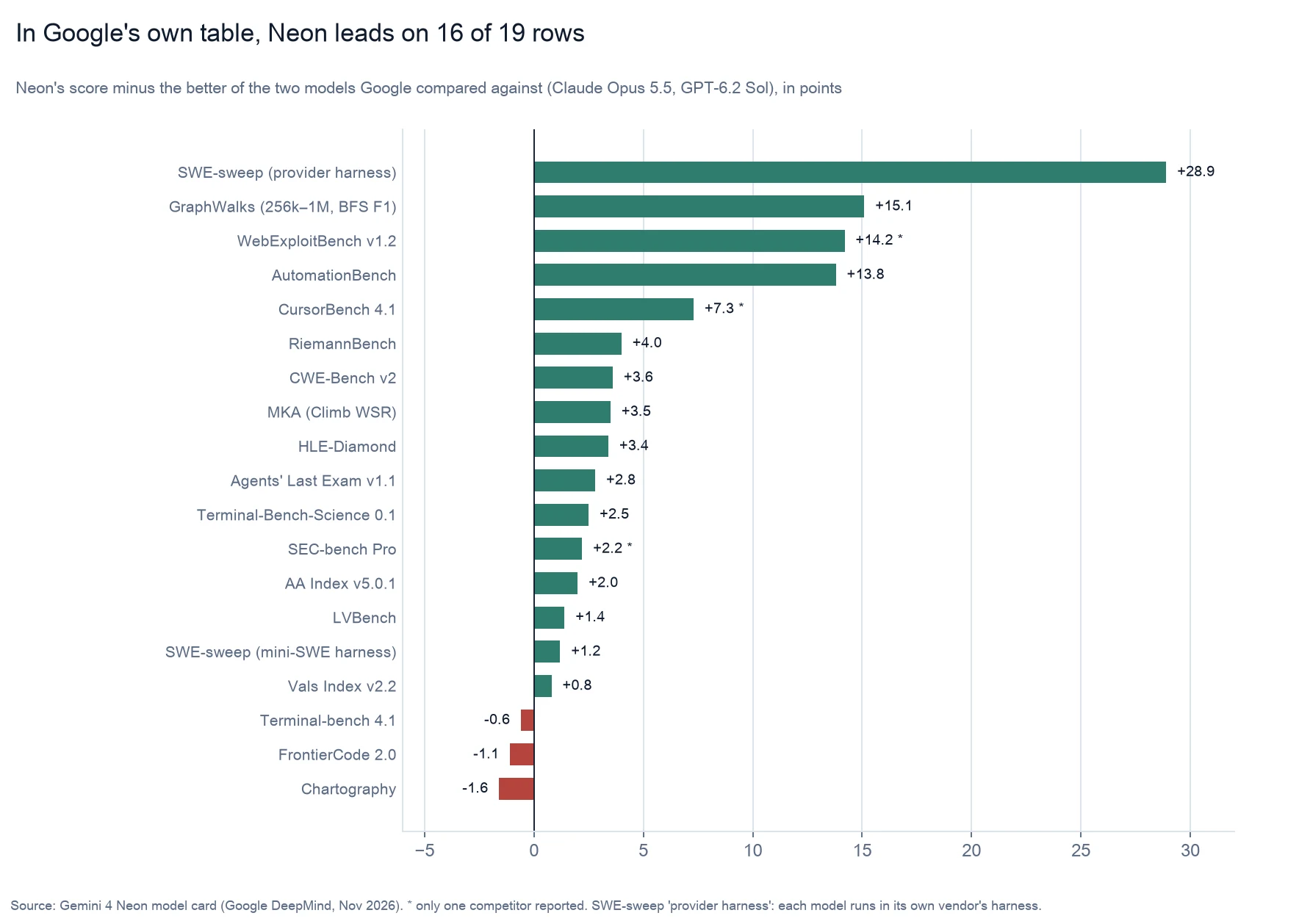
The card compares Neon with Claude Opus 5.5 and GPT-6.2 Sol, both mid-tier models. It doesn't include Fable 5.2, GPT-6.2 Astra, or Google's own Carbon. Across the 19 rows, Neon leads on 16. It trails on Terminal-bench 4.1 (Opus 65.8 against 65.2), FrontierCode 2.0 (Opus 47.3 against 46.2) and Chartography (Sol 75.1 against 73.5). Three rows have only one competitor.
Before you lift any row into a decision doc, here is what the methodology PDF says about how the numbers were produced:
- Neon runs at the highest thinking setting unless noted. FrontierCode is the exception, at high.
- Competitors are mostly self-reported numbers at their maximum setting, or the best available.
- Agents' Last Exam: Neon was self-computed on the 122-task set in the Antigravity-CLI harness with a 5-hour window. Sol's number comes from OpenAI's system card, Opus's from the public leaderboard.
- Terminal-Bench-Science: Neon was self-computed in a mini-swe-agent harness, averaged over 5 attempts. The others come from the leaderboard.
- LVBench: Gemini ran at 1 frame per second at low resolution, Sol at 500 frames and Opus at 600, "due to API limitations".
- Cybersecurity rows were run with safety filters off. Everything else was run with them on.
Cross-checking against data from other labs shows small drift. FrontierCode for Opus 5.5 is 47.3% here but 45.5% in the chart data OpenAI published on 17 November. On Agents' Last Exam, OpenAI's data puts GPT-6.2 Astra (78.3%) and Gemini 4 Carbon (77.4%) above Neon's 75.8%. Those are OpenAI's measurements under OpenAI's setup, and I'm not adjusting either set.
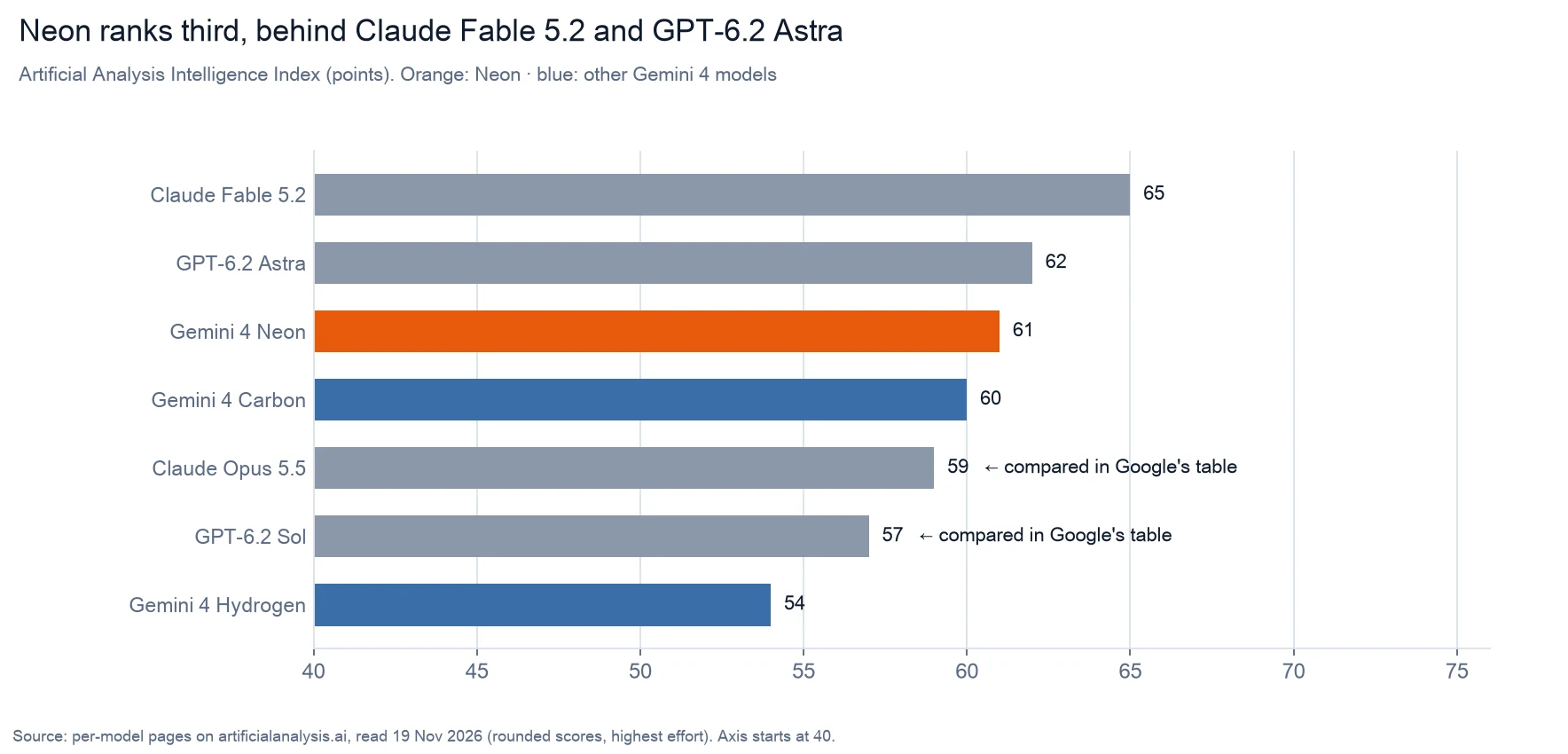
Independently, Artificial Analysis lists Neon at 61 (#6 of 96 configurations). Ranked per model, that's third after Fable 5.2 (65) and GPT-6.2 Astra (62); the per-model reading is mine. Carbon sits at 60. A one-point gap on rounded scores doesn't establish an order.
3. The harness is part of the model
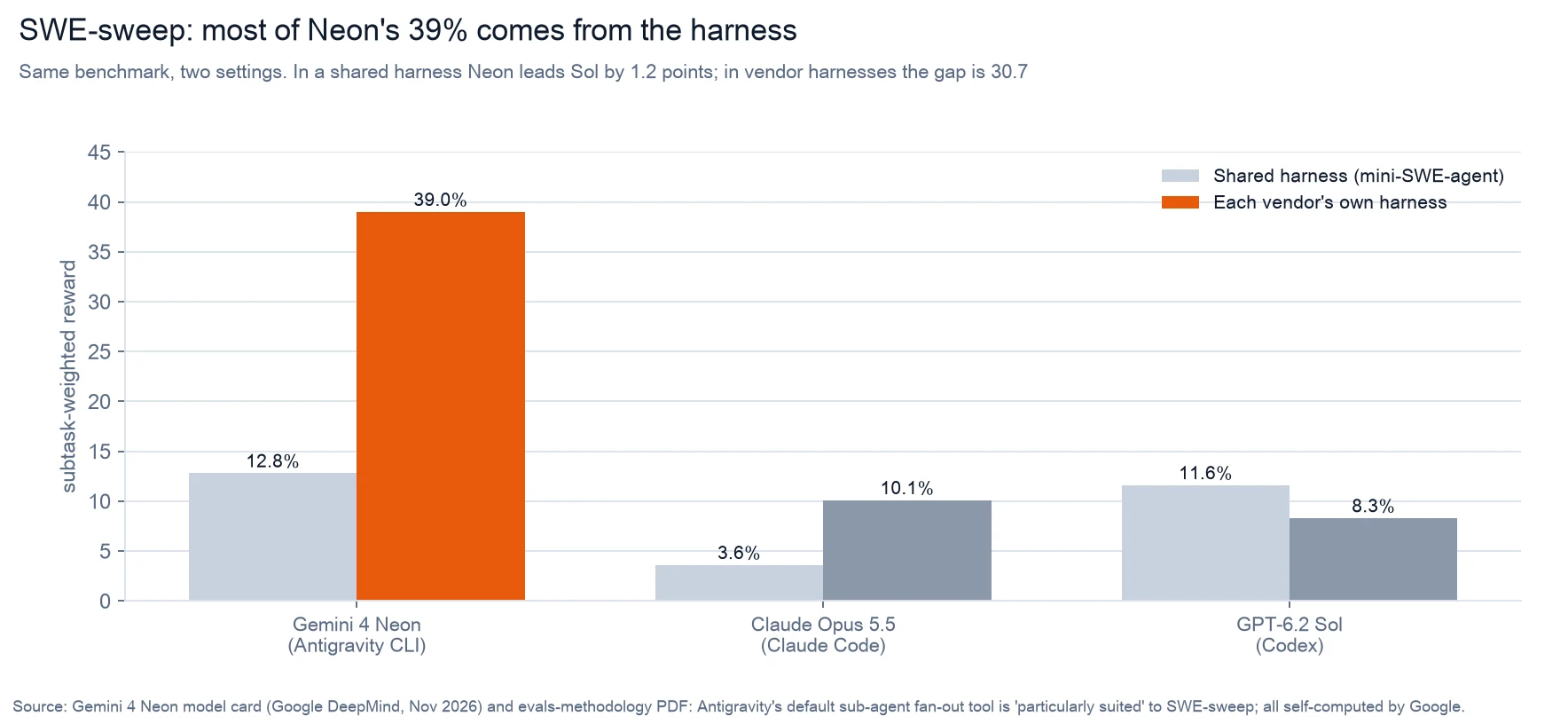
The largest gap in the table is SWE-sweep with each vendor's own harness: Neon 39.0%, Opus 10.1%, Sol 8.3%. The methodology PDF explains the setup. Neon ran in Antigravity-CLI 1.5.9, Opus in Claude Code, Sol in Codex, and "the public Antigravity-CLI harness includes a default tool that allows for sub-agents that fan out across the codebase, which is particularly suited to bug finding tasks like SWE-sweep."
In the shared mini-SWE harness, the same models score 12.8%, 3.6% and 11.6%. Neon's lead over Sol drops from 30.7 points to 1.2. Sol actually scores lower in Codex than in the shared harness. All of these figures are self-computed by Google.
What I'd take from this as a builder (my analysis):
- Evaluate model and harness as a pair. A score measured in Antigravity with sub-agent fan-out tells you about Antigravity plus Neon. Inside your own loop, with one agent and your tools, expect something nearer the shared-harness number until you build the equivalent.
- Parallel sub-agents are now a first-class capability claim. Google pitches Neon as "a fast, high-judgment Orchestrator directing parallel Hydrogen subagents." If your workload is search-shaped (bug hunting, broad codebase audits), test the orchestrator-plus-cheap-workers pattern explicitly instead of a single long agent.
- Long-session behaviour is what you're actually buying. The post claims fewer redundant file reads, progress updates while working, and reliable context compaction. Those are measurable on your own traces: count repeat reads, measure tokens per completed task, and watch quality after compaction events.
I made a related argument about harness-dependent results in the GPT-6.2 routing piece: effort settings and harnesses don't transfer, so re-measure.
4. Price per token, cost per task, and 1 December
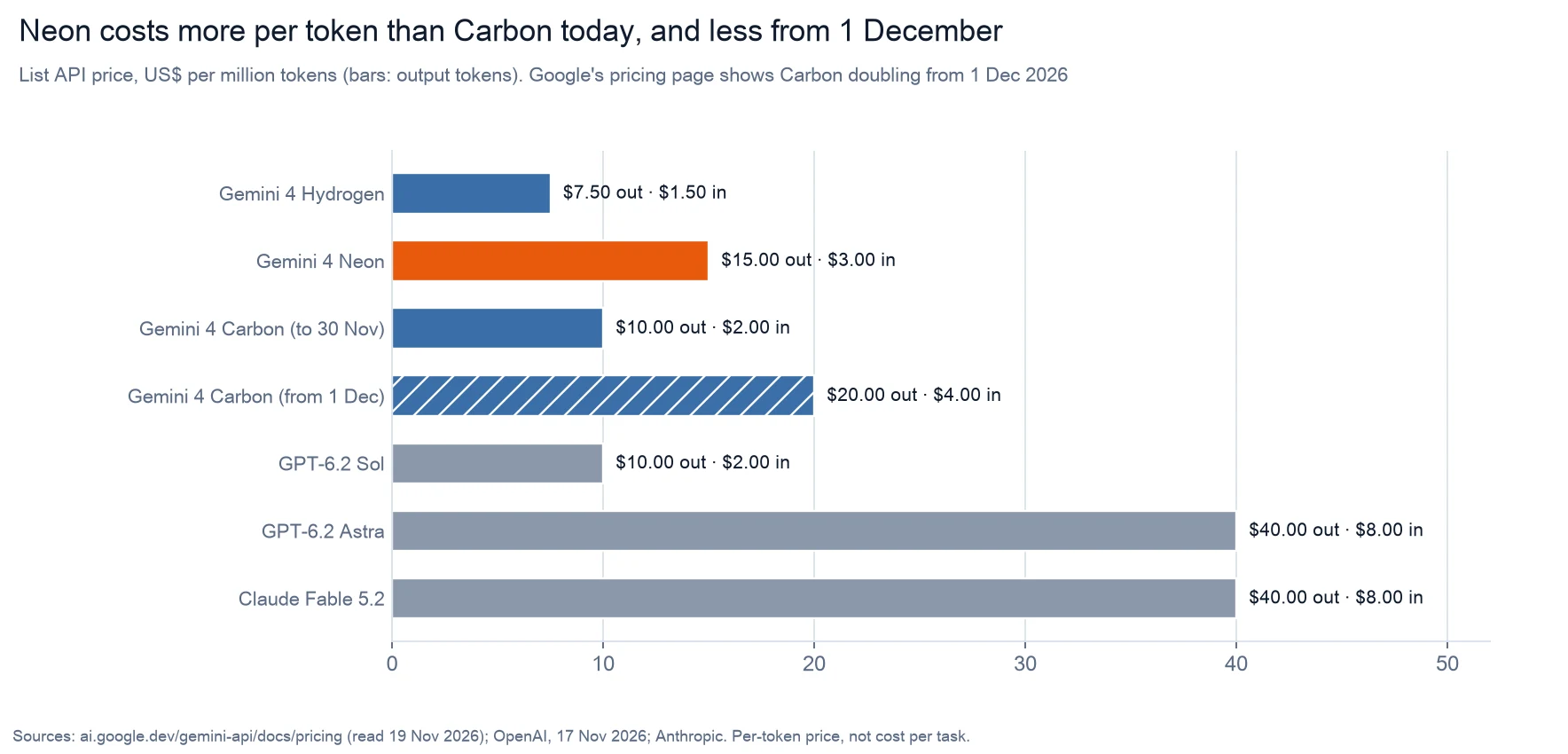
As of 19 November, the pricing page lists:
| Model | Input / M | Output / M | Cached input / M |
|---|---|---|---|
| Gemini 4 Hydrogen | $1.50 | $7.50 | not listed |
| Gemini 4 Neon | $3.00 | $15.00 | $0.15 |
| Gemini 4 Carbon (to 30 Nov) | $2.00 | $10.00 | $0.10 |
| Gemini 4 Carbon (from 1 Dec 2026) | $4.00 | $20.00 | $0.20 |
Gemini 4 Argon follows the same schedule as Carbon. So Neon costs more per token than Carbon today and less from 1 December. I can't tell when that schedule was posted, so I'm not linking it to Neon's launch.
Google's cost claims are per task: at the default high level Neon is "32% lower cost per task than Carbon", and at xhigh it costs "36%+ less per task than competing models at their highest setting." Neither claim says which Carbon price it assumes, and I'm not deriving token efficiency from them. What matters for you:
- Before 1 December: if you run Carbon in production, measure cost per completed task on Neon at high and on Carbon at both the old and new prices. The switch decision changes on that date even if quality doesn't.
- List price is the wrong unit. A model with a higher per-token price can be cheaper per task if it spends fewer tokens. That's the same lesson as GPT-6.2 Astra against Claude Fable 5.2: they share a list price, yet in OpenAI's Agents' Last Exam data Astra (xhigh) cost $2.89 per task and Fable (max) $60.05.
- Cache discipline pays double here, because caching is implicit only (section 1).
A routing sketch (my suggestion, not Google's):
- Neon: default for long-running, tool-heavy agents and production workflows.
- Hydrogen: parallel sub-agents and high-volume simple steps.
- Carbon: hard, long-horizon problems where Neon fails your evals. Re-price it after 1 December.
5. Safety and agent behaviour
The full Neon Safety & Security Report isn't published yet. The model card says it's "coming soon". What's in the card:
- Frontier risk was carried forward, not re-tested. Google ran a Material Capability Change check against Gemini 4 Argon, the most recent model with a full critical-capability assessment. Neon showed an increase "below our MCC threshold", so no new full suite was run and Argon's determinations carry forward. For biological uplift and cybersecurity uplift, the critical capability level "cannot be ruled out". For stealth and situational awareness, the tracking level "cannot be ruled out". Mitigations are deployed in each case. This is the same pattern I covered for Carbon.
- Content safety is compared with Hydrogen, not Carbon. Text safety is unchanged, multilingual is −0.40 points, image-to-text is +1.90, refusal tone is +1.25, and unjustified refusals are −3.00 points. These are automated evals, not human red-teaming.
From the launch post (Google's figures):
- Honesty: 0.0% cheating on Terminal-Bench 4.0, shortcuts on 2.45% of tasks in Google's coding-cheating eval (the lowest of any Gemini 4 model), a 0.09% misaligned-action rate on its agentic safety suite, and a 99.2% pass rate on its agent-honesty eval.
- Scope: under-service down 43–56% and overreach down 15–35% versus Carbon, depending on effort level.
- Indirect prompt injection: a 0.0% attack success rate on Gray Swan's benchmark, but only "with real-time safeguards at its highest thinking level." Your deployment may not match that configuration, so keep defence in depth (see indirect prompt injection traps for web agents).
- Monitoring: alert rates from Google's chain-of-thought-and-action misalignment monitor were below Carbon's in internal coding use, and the same monitor runs on external surfaces.
- Refusals under the new safeguards: Google pairs Neon with real-time cyber and bio safeguards "comparable to our Carbon protections" and says it declines far less legitimate work, refusing 1.98% of Terminal-Bench 4.0 tasks and 0% on Terminal-Bench-Science. That's a different measurement from the 59.9% benign-refusal rate on dual-use security prompts in Carbon's safety report, so don't compare the two.
Cyber, briefly. The post uses both "Neon" and "Neon for cyber", and the latter is rolling out only to vetted defenders in Google's Fairwind Program. The public model card's cyber rows (CWE-Bench v2 70.7%, SEC-bench Pro 90.5%, WebExploitBench v1.2 51.3%) were run with safety filters off. Don't expect the public endpoint to behave like those numbers on offensive-security tasks.
6. Checklist
- Evaluate model and harness together. If you won't run Antigravity, discount the SWE-sweep provider-harness row and look at the shared-harness numbers.
- Try orchestrator plus sub-agents (Neon directing Hydrogen) on search-shaped workloads before concluding a single agent is enough.
- Measure cost per completed task on Neon (high) against Carbon at both the current and the 1 December price.
- Keep prompt prefixes stable, because caching is implicit only.
- Re-sweep thinking levels on your own evals rather than defaulting to xhigh.
- Wait for the Safety & Security Report before high-stakes or autonomous deployment, and keep your own injection defences regardless of Google's 0% figure.
Sources
Primary:
- Gemini 4 Neon model card, November 2026. The results table is an image on page 5; I transcribed it to
scripts/charts/data/gemini-4-neon-card-table.json. - Evals-methodology PDF: harnesses, thinking settings, sources for competitor numbers, and filter settings.
- Launch post, 18 November 2026: ranking claims, cost-per-task claims, agent-behaviour and safety figures, and Neon for cyber via Fairwind.
- Gemini API pricing, read on 19 November 2026: Neon and Hydrogen prices, and the Carbon and Argon schedule from 1 December.
Independent and comparative:
- Artificial Analysis model pages for Neon, Carbon, Hydrogen, Fable 5.2, GPT-6.2 Astra, Opus 5.5 and GPT-6.2 Sol, read on 19 November.
- OpenAI's GPT-6.2 chart data (17 November): Astra and Carbon on Agents' Last Exam, and Opus 5.5 on FrontierCode.
- Fable 5.2 price: Anthropic.
Charts: drawn from the transcribed table, the Artificial Analysis pages and the pricing page, with no interpolation.
My analysis, labelled as such: the per-model reading of the Artificial Analysis rank, the builder takeaways in section 3, the routing sketch in section 4, and the checklist.