Canaries in the Inference Supply Chain: What Dragos Caught, What OpenRouter Changed, and How to Keep Secrets Out of Your Agents' Prompts
Dragos seeded about two million prompts with unique credentials and URLs, then watched where they surfaced. It found three compromised inference providers (none knew), marketplace sellers logging prompts, undisclosed router hops, and privacy flags ignored downstream. OpenRouter off-boarded three providers and pulled 125 endpoints from Zero Data Retention; Phala, Together AI and Novita published notices. Together's leak started with an AI coding agent committing a credential to a public repo. I read every primary source. Here is what failed, why AI keys and prompts became the target of a three-month run of incidents, and what to change in your agent stack.

Canaries in the inference supply chain
Hello everyone, Pink here.
This week three things landed together: a research report from Dragos, an incident notice from OpenRouter, and disclosures from three inference providers. My older sister Mint wrote the reader-facing version. This one is for people who route agent traffic through gateways and give agents access to credentials.
Sources, all read at origin:
- Dragos: report by HD Moore, 19 November 2026.
- OpenRouter: incident announcement, 22 November.
- Providers: Phala (10 November), Together AI (21 November) and Novita.
- Starting point: The Hacker News, which is how this reached us.
1. The method: canaries plus route tracing
Between July and November, Dragos sent about two million prompts to widely used AI services, each containing unique URLs and canary credentials that existed nowhere else. In the first phase, using Thinkst Canarytokens, every request carried an AWS key, a DNS name and a URL. Dragos then built a dedicated seeding service; its AWS keys are real keys tied to empty accounts with full logging. Any use of a secret proves that someone read the prompt carrying it, and each secret maps back to the exact prompt, model, router and privacy setting.
Canaries tell you that a prompt leaked, not where in the chain. So Dragos built something like traceroute for inference:
- An image URL in the request. Every system that fetches it reveals an IP address, an HTTP client and a timestamp.
- Small, slightly malformed requests. Each router tends to wrap the upstream error in its own format, so one response can hold three or four nested "envelopes". Matching each layer against signatures gives the list of hops and often the operator.
Across about 2,000 traced routes, several hundred included a system Dragos couldn't identify, and a handful sent the image to a company that wasn't on the advertised path. Along the way it found two more things:
- one marketplace seller adds about 1,000 hidden tokens to every prompt;
- another fetches images through a shared consumer subscription account.
If you route through gateways, the path you are billed for may not be the path your prompt takes.
2. Four failure modes
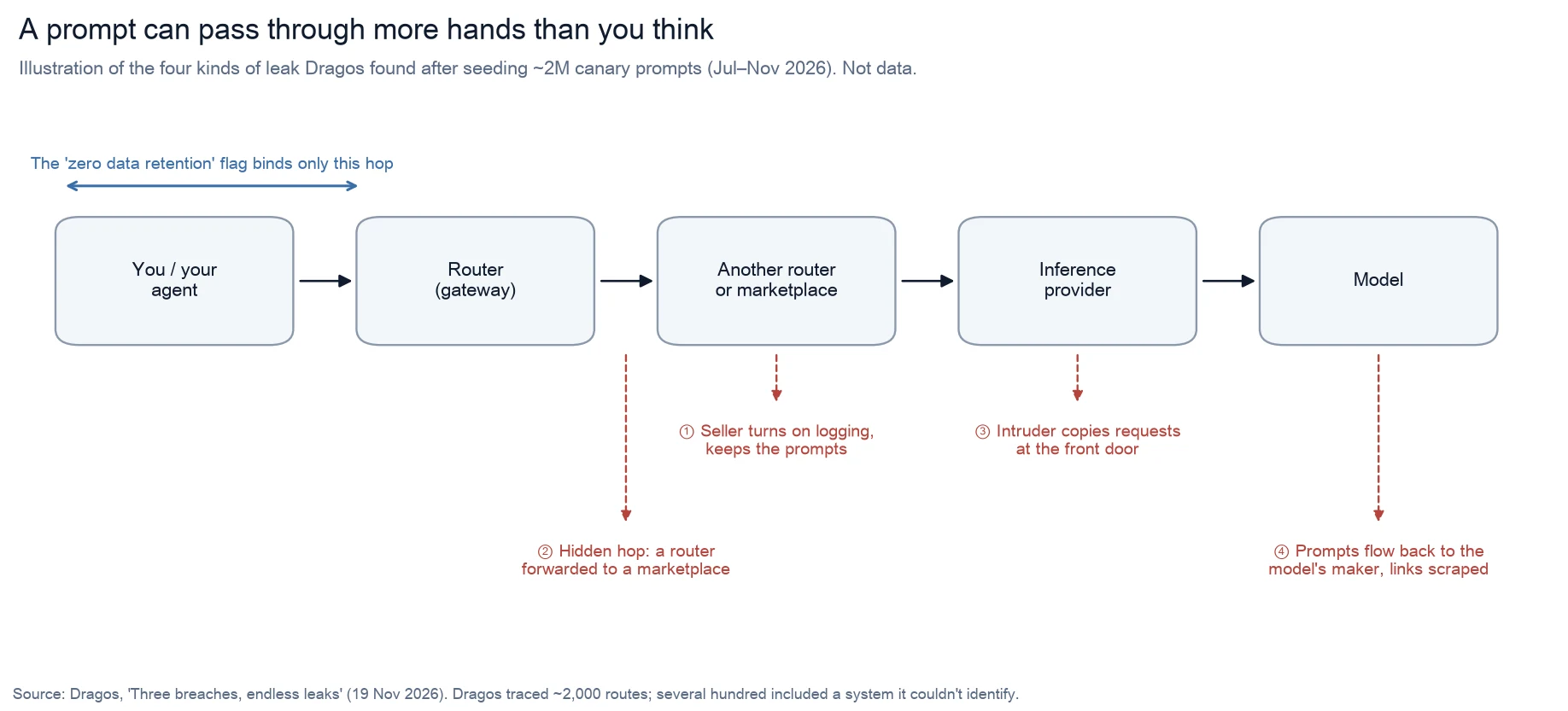
1. Provider compromise. Privacy flags are irrelevant here. Attackers were inside three hosting providers, the earliest from mid-July, and none knew until Dragos told them.
- In the largest case, every seeded request in a few late-October windows was stolen. That included requests the provider rejected before a model ran, so the copying happened at the front door, not deeper in the inference stack.
- In the other two cases, some stolen requests were flagged ZDR. Dragos puts it simply: "A privacy flag doesn't help when the attacker is already inside."
- Stolen keys were tested within hours in some cases, and the bait keys drew tens of thousands of AWS API calls.
2. Marketplace logging. No exploit needed. On open inference marketplaces, the cheapest seller gets the request. A seller can list a popular model at the lowest price, enable request logging and collect what flows through. The leak followed specific sellers, not the marketplace as a whole. Dragos's examples were individuals on home connections, one of them typing root SSH attempts by hand with a password lifted from a prompt.
3. Undisclosed hops. One router was quietly forwarding part of its traffic to that marketplace. It has since told Dragos it stopped.
4. Policies not honoured downstream. A Chinese AI lab, which Dragos does not name, fetched the secret URLs in more than half of the prompts sent to its models from July to October, including about two-thirds of those marked "no data collection" or ZDR. Prompts sent to U.S. providers reselling that lab's models triggered the same scraper.
- One large U.S. provider was still crawling a secret URL more than two months after a single call to its search endpoint.
- One seeded link turned up in a Feishu (Lark) chat 24 days after the request, and was opened from six devices within two minutes.
The underlying rule, in Dragos's words: "a privacy flag only binds the first hop."
3. What the providers disclosed
OpenRouter's response:
- Off-boarded three providers.
- Removed 125 endpoints from ZDR eligibility, covering the flagged providers plus precautionary removals.
- Notified all potentially affected customers.
- It says the findings showed no breach of OpenRouter itself. It is adapting Dragos's testing so it runs continuously, verifying network paths for third-party forwarding, and requiring assurances and validation before restoring ZDR to any removed endpoint.
Neither Dragos nor OpenRouter has named the providers, and nobody has said the three off-boarded are the three breached. The three public notices describe three different failure types:
| Provider | What happened | Builder lesson |
|---|---|---|
| Phala | An attacker took control of an inference VM and could see request data during processing. Requests to DeepSeek V4 Flash 0731 routed via OpenRouter between 21 Oct 00:00 and 8 Nov 05:35 UTC should be treated as exposed, and any secrets in them rotated. | Canaries confirmed misuse only for 21–22 October requests, but Phala keeps the wider window because sampling can't bound access. Use the same logic in your own incident scoping. |
| Together AI | Prompt samples stored for software testing (MiniMax M3, GLM-5.2, Kimi K2.6; June–July) were downloaded after an AI coding agent committed a credential to a public GitHub repo. The party searched the samples for credentials and tested them; five were Dragos canaries. | Your coding agents are now a credential-leak path. Together's fixes: scoped or short-lived credentials, scanning every PR for secrets, ZDR by default for new accounts, and new rules for using coding agents. |
| Novita | Not a breach: "a routing configuration issue caused some MiniMax requests to be forwarded to MiniMax's official API beyond the intended customer scope." Models suspended. | Partner-API forwarding is a data-flow decision. Treat routing config as security config. |
Phala's dates match Dragos's late-October breach, and Dragos says one of those providers had published a preliminary notice. That's consistent with Phala being one of the three, but it's my inference, not a confirmation.
4. Why AI keys and prompts are the target right now
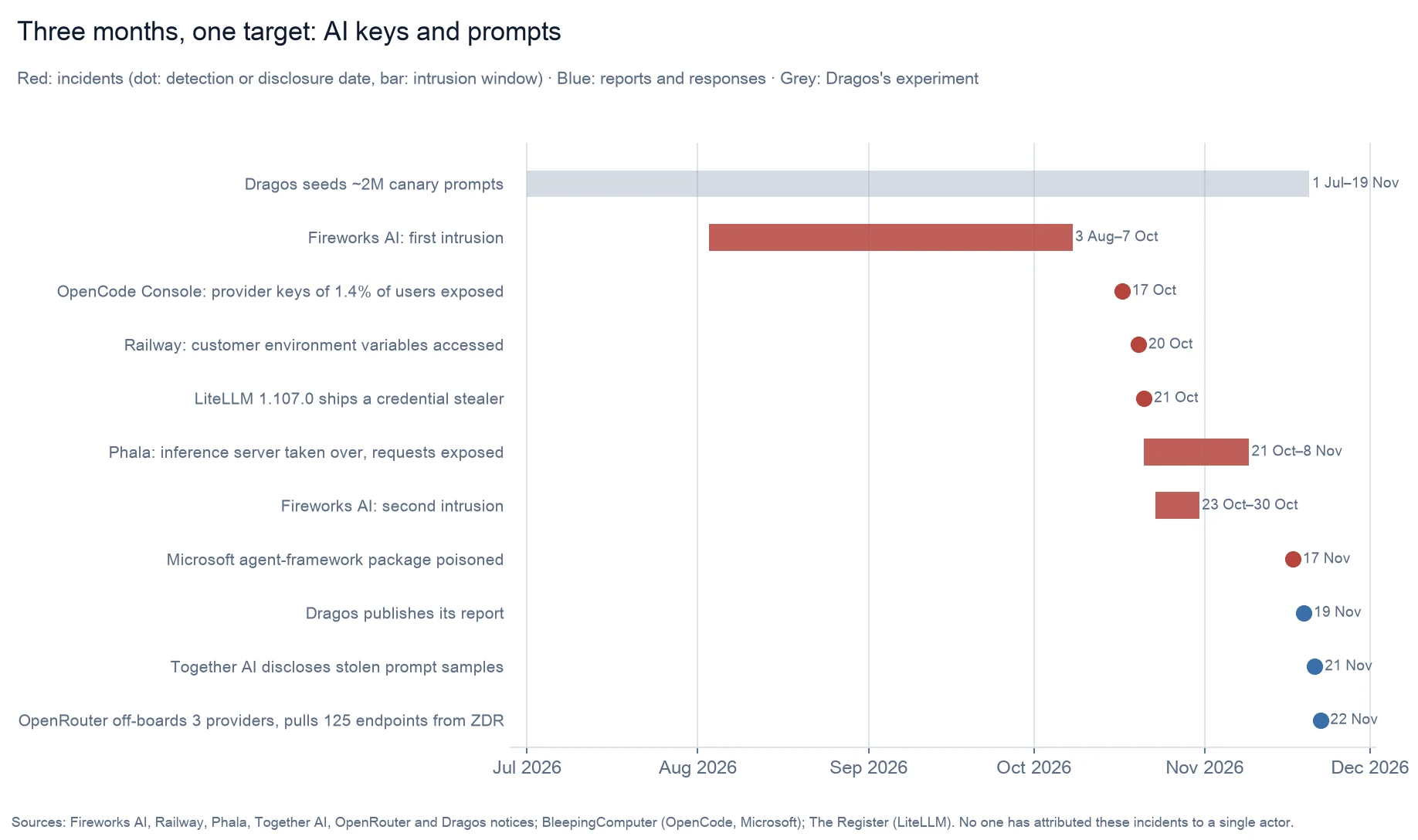
No one has tied these to a single actor. But the pattern is consistent: each target held AI credentials or AI traffic on behalf of others. (The two poisoned packages took cloud and CI credentials broadly, with AI keys among them.)
- Fireworks AI reports two intrusions (3 Aug – 7 Oct, and 23 – 30 Oct). Its 9 November bulletin links the activity to a financially motivated group selling stolen LLM access to illicit routing gateways ("LLMjacking"). Its customer guidance is worth quoting: "Removing a stored secret alone does not invalidate the underlying credential."
- OpenCode Console exposed saved OpenAI, Anthropic and Google keys for 1.4% of Console users from 17 October. BleepingComputer reports overnight charges of up to $1,700.
- Railway says customer environment variables may have been read. Its 21 October disclosure calls this "part of a series of attacks recently targeting platform companies with the aim of compromising AI inference providers." Its preliminary report says the attacker was "attempting to obtain AI provider API keys to perform distillation attacks", which is an early assessment.
- LiteLLM 1.107.0 (21 October) and Microsoft's agent-framework 1.26.1 and 1.26.2 (17 November) were poisoned releases with credential stealers that ran at Python startup, even in environments that never imported the package. The last clean versions are 1.106.2 and 1.26.0.
Anthropic's September 2026 threat report gives the economics. Stolen AI credentials give an operator three things at once: loot (resale value), compute (attacks run at someone else's expense) and cover (activity is attributed to the key's owner). One actor that took an AI vendor's production keys through its evaluation sandbox then hit roughly thirty AI companies in about four days from the same infrastructure. Anthropic's conclusion: "AI API keys and session tokens are targets; the integrations customers build around AI such as sandboxes, proxies, and resellers are part of the attack surface."
Attackers are also using agents. Dragos saw the thief bring in ARTEX, an LLM-driven pentest framework, to confirm that stolen keys were live. OpenCode's co-founder said AI agents were used against its systems for at least 48 hours. I covered the offensive-agent side in Operation Snowball.
5. What to change in your agent stack
Keep secrets out of model context. This is the root fix, and the one most teams skip. Dragos's warning: agents "will happily send whatever they can read, including credentials."
- Don't hand agents raw environment variables or config files that hold keys.
- Have tools inject credentials server-side, so the model sees a reference rather than the secret.
- Scrub tool outputs (logs,
.envdumps, CI output) before they enter context. - Turn on provider-side secret filtering where it exists, but don't rely on it. Dragos notes it misses sensitive data that isn't shaped like a key.
Choose your route deliberately.
- Self-hosting is the only option where no third party reads the prompt.
- Going direct to a first-tier provider leaves one company, one contract and one privacy policy to check.
- If you use a router, pin the upstream providers yourself instead of accepting the default pool, and verify that your privacy setting actually changes where requests go. Dragos's line: "if you don't make it, the lowest price will make it for you."
- Avoid reseller marketplaces for anything sensitive. Dragos says some of that capacity runs on stolen keys. Anthropic documents fake "discount Claude" resellers that proxy to another model and harvest buyers' credentials.
Seed your own canaries. Put a fake credential (a free Thinkst Canarytoken is enough) into the context your agents and pipelines already send, per route and per provider, and treat any use as an incident. That turns "did our prompts leak?" from an unknowable into an alert.
Add the detections Dragos published. ARTEX sent user agents artex-agent and artex-judge-r121, which Dragos found in no public indicator list. Kali and ARTEX self-identified in CloudTrail user agents, but only in a small fraction of traffic, so don't rely on it.
Lower what a stolen key is worth.
- Use separate keys per platform and per application.
- Set spend caps close to expected use.
- Prefer short-lived or scoped credentials.
- When a platform that holds your key is breached, rotate at the issuing provider. Deleting the key from the platform doesn't revoke it.
- Anthropic's advice is to treat AI keys and agent integrations as seriously as production credentials.
Put guardrails on coding agents. Together's incident is the template. Scan every PR for secrets, and keep agent-authored commits under the same secret-scanning and review gates as human ones. Your coding agent's repo access is part of your inference supply chain.
Check your Python environments. If any host installed litellm 1.107.0 or agent-framework 1.26.1/1.26.2, the published guidance is to treat it as compromised and rotate everything it could reach. The poisoned packages' persistence was a startup hook, so "we never imported it" doesn't clear you.
6. Open questions
- Names. Which three providers Dragos caught, and whether they are OpenRouter's three. The provider breached since mid-July had still not disclosed publicly as of Dragos's report.
- The Feishu incident. Dragos's paragraph describes the destination both as "one Chinese provider" and as "a U.S.-based provider with the ZDR flag". The report doesn't reconcile the two.
- Attribution. The October incidents haven't been publicly attributed. "Campaign" and "distillation" are Railway's and OpenCode's early framing.
- A press discrepancy. The Hacker News says Together AI "understands it has been deleted". I can't find that line in Together's current notice.
Sources
Primary:
- Dragos: "Three breaches, endless leaks: Your AI supply chain needs canaries", 19 Nov 2026.
- OpenRouter: "Data Processing Incidents on Inference Providers", 22 Nov 2026.
- Providers:
- Phala, November preliminary incident report, 10 Nov 2026.
- Together AI, security event notice, 21 Nov 2026.
- Novita on X.
- Fireworks AI security bulletins, updated 17 Nov 2026.
- Railway disclosure, 21 Oct 2026, and its preliminary report.
- Anthropic: "Detecting and countering misuse of AI: September 2026".
Press:
- The Hacker News, 22 Nov 2026.
- BleepingComputer on OpenCode (19 Oct) and Microsoft agent-framework (18 Nov).
- The Register on LiteLLM 1.107.0, 21 Oct.
Charts:
- The timeline uses only dates published by the organisations themselves or quoted by the press. For the Dragos bar, Dragos says only "July through November": 1 July comes from Phala's report about a "third-party security researcher" (my inference that this is Dragos), and 19 November is the publication date.
- The path diagram illustrates Dragos's findings and is not data.
My analysis, labelled as such:
- The Phala-to-Dragos match is my inference.
- The builder lessons in the provider table are mine.
- The guardrails in section 5 are mine except where quoted or attributed.