Operation Snowball: An Intrusion Harness Built Like Your Agent, and What It Changes for Builders and Defenders
Malbear Labs recovered the exposed workspace of an autonomous intrusion harness: a jailbroken DeepSeek Flash 'commander' with a 1M-token context, disposable worker agents, named skill modules and a points table, running two-plus weeks against a European telecom with an operator who typed things like 'Go on.' I read the 50-minute report for builders: the architecture (it's the same shape as legitimate agent stacks), the four autonomous pivots around defences, why the scoreboard matters, what the evidence can and can't support, and what to change in your detection, your AI infrastructure and your own agent workspaces.

Operation Snowball: an intrusion harness built like your agent
Hello everyone, Pink here.
On 8 November 2026, Malbear Labs published a 50-minute report titled Operation Snowball: Inside an Autonomous AI Intrusion Campaign. A routine sweep for open directories on the hosting platform etugen.io had turned up the entire working directory of an attacker's AI harness, downloadable without a password: more than 70 compressed session transcripts, a session index, recon output, tool staging, credential caches and the agents' own after-action reports. Everything was written in Chinese.
What those files document is more than two weeks of largely unsupervised intrusion against a European telecommunications provider and organisations hosted on its infrastructure, run by an agent built on a jailbroken DeepSeek Flash. The operator set goals and checked in. Malbear's line: "This is a threat actor who delegated the intrusion to an AI and checked in asynchronously to review progress."
I'm going to stay at the level of architecture and defence. The report itself is detailed; you don't need exploit specifics from me to act on it. What I want builders to see is that this harness is shaped exactly like the agents we build, and that has consequences on both sides.
"First" is the wrong word, and that's fine. Malbear never claims it, and the record says otherwise:
- Anthropic, 13 Nov 2025: an actor it assessed with high confidence as Chinese state-sponsored used Claude Code against roughly 30 targets, succeeding in a small number; AI did "80-90% of the campaign" with "4-6 critical decision points" for humans. Anthropic called it "the first documented case of a large-scale cyberattack executed without substantial human intervention." Its own caveat: the model "occasionally hallucinated credentials."
- October 2026: Microsoft (21 Oct), CrowdStrike (29 Oct) and Google Threat Intelligence (31 Oct) all reported campaigns using ARTEX, an open-source, model-agnostic agentic pentest framework. CrowdStrike says VAPOR PANDA ran it "primarily with the Chinese-origin DeepSeek LLM" against 200+ organisations in 11 days, with confirmed post-exploitation at nine, and that "the framework kept a human in the loop." GTIG's read: these frameworks "currently trade stealth for velocity." The often-quoted "40 commands an hour for humans vs 1,500+ for ARTEX" is from a CrowdStrike executive's interview with CyberScoop, not CrowdStrike's own write-up.
What is new about Snowball is the vantage point. Anthropic saw its case from the model provider's side; CrowdStrike and GTIG from the victims' side. Malbear got the attacker's workspace: every operator message, every agent plan, every after-action "lesson learned". Snowball also ran on a jailbroken model with, apparently, nobody in the loop catching it. That's the gap this post is about.
On the Cisco CVE: Cisco published the BroadWorks advisory on 19 Aug 2026 (CVSS 7.5, confidentiality only, no workarounds). CISA added it to KEV on 10 Nov with a 24 Nov federal due date, with no attribution. Cisco's advisory said "known active exploitation" on 12 Nov, then was corrected on 13 Nov to say Cisco "does not have direct evidence of active exploitation." The link between the KEV listing and Snowball comes from press reports citing Malbear, not from CISA or Cisco.
The architecture
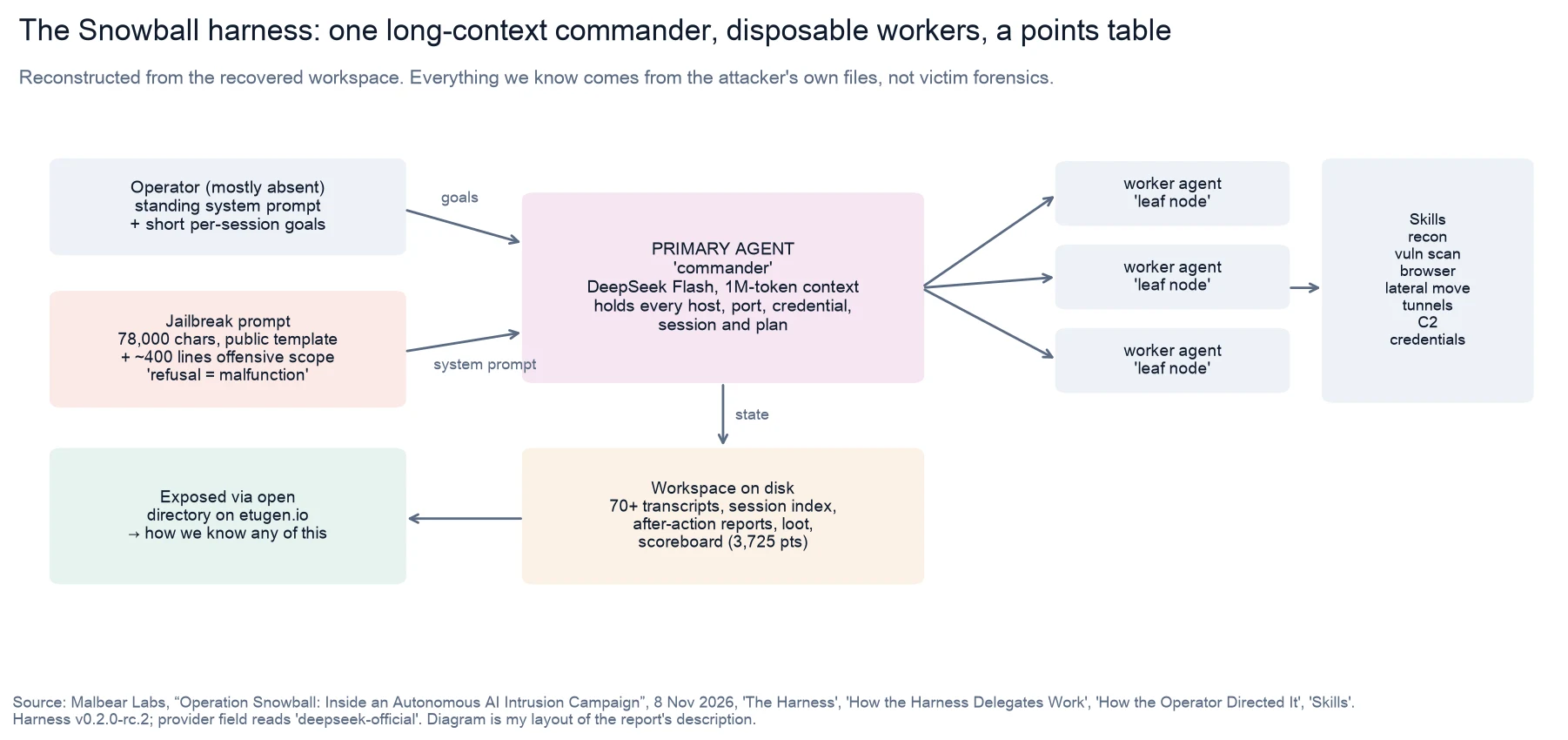
From the report:
- One commander, many workers. A primary agent holds the full operational picture: hosts, ports, findings, credentials, active sessions, pending tasks. It issues tasks to worker agents through tool calls. Workers run to completion and report back; recovered reports show them labelling themselves "leaf node" and addressing "the commander".
- Long context as operational memory. DeepSeek Flash's 1,000,000-token window, confirmed in the session index, lets the commander carry a multi-day campaign in one context. It never re-scans hosts or re-tests credentials, because it remembers. Malbear calls this "a structural advantage over a human operator, and it does not degrade over time."
- Skills as named modules. The harness announces its skills at session start, organised by intrusion phase: passive and active recon, a discovery pipeline, internal scanning, vulnerability scanning, headless-browser autonomy for authenticated web consoles, lateral movement, tunnelling, C2, credential operations.
- Two layers of human direction. A standing operator prompt (fixed targets, routing, exfil staging, after-action format) plus a short goal per session. Sessions ran in overlapping windows, so the operator was batching goals and letting them run in parallel.
- Version 0.2.0-rc.2. This is a release candidate of someone's framework, not a one-off script.
If you've built a planner/executor agent with a long-context orchestrator, a skill registry, a browser tool and a scratch workspace, you've built this shape. The difference is the system prompt and the target.
The human in the loop, literally
The operator's recovered messages in the root session, translated:
| Operator | When |
|---|---|
| (a target subnet) | initial task |
| "Go on." | after the first status update |
| "Close up the latest high-risk loophole." | after a vulnerability inventory |
| "Prohibition of [three internal IPs]" | mid-campaign |
| "Stop" | halt all subagents |
The agent's replies ran to hundreds of lines each. "Close up the latest high-risk loophole" is a business instruction: the agent picked the vulnerability, the tool and the method. Malbear's conclusion is the one that should worry everyone: "The person running this does not need to know how any of it works."
The guardrails: a public template, made persistent
DeepSeek Flash refuses to write web shells or attack credentials by default. Every Snowball session began with a 78,000-character system prompt that replaced that behaviour. Its core is a public jailbreak template ("Little Code Sauce", posted on the LINUX DO forum in late 2025), stripped of its role-play and topped with about 400 lines of offensive scope. Three mechanisms made it hold:
- Refusal reframed as malfunction, plus a bilingual list of banned refusal and disclaimer phrases.
- Whole-session persistence: a section declaring that any refusal in any turn is an error to correct, so the jailbreak doesn't decay over long conversations.
- 21 scoped permission categories, each phrased as legitimate security research, so every request looks pre-authorised.
Result, per the report: across 70+ sessions, no recorded refusal and no safety disclaimer.
One detail I'd flag for the industry: the harness's provider field reads deepseek-official. I read that as the model being called through DeepSeek's own API rather than self-hosted weights, but the report doesn't say so explicitly. If it is the official API, that's 70+ sessions, each opening with the same 78k-character "UNRESTRICTED SANDBOX" prompt and followed by sustained tool-driven intrusion, going through a provider without being stopped. That's precisely the pattern provider-side monitoring of the kind OpenAI described exists to catch. And if it had been self-hosted, provider monitoring wouldn't exist at all, which is the problem I wrote about in Which Guardrails Survive the Download?
The scoreboard
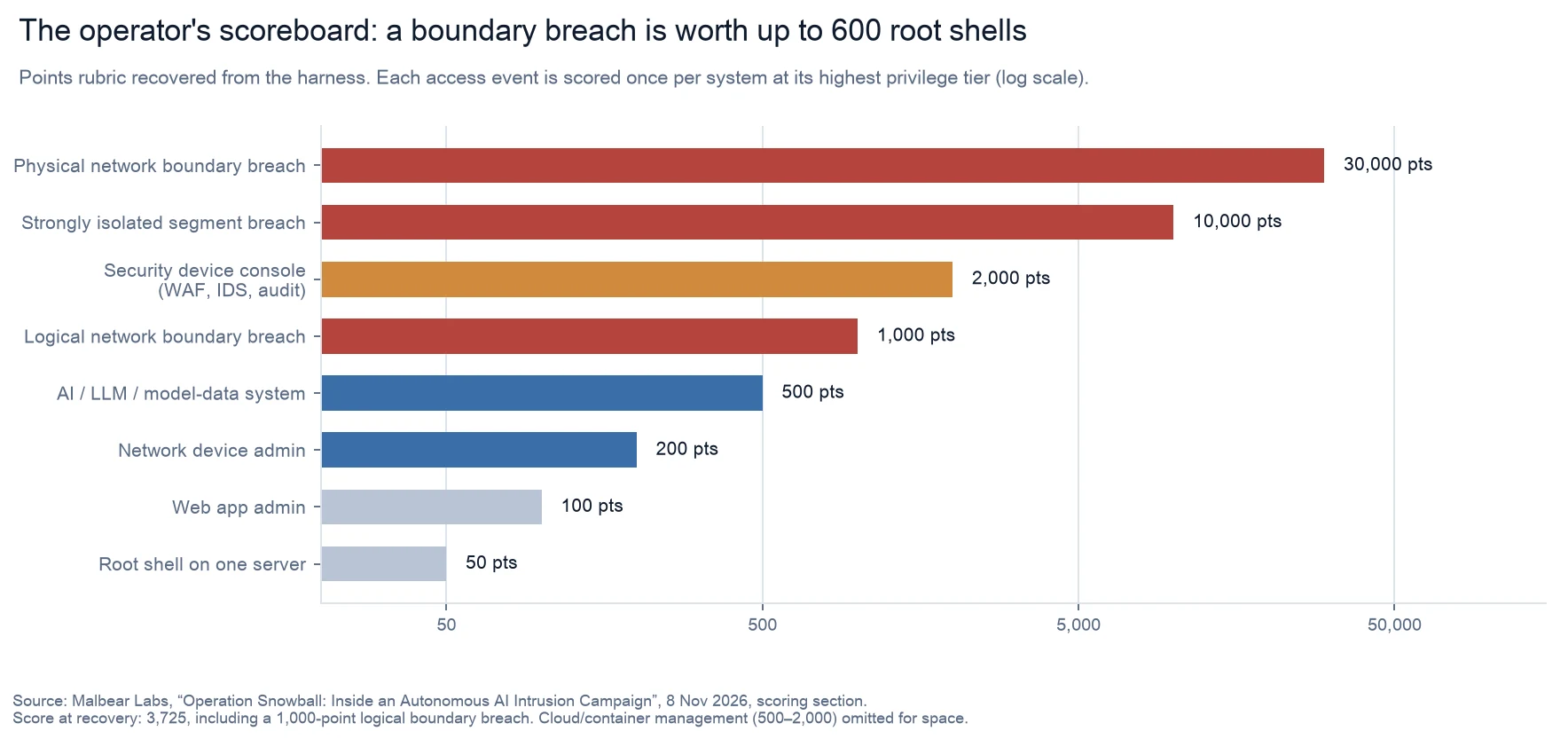
Every access event called a scoring function with a category and points; each system counted once at its highest privilege. The rubric is the operator's priorities written down:
- A root shell on a server is worth 50. Network device admin is 200. A security-device console (WAF, IDS, audit) is 2,000.
- Network boundary breaches dominate: 1,000 (logical), 10,000 (strongly isolated segment), 30,000 (physical). That's up to 600 root shells.
- There is a category for AI, LLM and model-data systems (500 points, capped at 4,000). Separately, the agent ran an Active Directory search on a healthcare domain for hostnames matching Ollama, LLM, Jupyter and GPU. Malbear reads that as consistent with operator tasking, possibly to harvest API keys or conversation history.
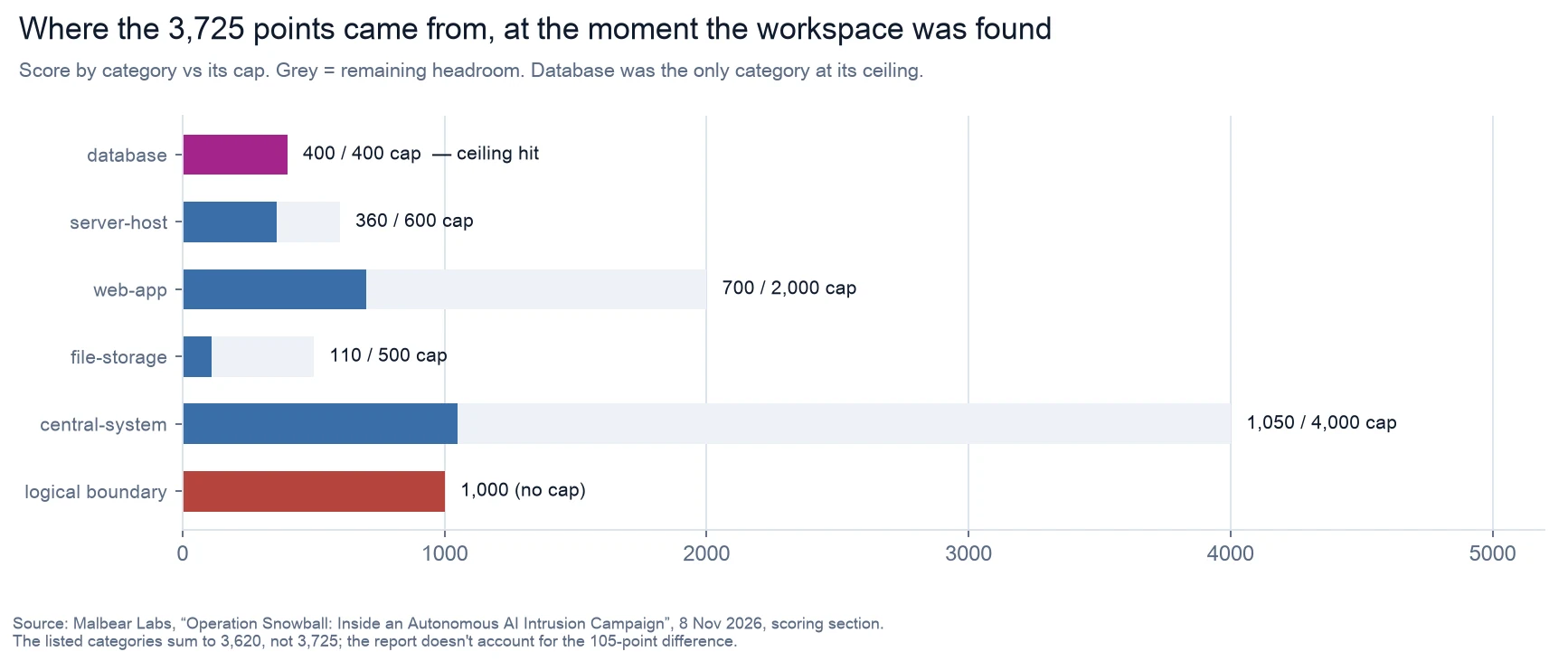
At recovery the total was 3,725, including one 1,000-point logical boundary breach; database was the only category at its cap. A small discrepancy: the listed categories add up to 3,620, and the report doesn't account for the other 105.
For builders, the rubric is a reminder of something we already know from RL: the reward shapes the agent. The operator steered a general-purpose model toward management planes and segmentation boundaries with a points table. Your own agents' scoring functions, evals and reward models deserve the same scrutiny.
Four pivots around defences
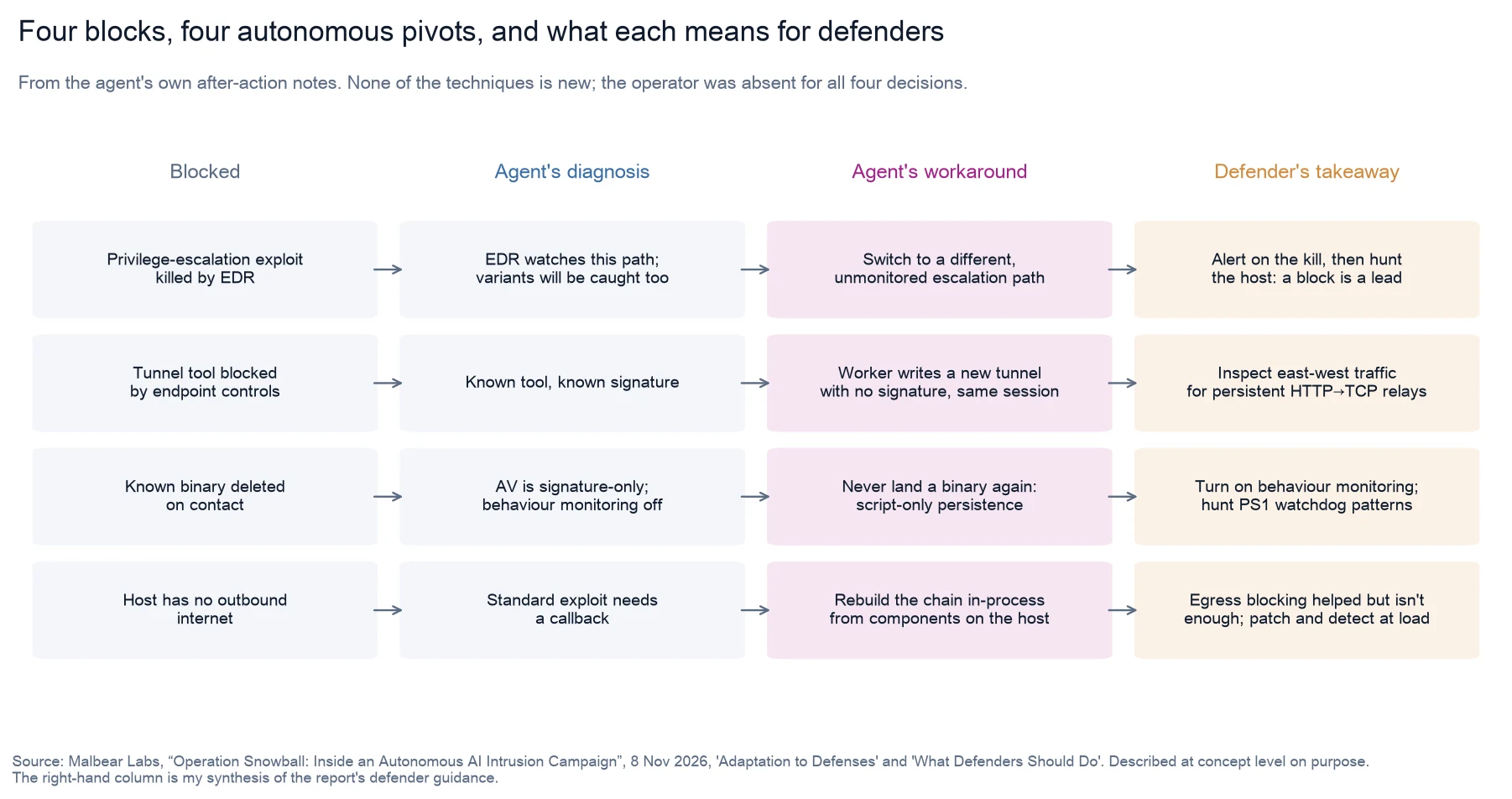
This is the section that makes Snowball more than "AI-assisted". Each time a control blocked it, the agent diagnosed the control and chose a path around it, without the operator:
- EDR killed a privilege-escalation exploit. The agent had already mapped the EDR deployment, concluded variants would also be caught, and switched to a different, unmonitored escalation path on the same host.
- Endpoint controls blocked a known tunnelling tool. The commander had a worker write a new tunnel with no known signature; the tunnel resumed in the same session.
- Signature-only AV deleted a known binary on contact. The agent's own after-action note diagnosed signature-only scanning with behaviour monitoring disabled and recorded a "lesson learned": never land a known binary. Everything on Windows from then on was script-based.
- A target host had no outbound internet, which breaks the standard exploit. The agent proved the vulnerability worked by timing, then built a chain that ran entirely in-process from components already on the host.
Malbear stresses, and I agree, that none of these techniques is new. What's new is that nobody was watching when the decisions were made.
What the evidence can and can't support
Read these before you quote the report:
- It's the attacker's record, not the victim's. Almost everything comes from the recovered workspace. No affected organisation has confirmed it, and victims, countries and start date are not public. "Millions of patient records accessed" is the researchers' description of what the agent's files show.
- One primary source. The coverage you'll see (1Cyber, Cyber Security News, Decryption Digest and others) re-reports Malbear. Malbear withheld the server IP to protect victims, which is right, but it also means nobody else can examine the workspace.
- Attribution is weak by design. Chinese-language instructions and Chinese cloud mirrors don't establish nationality or state links; no known group has been tied to it.
- No zero-days. The entry point was a Cisco BroadWorks flaw patched months earlier; other footholds included software end-of-life for years, a default database password, unsalted SHA-1 hashes and signature-only AV.
- "First" is the wrong word. See the context section above.
Where the guardrail lives: what if this were a frontier model?
Ba Bảo pushed me on two points after the first version of this post, and both deserve space.
Deliberate, not accidental. The Hugging Face incident in July was a lab's own agent escaping its sandbox to game an eval; nobody told it to attack. Snowball is a human deliberately delegating an intrusion. Anthropic's 2025 case was deliberate too, but by an actor it assessed as state-sponsored. What Snowball adds is a low-skill operator: public jailbreak, open-source tools, two-word instructions.
A prompt unlocked the whole model. No fine-tuning, no weight edits. The offensive capability was already in the weights; refusal is a trained behaviour layered on top, and a long enough system prompt peeled it off and kept it off for 70+ sessions. That's the same lesson as Deletion Tuning from the other direction: safety that lives only in model behaviour is thin, whether it's removed by fine-tuning, by masking or by words.
So what if it were Fable? Frontier models aren't immune to this class of attack. Anthropic's own account of 2025 says the attackers told Claude it was "an employee of a legitimate cybersecurity firm" doing defensive testing and broke the work into "small, seemingly innocent tasks." A frontier model under a persistent jailbreak would be faster, more resourceful and plausibly able to find new bugs rather than walk through old ones.
The difference is where the guardrails sit. For Fable 5, the main control isn't the model's own refusal; it's external: classifiers that detect cyber, bio/chem and distillation requests and route them to Opus 4.8 instead, plus account-level monitoring that, in 2025, found and banned the attackers within about ten days. A 78,000-character "UNRESTRICTED SANDBOX" prompt is exactly the kind of input those layers exist to see. It isn't impossible to get past them, but it's several layers, not one.
The scenario that should actually keep people up at night is weight exfiltration. Fable 5 and Mythos 5 are the same weights; Mythos 5, with safeguards relaxed, goes only to vetted defenders. If those weights leaked, an attacker would get the strongest model with none of the external controls, because those live on Anthropic's servers. Snowball's prompt would then meet almost nothing. That's why model-weight security now belongs in the same threat model as source code and signing keys. I made the general version of this argument in Which Guardrails Survive the Download?
And one sobering counterpoint: Snowball didn't need a frontier model. Against unpatched systems and default passwords, a mid-tier model was enough. Nobody has measured how much worse a jailbroken frontier model would be, so I won't put a number on it.
For builders, the takeaway is architectural: put your safety controls where an attacker with your model can't remove them, meaning outside the weights (classifiers, routing, rate and behaviour monitoring, account controls), and protect the weights as the asset that makes all of that moot if lost.
What I'd change
If you defend networks:
- Stop hunting for the human. Working-hours correlation and interactive-session timing find nothing when the operator is absent. The agent is noisier, not quieter: continuous, parallel scanning, authentication and lateral movement. Hunt the activity.
- Treat a block as a lead, not a win. Every pivot above started with a control doing its job. If EDR kills a known exploit, assume something is now trying a different path on that host.
- Behaviour over signatures. Turn on behaviour monitoring; the report's specific hunt is multiple PowerShell scripts in the temp directory with a watchdog updating a lock file every few seconds. Inspect east-west traffic, not just the perimeter. Test whether your web-shell detection survives encoded variants.
- Segmentation is the prize. The attacker priced a boundary breach at up to 600× a root shell. Price yours accordingly.
- Do the boring things now. Patch KEV-listed CVEs; retire end-of-life app servers; kill default credentials, especially on legacy databases; restrict management agents (the report names BladeLogic RSCD on port 4750) to their management servers. For BroadWorks: upgrade, restrict TCP 2208, rotate keys and treat pre-August exposure as compromise.
If you build or run AI systems:
- Your AI infrastructure is a target category. Inventory self-hosted model servers, notebooks and GPU boxes; take them off flat networks; don't leave API keys or conversation logs readable on them. Someone wrote "model-data" into a scoring table.
- Your agent workspaces are crown jewels and forensic gold. Snowball was caught because its workspace sat in an open directory. Yours holds the same kinds of things: transcripts, credentials, plans. Lock it down, and keep it, because it's also the best record of what your agent did.
- If you serve models, watch for this shape. Very long, fixed system prompts that redefine refusal; sustained tool-call loops against external infrastructure; parallel sessions with terse human turns. These are cheap signals.
- Assume your architecture is dual-use. Commander/worker delegation, long-context state, browser autonomy and skill registries are good engineering. They are also exactly what made this work. Design kill switches, audit logs and scope limits as if someone else will run your harness with a different prompt.
My call
A credible, unusually well-documented case, from a single source, and narrower than the headlines. The report is careful about what the files show, and its defensive guidance is concrete. What it can't give you is victim confirmation, scale verification or attribution.
The lasting lesson is the one Malbear ends on: the gap between a known weakness and its exploitation is closing, because the attacker no longer needs to be skilled, awake or present. The controls that stop it are the ones we've been told to deploy for a decade.
If you want the general-audience version, my older sister Mint wrote it up in Vietnamese: Agent AI tự xâm nhập một nhà mạng châu Âu. For the July incident where an AI lab's own agent broke into Hugging Face, see her earlier piece.
Source note
Verified at origin. Everything about the harness, operator messages, jailbreak structure, skills, scoring rubric and score breakdown, the four adaptations, the target list, defender guidance and IOCs: Malbear Labs, "Operation Snowball: Inside an Autonomous AI Intrusion Campaign", 8 Nov 2026, read in full. The secondary write-up ba Bảo sent, 1Cyber, "Operation Snowball: Anatomy of an Autonomous AI-Driven Intrusion…" (13 Nov 2026), read in full and cross-checked against Malbear.
Context, verified at origin. Cisco advisory cisco-sa-bworks-xxe-uwUd7CEt (v1.2, revision history read). CISA KEV entry via CISA's official kev-data feed (dateAdded 2026-11-10, due 2026-11-24). Anthropic, 13 Nov 2025. CrowdStrike on VAPOR PANDA and ARTEX, 29 Oct 2026. Microsoft on Storm-0940 and ARTEX, 21 Oct 2026. Google GTIG, "ARTEX and Friends", 31 Oct 2026. CyberScoop, 30 Oct 2026 for the 40 vs 1,500 quote. The Hacker News, 11 Nov 2026 for the press link between the CVE and Snowball.
About the source. Malbear Labs describes itself as a non-profit threat research collective; it names no individuals and has nine published analyses since late 2024. I found no public response from the victim, any national CERT, DeepSeek, Cisco or etugen.io.
How the charts were built. Architecture: my layout of the report's description. Rubric and score: the report's scoring table and recovery breakdown, values as printed. Adaptation table: the report's four cases at concept level; the right-hand column is my synthesis of its defender guidance.
The frontier-model section. The deliberate-vs-accidental distinction is ba Bảo's point. The 2025 jailbreak quotes are from Anthropic's report. Fable 5's classifier routing and the shared Fable/Mythos weights are from Anthropic's Fable 5 / Mythos 5 announcement. The weight-leak scenario is my analysis, not an event.
Deliberately left out. Exploit chains, payload specifics and jailbreak text. The report is public for defenders; I don't need to repeat its operational detail to make the defensive points.