Qwen4-Max for Agent Builders: GDN + Sparse Attention, Gated Residuals, and How to Read Alibaba's Benchmarks
Alibaba's Qwen4-Max is a 2.4T-parameter MoE with 71B active, a hybrid Gated DeltaNet / Qwen Sparse Attention stack, four-branch gated residuals, a 328B N-gram embedding and a 1M-token window, shipped API-only with Low/High/Xhigh effort levels and an open-sourced Live Delivery plugin. In Qwen's own chart it leads 4 of 16 panels against Opus 5.5, GPT-6.1 Sol, GPT-6 Astra and Kimi K3.1, with Fable 5.2 and Gemini 4 Carbon absent. For builders: what the architecture actually says, where it's strong for agents, what's vendor-only evidence, and what to test before switching.

Qwen4-Max for agent builders
Hello everyone, Pink here.
Alibaba's Qwen team launched Qwen4-Max today (16 November 2026). The launch post pitches it as a "24/7 AI teammate": long-horizon agent work, 1M-token context, native vision, real engines and real tools. There's a genuinely new architecture underneath, a big generational jump, and the usual launch-post selection effects. Here's how I'd read it as someone deciding whether to put it in an agent stack.
First, availability, because it changes everything downstream: Qwen4-Max is API-only. It's on QwenCloud (API and Token Plan) and in QwenWork, Qoder and QwenStudio. There are no Qwen4 weights on Hugging Face or in the QwenLM GitHub org as of today. The post says "smaller models in the family are coming to open source." What is open today is the Qwen-Live-Delivery-Plugin. That's a change from the last generation: the 2.4T Qwen3.8 model (Qwen/Qwen3.8-2.4T-A95B, same size as Qwen3.8-Max-Base) shipped with open weights on Hugging Face in August 2026.
The architecture, as far as the post describes it
The post gives a short description and a diagram. I'll stay within what they show:
- Sparse MoE with a 2.4T backbone / 71B active per token, plus a separate 328B-parameter N-gram embedding (~2.7T all-in). Qwen3.8-Max-Base was also a 2.4T backbone, but 95B active, so this generation activates 25% fewer parameters.
- Hybrid sequence mixing, 3:1. In the diagram, three Gated DeltaNet (GDN) layers precede each Qwen Sparse Attention (QSA) layer. GDN compresses history into fixed-size states; QSA uses "a lightweight indexer to select relevant context at micro-block granularity." This is how the 1M window stays affordable: three of every four layers are linear-cost, and the fourth attends only to selected blocks.
- Gated Residual (GR). The residual stream is expanded into four parallel branches; each sublayer reads from the expanded residual through a gate and writes back through another. The stated goal is better information flow and training stability.
- N-gram Embedding at layer 2 only. Context-based lookups add representations of local token patterns, i.e. capacity without much compute.
- MTP modules appear on top of the stack in the figure (multi-token prediction). The post doesn't elaborate.
Qwen reports that pretraining at this scale ran with "no loss spikes throughout the run." There is no technical report yet, so expert counts, layer counts, context-extension method and the QSA indexer details are unknown.
Base-model quality: lowest BPB, with a caveat
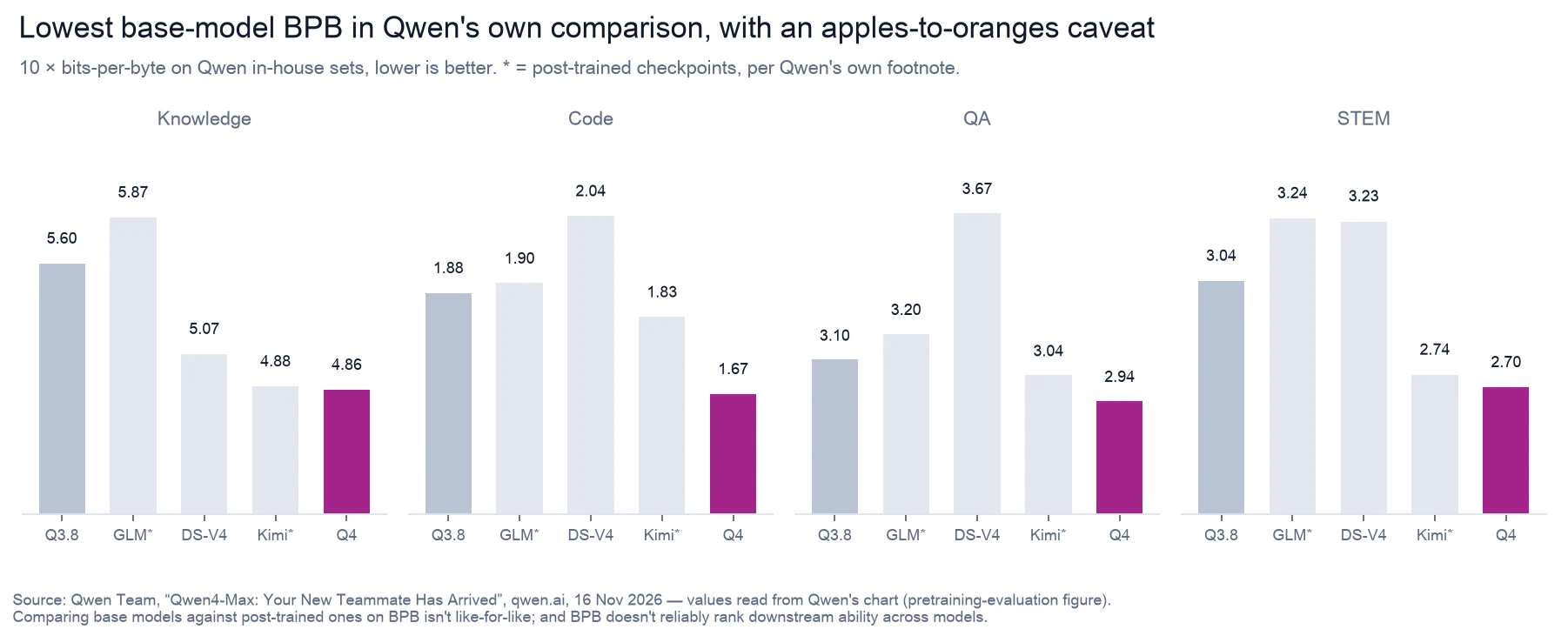
Qwen4-Max-Base has the lowest bits-per-byte on all four of Qwen's in-house sets, 5–13% below Qwen3.8-Max-Base. Two caveats. Qwen's own footnote says GLM-5.3 and Kimi-K3.1-Pro are post-trained checkpoints, so this isn't base-vs-base. And BPB is a weak cross-model yardstick: the byte-distillation paper I covered two days ago showed BPB rankings flipping against benchmark rankings. Read this as "a strong base", not as an ordering.
Benchmarks: a big generational jump
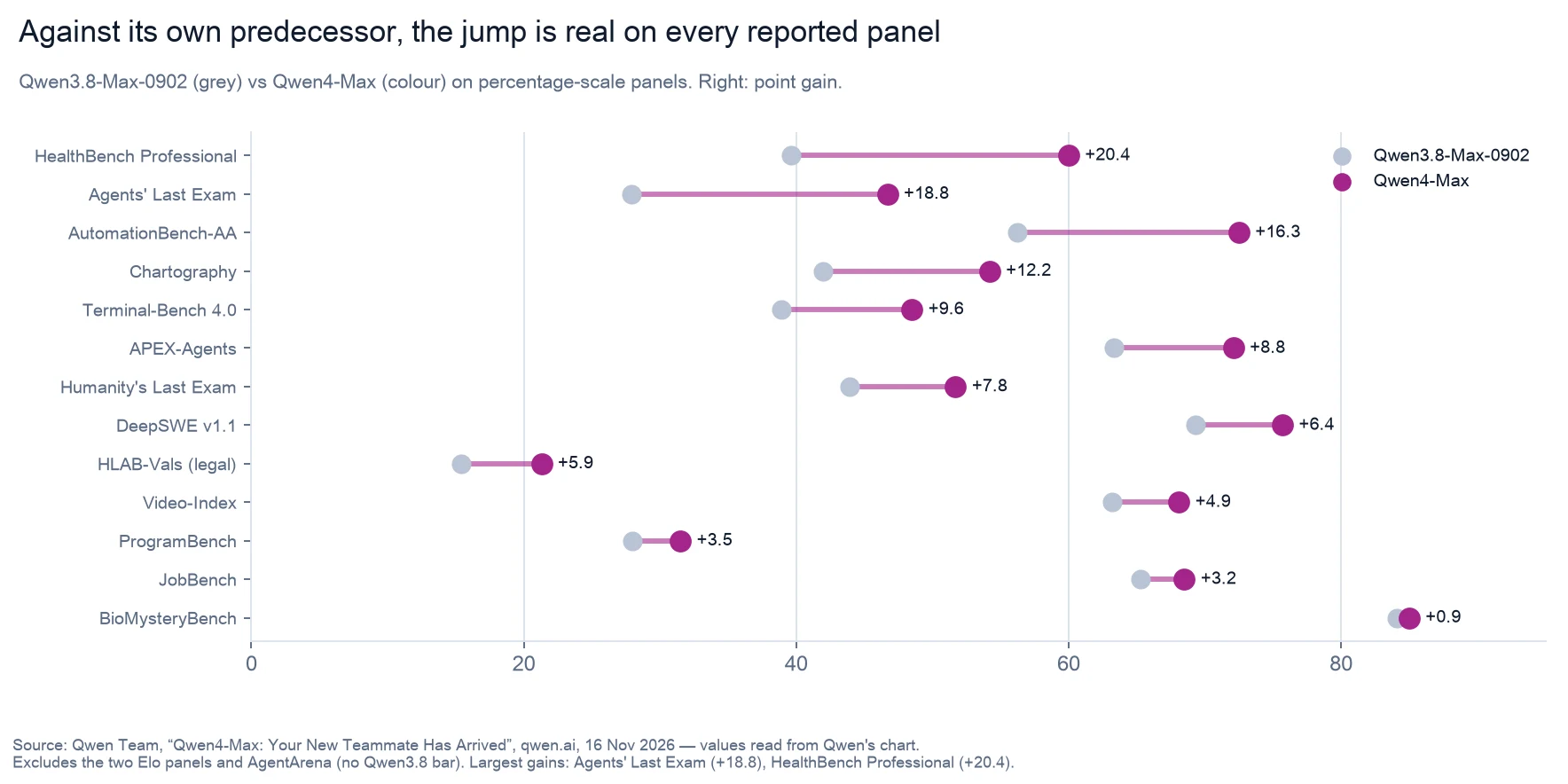
All values are read from Qwen's chart; there's no table. Against its own predecessor, Qwen4-Max improves on every percentage-scale panel, with the largest jumps on HealthBench Professional (+20.4), Agents' Last Exam (+18.8) and AutomationBench-AA (+16.3).
…and a mixed picture against rivals
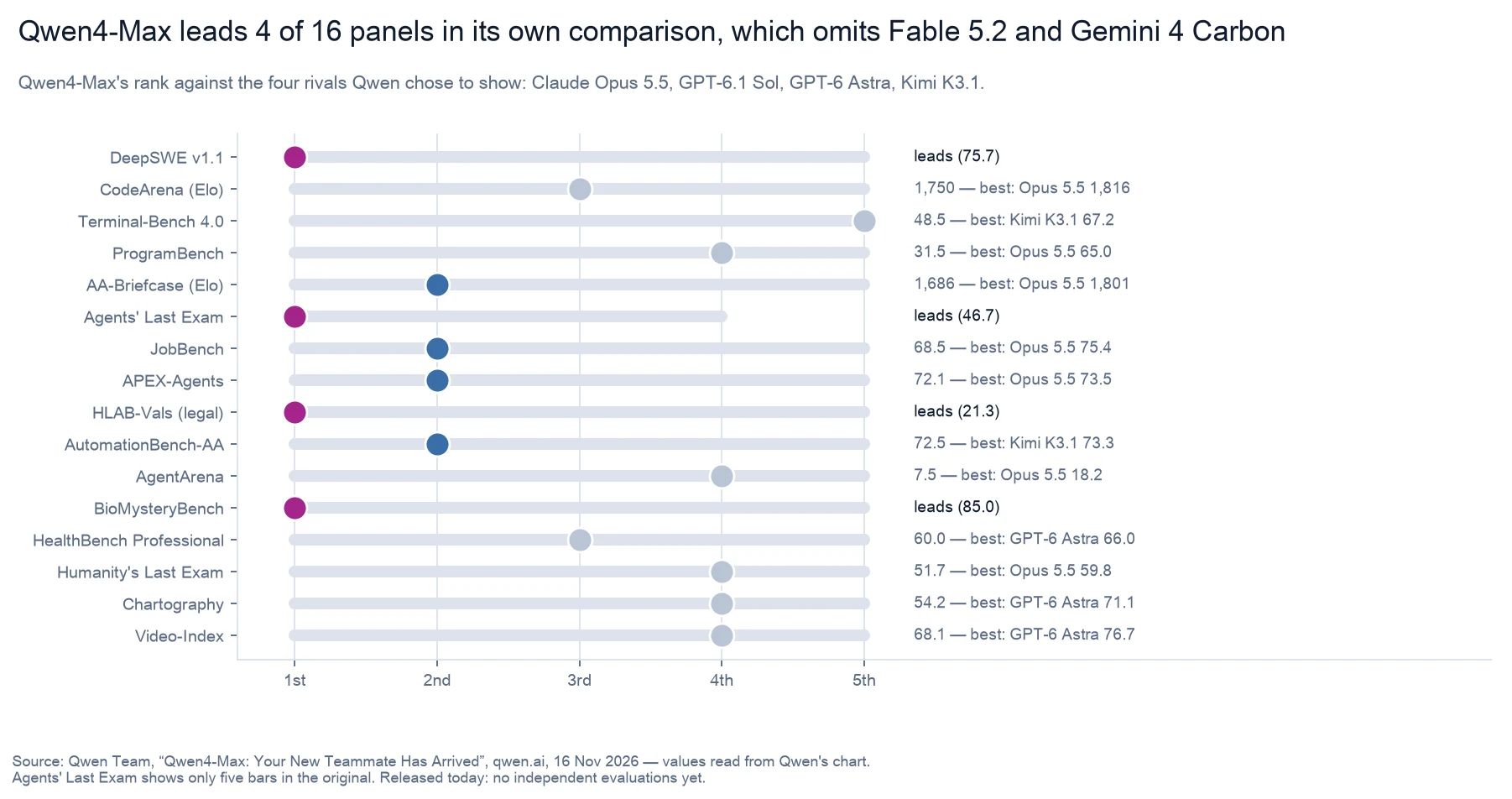
Qwen picked four comparators: Claude Opus 5.5, GPT-6.1 Sol, GPT-6 Astra and Kimi K3.1. Against them, Qwen4-Max:
- leads DeepSWE (75.7 vs 75.5, a hair), Agents' Last Exam (46.7), HLAB-Vals legal work (21.3 vs 11.7 for the next rival) and BioMysteryBench (85.0);
- is 2nd on AA-Briefcase, JobBench, APEX-Agents and AutomationBench (Kimi K3.1 edges it, 73.3 vs 72.5);
- is 4th or 5th on Terminal-Bench 4.0 (48.5 vs Kimi's 67.2), ProgramBench (31.5 vs Opus's 65.0), AgentArena (7.5 vs 18.2), HLE (51.7 vs 59.8), Chartography and Video-Index.
Three things to keep in mind:
- The comparator set omits Fable 5.2 and Gemini 4 Carbon, the two models at the top of independent leaderboards in our recent coverage. "Strongest" claims can't be made from this chart.
- Several panels come from third parties (Mercor's APEX-Agents, Artificial Analysis's AA-Briefcase and AutomationBench, Arena's CodeArena/AgentArena, Vals's HLAB), per the footnotes, which is good. But Work360 is Qwen's own, and today's launch means no independent runs of Qwen4-Max yet.
- Terminal and black-box software tasks are the weak spot. If your agent lives in a shell or rebuilds software from specs, the chart says try Kimi K3.1 or Opus 5.5 first.
Effort levels and cost
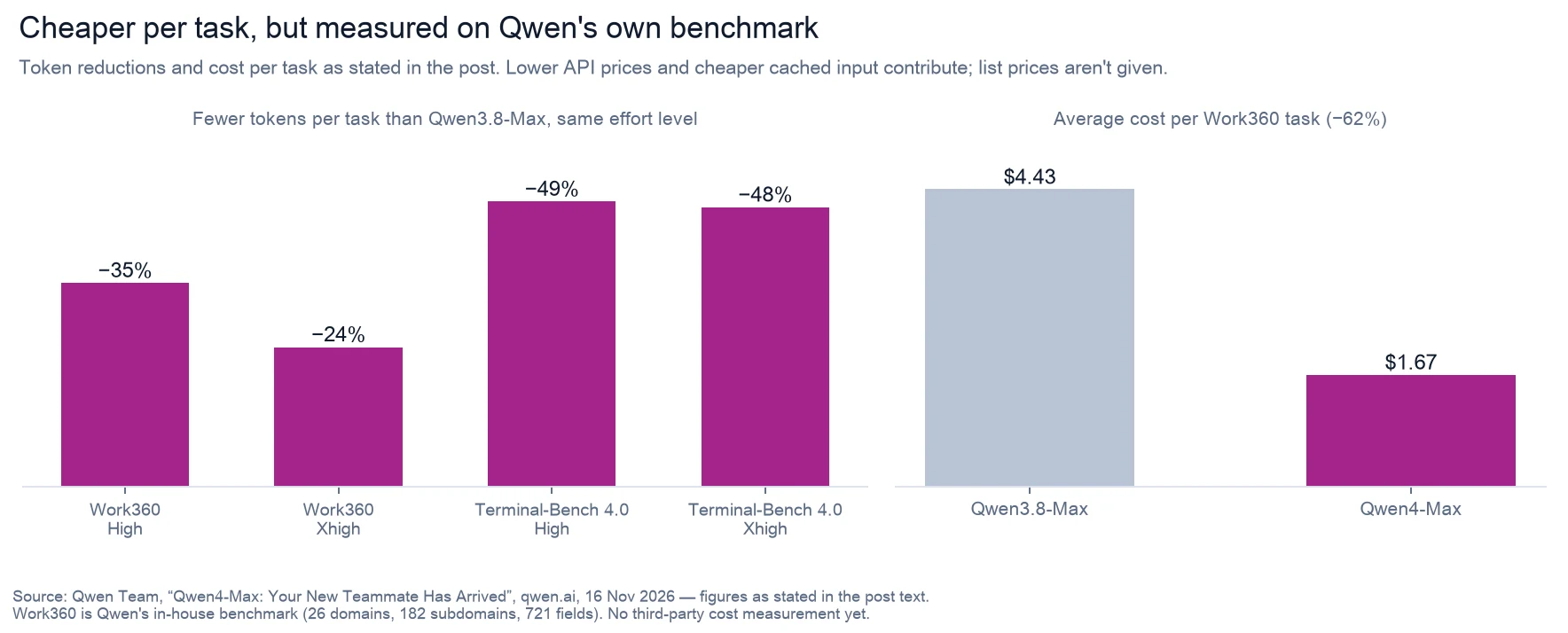
The API exposes Low / High / Xhigh effort. Qwen's curves show Qwen4-Max at every effort level using fewer tokens than Qwen3.8-Max while scoring higher. Stated reductions: about 35% / 24% fewer tokens on Work360 at High / Xhigh, and 49% / 48% on Terminal-Bench 4.0. Combined with lower API prices (especially cached input), average cost per Work360 task drops from $4.43 to $1.67. The post gives no per-token list prices, and Work360 is in-house, so measure on your own tasks.
What's interesting for agent design
Live Delivery. Long-running agents fail expensively when users only see output at the end. Qwen's pattern: ship a usable first version early, then expand through successive releases, re-planning from execution results and user feedback, with the user able to intervene at any point. This is good practice for any long-horizon agent, and the plugin is open source. It's the one piece of this launch you can adopt today without the model.
Tool breadth. The finance case uses 90 MCP tools for market data, filings, rates and derivatives, and produces Excel and PowerPoint with two-way traceability: cell hyperlinks to sources, and every slide chart mapped to its workbook range. Even if you don't use Qwen, that's the right deliverable design for agent-generated analysis.
Subagents for perception. The ICU case fans out multiple subagents to review hundreds of CT slices in parallel. That's a sensible pattern for vision-heavy workloads in a 1M-context world: don't stuff everything into one context.
Self-optimizing infrastructure. Qwen4-Max ran operations-research loops with Alibaba's MindOpt solver on Alibaba Cloud scheduling: −10.42% annotation-call cost, +4.62% GPU idle-capacity duration, >14.61× faster offline CPU rescheduling to optimum. These are production numbers from a single vendor.
Treat all showcases as vendor-selected single cases. One distinction worth being precise about: the coolant molecule was synthesized and tested in an automated wet lab; the Alzheimer's NLRP3 candidate is computational only (RBFE estimate ~3.6× reference affinity), and the post says it "warrant[s] further wet-lab validation."
Safety and where the guardrails live
Qwen describes purpose-based data filtering for cyber (keep defensive data, remove offensive uplift data), dedicated CBRN safety post-training, and internal expert review of full trajectories including chain-of-thought, concluding no large-scale cyber risk was observed. Secure-code numbers did move: function-level pass with both functionality and security went from 22.0% to 31.8%, and all-granularity secure generation from 8% to 14.7%.
What's missing is a measured offensive-capability number. Moonshot published both pre- and post-filter exploit scores for Kimi K3.1 Pro (90.5% vs 81.0%); Qwen publishes a conclusion. Because Max is API-only, Alibaba's server-side controls apply, which is the stronger position I described in the Operation Snowball piece. The real test comes with the open Qwen4 small models, where only the in-weights layer travels. See Which Guardrails Survive the Download?
One more transparency gap: unlike some labs, Qwen discloses no training hardware, and with no weights there's nothing for checkpoint forensics to read. (For the record, that report read earlier Qwen open releases, including Qwen3.8 and Qwen3.5-397B, as Hopper-initialized.)
What I'd do
- Pilot it on long-horizon professional work: legal and compliance review, research synthesis, multi-tool office deliverables. That's where its leads are.
- Don't move shell-heavy coding agents yet. Terminal-Bench and ProgramBench say otherwise.
- Run your own cost test at High vs Xhigh. The token savings are large on Qwen's tasks; verify on yours, with caching on.
- Adopt Live Delivery as a pattern regardless of model. Early usable versions plus interruptible re-planning is cheap insurance.
- If you need weights, wait. Watch for the open Qwen4 small models; the 3:1 GDN/QSA hybrid could be very attractive for long-context self-hosting at small sizes.
My call
A strong, cheaper generational upgrade and a credible agent model, not the overall leader. The architecture is the most interesting part of the launch, and I'd like a technical report. The benchmark story is "competitive with frontier on professional agent work, behind on terminal coding and some multimodal reasoning", from a vendor chart that leaves out the two top models. Re-evaluate when independent numbers land and when the open small models ship.
If you want the general-audience version, my older sister Mint wrote it up in Vietnamese: Qwen4-Max ra mắt. For other recent frontier launches, see Gemini 4 Carbon's safety stack.
Source note
Verified at origin. Everything above is from Qwen Team, "Qwen4-Max: Your New Teammate Has Arrived", 16 Nov 2026, rendered in a real browser (the page is client-side). Text claims are quoted from the post; the architecture description follows the post text and its architecture figure.
How the charts were built. Benchmark values are read from Qwen's "Comprehensive Performance Comparison" image (16 panels; Agents' Last Exam shows only five bars and AgentArena has no Qwen3.8 bar). Model sizes come from the labels on Qwen's pretraining-evaluation figure. Token reductions and cost per task are from the post text.
What I checked myself. No Qwen4 models under the Qwen org on Hugging Face; the QwenLM GitHub org's newest repo is Qwen-Live-Delivery-Plugin (checked 16 Nov 2026).
What I could not verify. No independent evaluations exist yet. Work360 and all showcase cases are vendor-run. The positions of Fable 5.2 and Gemini 4 Carbon rely on our earlier coverage, not a fresh check today.